Film Reviews

Taking the Gun and Leaving the Cannoli: Finding what’s wrong in The Godfather Part II (1974)

Oh, this is too violent for me!

As is wont to happen when you start a new job and are surrounded by new co-workers, I found someone almost as much into film as myself. And so we bounce back and forth throughout the week. What do you like, what do you not, did you see this. What’s your thing. And that’s when he hit me with a stunning assertion: The Godfather Part II was not a good movie.

As any good Redditor would, I asked for proof. And thus, like the President in Corman’s Death Race 2000 he sent me...this…

http://archive.spectator.co.uk/article/24th-may-1975/18/violence-please

http://www.rogerebert.com/reviews/the-godfather-part-ii-1974

http://www.nytimes.com/movie/review?res=9901EFDC1E31EF34BC4B52DFB467838F669EDE

Please feel free to read the above articles. I might note that Ebert had a stellar career and he would re-watch films and write new reviews and being a man who recognized when he was wrong he often changed his reviews when he saw things he didn't see the first time or admitted some oversight. It takes a true critic to be flexible with art. I loved Patrick Nagal when I was a kid. Now I think he’s shit.

Reading through the reviews, I found myself at first puzzled, then agreeing, and in the last review, laughing hysterically. I typed out the response below and when I was done (not in a slow work day, mind you) I found it so worthy I decided to make a blog out of it.

And so I give you...this...

"Not that it matters, but I found a remarkable amount of holes in these reviews. As I go through them, keep in mind the following points:

1       Although the Godfather Part II was a ‘sequel’ it also was a ‘prequel’ due to half the film being in flashback. This was at a time before ‘Jaws’ made sequels profitable, and thus unless you were watching B-movie horror shows (Bride of Frankenstein, Abbot and Costello meet Dracula) the audience was simply not used to sequels, and this was a sequel and a prequel at the same time.

2       And although the Godfather Part II was a pretty expensive film at the time, it was made by one of the most famous auteurs ever to have any money, Francis Ford Coppola, who essentially shot a 40 million dollar movie as if he were still in UCLA Film School, and this makes the structure of the film very deviant for the time. Reading the first article by Robinson honest to goodness makes me remember of those poor fucking souls who walked out of Pulp Fiction and asked me on Monday “did I miss John Travolta coming back to life?” Robinson actually admits, after a narrative paragraph at the beginning shot, that he is confused who the little boy was, even though he is called ‘Vito’ and later ‘Corleone’ at Ellis Island. This is lazy viewership.

3       In that Coppola is an auteur, I’m sure you’re deft enough to understand that he made unbelievably high tier films at a time when the auteur theory was under attack. Pauline Kael, whom I hate with every inch of my cinema loving soul, was the founding influence of film analysis after the death of the twin super star movie-social columnist elites Hedda Hopper and Louella Parsons. Kael spent her life watching films “only once” and attacking the French auteur theory so savagely it actually destroyed careers and legends (Orson Welles to name one). If you read any book of Robinson or Ebert’s fantastic ‘Life at the Movies’ they praise Kael and everything she did for them, which was make sure that watching movies could be a job. I say this because auteurism, in its greatest extent, would deny that, Pulp Fiction for example, was Quentin Tarantino’s movie. That it could, in fact should, exist without him. In this mode of thinking, the Godfather Part II could exist in a universe without Coppola. And that notion is fucking insane.

But on to the reviews and the strangeness within them:

1)      Robinson actually complains about the setting being ‘too well done.’ The setting which inspired Scorsese’s Five Points in ‘The Gangs of New York’ and more recently Spielberg’s Brooklyn Bridge neighborhood in ‘Bridge of Spies.’ Too well done. Then you’ll never be satisfied. He ends the article by commending the films’ look but says he feels like he looked at family snapshots in the wrong order. This is amazing because that’s what Coppola did to plan several shots. So the effect was there, he just didn’t appreciate it because it looked…too nice. Strange for a reviewer of Hollywood film.

2)      I didn’t read the ’08 4-Star Ebert article because I wanted to stay contemporary. It’s hard to look at modern reviews of older films. I do it a lot. So I went back to 1974 to see Ebert’s review – a masterful criticism, surgically explaining the problems of the film:

“Coppola was reportedly advised by friends to forget the Don Vito material and stick with Michael, and that was good advice. There’s also some evidence in the film that Coppola never completely mastered the chaotic mass of material in his screenplay. Some scenes seem oddly pointless (why do we get almost no sense of Michael’s actual dealings in Cuba, but lots of expensive footage about the night of Castro’s takeover?), and others seem not completely explained (I am still not quite sure who really did order that attempted garroting in the Brooklyn saloon). What we’re left with, then, are a lot of good scenes and good performances set in the midst of a mass of undisciplined material and handicapped by plot construction that prevents the story from ever really building.”

This is the problem in a nutshell, and if you watch the Godfather Part III you’ll see all of these problems simply enhanced by another 40 million dollars. The ’08 review (which I read much later) makes sense as most things roll forward with either gaining impressiveness or gathering ire. I have to forget that I’ve seen Part II possibly 60 or 70 times, possibly since the age of 10 or so. Distance is hard.

3)      Canby, a Kael-worshipper who probably REDACTED, starts his review by insulting Coppola personally, laments the absence of Brando, then fails to adequately describe the structure of the film and this I take back to point 2 above. Remarkably, the point of the film (Michael’s failure to become anything like his father) which Ebert nailed in one sentence, Canby misses as “spiritually desperate,” and while he focuses on bad dialog, he glances over racism, the stand in for Meyer Lansky (in fairness, everyone misses Lansky), Ebert’s point on the garroting, and instead proves he has no understanding of the film as a whole.

This is not my first trot with Canby. The man is vacuous. I would pull his reviews in film school and show them to the class so we could have a good laugh. This man saw the final shot of Michael in the end of the film contemplate his whole life as a failure and called that evidence that the film, and Coppola, is “spiritually desperate.” When I read that, I had to re-read it, because I thought he was calling Michael spiritually desperate, and that kind of makes sense. But if you go over it again, he calls the whole movie a desperate attempt to be something. Kind of funny, since this film is immortal, and no one knows who Vincent Canby is except laughing film students.
 

Pete's Dragon (2016) and Problematic Nostalgia

There's magic in the woods, if you know where to look for it.

Nostalgia is a powerful drug. And after trying to make it through fifteen minutes of the first Pete’s Dragon from the 1970’s with the kids, we had to abandon all hope of ever liking it for the following hour and fifteen minutes. This is sad, but it is indicative of what happened to Disney after Walt died. To say the company lost direction is an understatement. They literally (not figuratively) reused old slides from the forties and fifties and inserted them into Robin Hood and The Rescuers. The color was from a horrible pallet, the outlines were vague, and the voice acting was on par with Peanuts (which I love, but come on). So when I went to the remake of the horrible original that opened with a musical number of redneck hobos singing about child abuse, I went with caution.  

Caution turned to trepidation after the first fifteen minutes was over.  We all knew going in that Pete’s parents were dead meat. It’s the Disney way to commit fratricide and matricide at the beginning of their films. So the kids were not shocked. In fact, they were expecting it. But I was not expecting a camera style that respected Pete’s point of view, displaying the tragedy and risk of the moment in a light that didn’t just pull at your heartstrings, but put you into a plot without needless emotional blackmail like most films…Disney’s included. This style wraps around the character of Pete like a warm blanket that makes the audience feel secure, too. This is done so effectively that when we are reintroduced to the human world, we feel off, and this is where the film may fail.

It’s not that the camera stops while the loggers are killing the forest; it’s just that it makes us feel uncomfortable. Bryce Dallas Howard and Karl Urban are capable actors, but miscast in this adventure. To be honest, Jessica Chastain would have shone in this role. Urban would have been better deployed in Wes Bentley’s role. It is at this juncture, with these characters that I first looked at my watch. 30 minutes. Not a good sign.

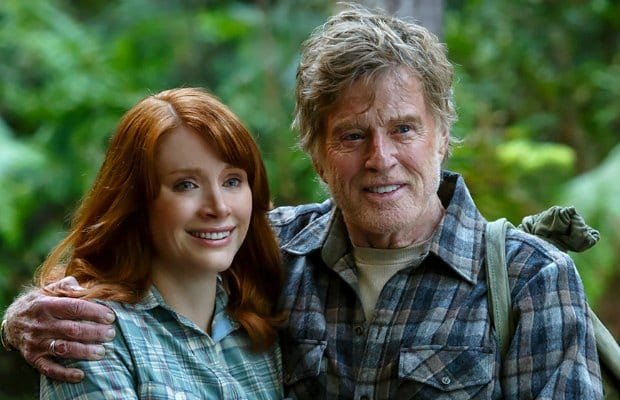
There are bright spots: the actor Oaks Fegley is an inspired choice for Pete that could be one of my son’s friends. Oona Lawrence as Natalie whom he is paired up with shares the cake and is not sidelined as a girl. And Howard may be the star but real reason why most people are seeing this film is the acting powerhouse that is Robert Redford, and when has this man not delivered? He’s extremely rough in this film and I have to say I like it better when he doesn’t shave or comb his hair. Redford has cleaned up for some gigs in the past, including Captain America: Winter Soldier and though I loved him in it, I have to say I prefer Sundance to The Sting. Redford probably put in a weeks’ worth of work but he made it count. And he’s not the reason if the film suffers.

The film is pure fantasy of course, but it is fantasy that a lot of people need right now. I’m trying not to let my late experience in California bias my opinion of the film (see my blog ‘Fantasyland’ on the Docking 94 Blog) but we’re having a hell of a time up here in Alberta and it was nice to see the Fantasy Machine in Hollywood is alive and well. It was kin to seeing Star Wars in the middle of a bad bout of StagFlation. In this vein, Pete’s Dragon is a good film, but not a great one. The middle hour isn’t horrible but very predictable and punctuated with scenes by actors who could be replaced and conventional shots that are not on par with the opening and close of the film. Disney’s live action franchise is suffering quite badly considering they are flushed with cash from Marvel and Disney, and unfortunately their only plan forward is a series of live action remakes of older films (Cinderella and Jungle Book in the past, Beauty and the Beast and Mulan upcoming) that show how deeply conservative the company is in wagering money on their own films. I will always believe original storylines will go farther than rehashed material but we also must recognize that studios are spending their hundred million, not our hundred million. What then do we expect them to do? Of course they are going to play a safe game – as would you with your money. It’s risk mitigation with scripts and casting. Disney seems to have the right idea in hiring challenging directors like the brilliant Kenneth Brannagh, and XXXXXXX here. However it also seems they need help in screenwriting, editing, and casting. These are the outstanding problems in Pete’s Dragon. Hopefully these issues will be corrected before Disney asks me to spend another hundred dollars to entertain my family. Halfway doesn’t cut it when you’re on a limited budget.


BEN-HUR 2016 (For Better, For Worse)

How many Romans do you even know? Have you ever had a conversation with a single one in your life? Don't spit your hate for all when you don't even know one.

First Screening. August 2016. SPOILER WARNING

I’m sure this article will only be a shorter rehash of many reviews posted and printed about a problematic enterprise that held a lot of hope only to crash into the well of disappointment. There are many things that are interesting about the remake of Ben-Hur, but I find the most interesting thing to be that it is actually not that bad. In fact, it comes nowhere near the apocalyptic reviews I’ve read in short. On top of this, I actually saw the film because the word of mouth of the film was very good. I met several people on vacation in Hollywood who saw it because the premiere at Grauman’s was that week, or people in the In-N-Out Burger in Long Beach who walk to the theatre once a week. I also talked to a very nice African-American couple who praised it in the thriving metropolis that is downtown Big-Bear City. All of them claimed to have seen the first one. None of them mentioned religion as a motivation or plot point at all.

I’ll skip the history of the novel by Lew Wallace and only focus on the dramatic differences I saw between the original film which I viewed only a couple of months ago with my son and the new version I also saw with him and my cousin in Southern California last week. Just in recalling the old one with my son over our trip back home and countless conversations in the car since, we’ve nailed down some pretty big differences that may make the critics uncomfortable even if the audience that does see it may not have the same opinion. This has happened repeatedly – look at Suicide Squad last month.

This Ben-Hur is shorter, there is no doubt. At two hours, five minutes it does not even come close to the three hour, thirty-five minute extravaganza that is the Charlton Heston classic. This sounds an insane reason to like one movie over another but in the day of shorter attention spans and the near impossibility for Hollywood to release a film that can only be shown three times a day instead of six – and therefore only make half the money – this is a reality of epic remakes. It also enables the filmmakers to jettison storylines they just have no time for or to truncate things they think make the film slow. Point in fact is Heston’s lengthy scene in the House of Hur with Ester when he returns from the Galleys.  My son, durable, honest, but greatly interested in the film, sighed, rolled over, and went to sleep.

The shorter version dropped Ben-Hur’s adoption by a wealthy Roman Patriarch, thus ensuring his safe return to Judea. It also cut out long and drawn-out scenes of Ben-Hur training his horses for the ever-famed chariot race. Long walks, long contemplations, long serious shots over the ocean or into the desert were simply not included to move the story along. In essence this did what it was designed to do. The longest part of the film is Ben-Hur’s life in Jerusalem up to his arrest and Masala’s betrayal.

The end effect of this is the first debatable point. What does this achieve? Trimming off an hour and a half of your running time sounds like a great idea from a cost perspective and from a revenue perspective. But unfortunately it may have not worked from a plot point of view. Familiar with Ben-Hur’s patron saving him from the galleys and adopting him as a son, I was perplexed how he was able to show his face in broad daylight, even during a chariot race, without being immediately crucified.  This and other time saving techniques must be balanced with other confusing choices. The accident that leads to the invasion of the House of Hur is Ester’s over zealous curiousity at the marching Romans below. Her hand brushes a tile which falls onto a Roman and nearly kills him. When Masala investigates he finds the tile and the House of Hur innocent but still banishes Ben-Hur and his family to a life time of pain despite knowing they are all innocent only to advance his career as a Roman soldier…the only sure fire way to get ahead in the Roman Empire of the day.

Instead, what we have in the remake is a very complicated story of liberation. Zealot Jews are resisting the Roman occupation. One is wounded and is taken to the House of Hur. Because he is a boy, Ben-Hur allows it, nurses him back to health, and tries to convince the under aged boy through philosophy of politics that what he is doing is unethical as it does not keep the peace.  The broken piece of accidental tile then becomes an assassin’s arrow, the boy using the House of Hur as cover for murder. Ben-Hur inexplicably catches him and lets him go. Though he is a fellow Jew I find this absolutely astounding. So when Masala breaches the house he finds the bow, bandages from a wound, and Ben-Hur admitting under pressure that he shot the arrow. Of course Masala doesn’t believe him. But what is he faced with. Was Ben-Hur helping a contemporary terrorist? Check. Did the House of Hur provide him with a weapon? Check. Was the suspect using the weapon to commit a crime? Check. How is Ben-Hur not guilty under these circumstances? In the original film, Masala’s blind ambition towards advancement was his hubris that undid him. Here, Masala seems to be only enforcing the law and Ben-Hur is, if not partially responsible, directly guilty. Muddled around this is Masala’s new motivation – a grandfather who helped participate in the assassination of Julius Caesar. Thus he has a stained name that he must cleanse and what better way to do this than to arrest the man he grew up with as a brother? In the original this had meaning because Masala had betrayed Ben-Hur basically over nothing. But in the remake he seemingly does this to enforce the law and this takes away Masala’s betrayal. It is hollow. It seems this is done for the ending, which is in fact the next point.

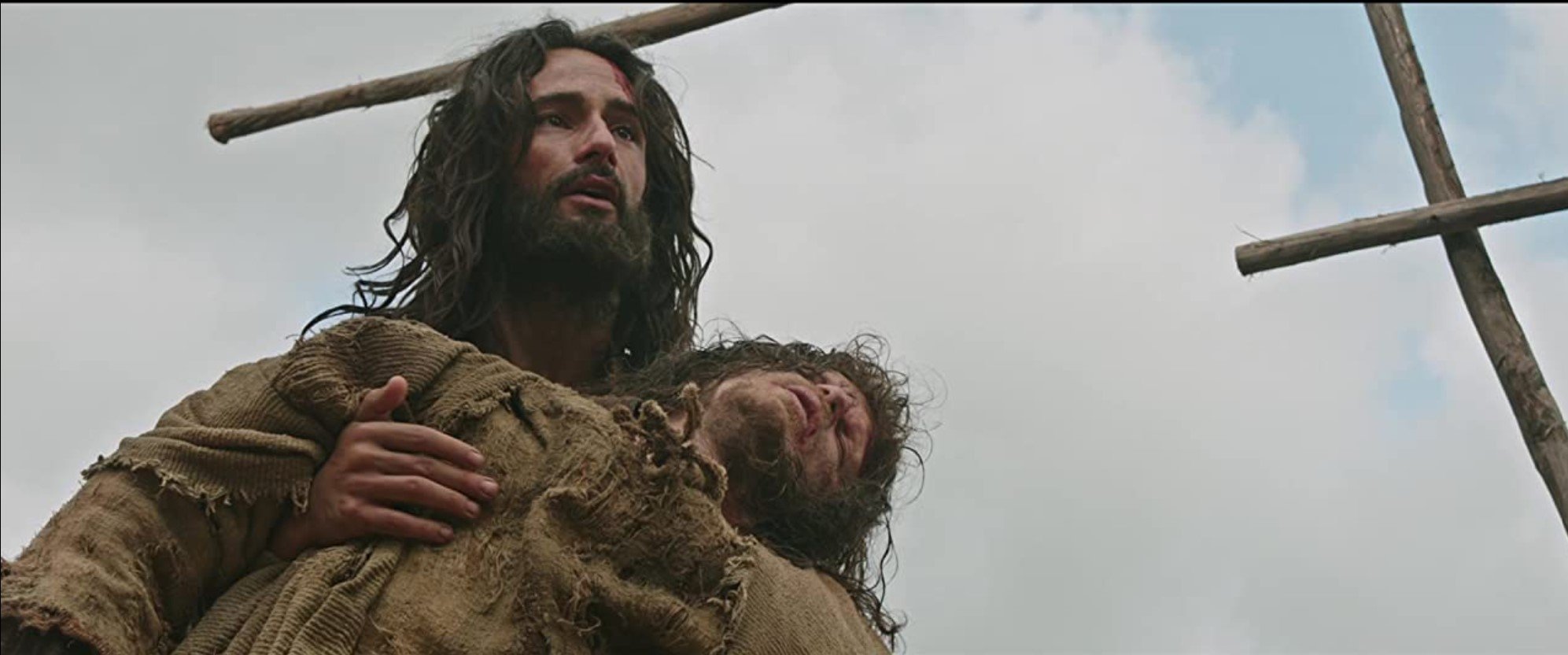
Heston’s Ben-Hur raced Masala to death in the arena, then saw him die in a fit of vengeance that left Ben-Hur satisfied that he had ‘won.’ The restitution of his family in a separate plot line was complicated (dropped in the remake) but the end result was they meet Jesus during the Passion, he cures the family of leprosy and Ben-Hur of his hate. They live happily ever after as reborn Christians. In the new version it is reverse. First, Ben-Hur runs across Jesus in the Passion. He is cured of his hate and when it rains after Jesus dies, his family is cured by the Heavenly water. Ben-Hur then sees Masala whom he forgives and takes back into his family as his brother. The new family goes off happily ever after and we are wondering how a family that spent 5 years in a dark hole with leprosy could possibly forgive their adopted son, who somehow was brought up to be a pagan in spite of the House of Hur being Jewish.

The new ending is quite powerful. And in this very strange mishmash of a film, I actually prefer it. It brings more power to the story and certainly to the Passion, which in the first film seems tacked on at the end. In fact, it should be called “Ben-Hur and Twenty Minutes of the Crucifixion.” I did not, in any way, connect the two in the first film. But I cannot deny that if they had done this in the first film the story would be even more powerful. I found it very touching.

Unfortunately this greatly powerful moment is scripted against his incarcerated family and book-ended with the family’s anger at Masala at the beginning of the story and the strange de facto acceptance of Masala at the end. In the middle is a rather rushed Roman fight scene, a dark and gloomy galley that a viewer can’t focus on, and a chariot race that despite being impressive, simply does not live up to the first Ben-Hur.

 So as a film, it doesn’t work nearly as well as the original even though it has a remarkable amount of pluses. The greater meaning of the Passion, the idea of forgiveness and redemption in our lives, and the superior acting by Jack Huston and a cast seemingly of unknowns in the west. I thought the acting was greatly better than the first, despite Heston’s classic leading man style, if only because acting style has improved a great deal. Morgan Freeman was great as only Morgan Freeman can be. I would have seen the film regardless of all other factors simply because his power as a heavy is something to behold in a town where heavies are fading fast.

I do expect the film to be derided for these flaws and not because of the religious message. This is something to say about a town and a community that despises religious film and despises them even more when they succeed. Since this film seems to have tanked so badly at the box office, the critics have gone soft on it, expecting it to be crucified in the court of public opinion, dead of itself, and in no need to a fifth wound to the heart.  But what if it had done well? It’s an interesting counter factual that we’ll never know. There is no reason to watch it again, but there is certainly no reason to not go see it now. Like most films, it’s not going to get better in your living room.

MAD MAX: FURY ROAD (What it's like to Work in Energy Service)

We are down 30,000 units of gasoline, 19 canisters of nitro, 12 assault bikes, 7 pursuit vehicles: the deficit mounts, and now sir, you have us stuck in a quagmire!

In one of the most amazing scenes I have ever experienced in cinema the past decade (for that is what MAD MAX: FURY ROAD is: not a movie – but an experience) Max wakes up after a traumatic accident that would make me shit my pants, most of you lie about how you reacted to it and cause the worst form of post-traumatic stress on par with surviving storming a beach of Normandy, surviving a home invasion by ISIS or sitting through three and a half minutes of any Justin Bieber song.

George Miller, the Director, must have used 48 Frames per second and slowed down the film to recapture the image at the standard 36 (I imagine this would be a lot easier to do in the world of digital). You can see each individual sand grain move in waves off of Max’s head as he slowly comes to the conclusion that he is in fact alive. After snapping to and undergoing an immediate panic of “where am I?” “Who am I?” “What happened?” “What is going on?” he realizes he still has a steel mask on his head that he cannot remove and a chain connecting it to something buried in the sand. Attached to this chain and imbedded in his neck is an IV which he removes and follows the chain to its' source: a teenager in a car submerged in sand who is unconscious and the recipient of Max’s blood. Max then hears a noise and like a desperate animal he searches for the source: the enemy who put him here is on the horizon, barely visible, but is organizing. Max does not have a lot of time. Opening the door he tries to pry the chain connection off the boy but cannot. BUT he finds a double-barreled shotgun, checks the ammunition, and hesitantly but in a very “me or him” mindset he places the gun against the wrist of the boy and pulls the trigger. The shells are duds, worthless, and Max is exasperated. He must get away from the boy and away from the psychopaths tracking him down in the next few minutes. Then he hears another sound from behind him. He frantically turns his head to see an 18-wheeler trying to start its engine. Max’s only hope is for whoever is there to help him get the chain off the boy and the mask off his face. He tries to lift the boy but the chain goes through the door and he cannot fit the boy through the door. In a struggle that would tire me out for the day, Max puts every effort of his life into wedging the door back and forth until it comes off the hinges (the door is rusted, the car is obscenely old). With the door free, Max pulls the boy out of the car and hoists him on his shoulder. Then he picks up the door with one hand and the shotgun that does not work in the other. Faced with certain death if he is caught, he fights with every step to approach the rig to gain help. When he rounds the truck he is faced with six women who have no interest in helping a man with anything (nothing sexist here, it’s just the plot). With the shotgun that doesn’t work, a dude over his shoulder and a door chained in-between the dude and himself, Max now has to bluff his way in order to force people to help him get free and stay alive. That’s all you need to know for now.

There are a billion other reasons why I love this film, but I am only going to focus on the above scene as a metaphor for my last job in the Oil Patch. When I sat in the theatre last year watching this play out, I watched with great interest not because of my loyalty to George Miller or my fandom of The Road Warrior or because Tom Hardy surprised me in Tinker, Tailor, Soldier, Spy or even (gasp) because of Charlize Theron. I watched with great interest because despite the post-apocalyptic scenario, despite the simplest of plot lines, despite the end of the world apparently taking place in the Australian Outback – despite all of these things…I knew exactly how Max felt. I empathized with his character more than any other that I could think of. More than Luke Skywalker. More than “Jack,” the Narrator of Fight Club. I sympathized with him because that was what it was like to work in the energy service sector of the Oil Patch.

There is a great Dilbert cartoon panel by Scott Adams(I’m not sure if it’s real or not) but Dilbert tells his mother he worked to midnight. His mother says “well, at least you made extra money” and Dilbert replies that he doesn’t get overtime. “Well, at least the work was important” his mother comments and Dilbert responds that it wasn’t because his boss changed presentation slides that made the presentation worse. “Well, at least you’re prepared for your meeting” she says and Dilbert informs her that it was cancelled…which is fine because the project had no funding anyway. “So you worked for free to worsen a presentation for a meeting that won’t happen for a project that doesn’t exist?” Dilbert confirms this. “Oh…you must work for… (Insert Company Name Here).”

I would come to work in the middle of a firestorm. The instant knee-jerk reactions to anything a client said – no matter how subtle – freaked everyone the fuck out. Instead of communicating with a client over how best to serve their needs, the earth was moved no matter how much, no matter how far, no matter the effort in time, the cost in labor, the sacrifice to the company or families, the application to accounting rules, the risk to the safety of employees, etc. It had to be done. And after it was done, the client normally said: “Oh…right. Thanks…” and immediately put the problem out of his mind because in the grand scheme of what he was dealing with it was never really much of a footnote to begin with.

I worked, on average, about 60-80 hours a week my first two years in the Oil Patch and again in the first two years of my transfer to Canada. In between that and since then I worked on average about 50-70 hours a week not because I had too many projects or because stuff “just had to get done on time,” but because it was always easier to ask your employees to accomplish the impossible than it was to explain to the client the issue wasn’t as catastrophic as it looked or cared to present another solution after consulting with the people who had to execute the outrageous promises made. It was easier to disrupt a set system of process to achieve a result than it was to tell a client “this is a lot of trouble for zero billable hours.” 99% of the time, these issues were never invoiced for. Usually this was because the system set up to invoice our clients was not flexible enough to allow such “add ons.” The Project Manager didn’t want to tell the client it cost something, the Sales Representative didn’t want to put his commission in danger, the Accounting Department didn’t want to create new line items, the Legal Department didn’t want to renegotiate contracts, and management didn’t want to miss a lunch that day.

So I came to work most days neutered. And as the price of barrel fell my language changed from “No, that’s crazy” to “can I talk to your client” to “we’ll have to work that out” to “sure, when do you need it by?” This attitude stole revenue not from the decision makers, but from the blue-collar workers who needed it to feed their families. In the end if you had a degree and no common sense or experience you were inherently more valuable than someone with no degree but loaded with common sense or experience. There was in most cases nothing I could do: no more hours I could work, no more money I could save, no more promises I could make, no more tricks up my sleeve. All because the fear generated by 22 dollars a barrel turned an “idea so fucked up it proves he doesn’t know what he’s talking about” to “I’ll have it done today by noon - for free.” This is the interpretation of service in the Oil Patch. The absolute groveling and debasement of people and their labor to a single factor above all else: safety, morale, business ethics. It’s not about the bottom line. It’s about control and fear. It’s about using the barrel price to get what you want.

It was like showing up to work chained to a dude over my shoulder, a door hanging on the chain, and a gun that did not work in my hand and being forced to use that emasculated object to bluff someone in an effort to force them to help me. Help me, I would ask. Please, I’m trying to make money. I’m trying to contribute, to create ideas for revenue. I’m trying to save my job, your job, as many as we can. Please, I’m begging you, can you talk to the client about billing for this? Talk to HQ about adding this service, about increasing our profit? About cutting our costs? And the answer from the multi-billion dollar service giant? Fuck you. You’re fired.

And so I completely empathized with Max. He just wants to survive. I wish I was as smart as Max. 

Woman in Gold (Two Americas; Tvy Österriechen)

“In our case, we have a treaty, article 26 of the Austrian State Treaty says Austria must return property taken from Jewish families during the Nazi era. So there's no dispute between the two countries as to whether or what type of law would apply in this case.”

You don’t have to watch The Woman in Gold (2015) with Helen Mirren and Ryan Reynolds to understand what I’m about to expound upon, but you should by all means check out this wonderful film which perhaps lets a few things kick around that it did not intend. The film is not riddled with under lying symbolic meaning or symbolism. Maria Altmann, the daughter of a wealthy Jewish businessman, fled Austria after the Anschluss in 1938 leaving behind most of her family and all of her family’s possessions. Her family that stayed was murdered and all her family’s property was either stolen or destroyed. Her aunt’s necklace found its way to Hermann Goering’s wife. The painting of the same aunt, Adele, was stolen by the NAZIs and after the war given to the Belvedere, the Austrian State’s national art gallery in Vienna. The film is about how Maria and her lawyer, Randol Shoenberg, fought a seven year battle to get five paintings, including the portrait of Adele, back. There’s tons of more detail that I’m not going to get into because I don’t want to focus on the plot.

            Instead this is about the exceptional screenwriting talents of Alexi Kaye Campbell, a Greek immigrant who has more acting credits that writing experience, and Brit director Simon Curtis who kick started a very distinguished TV career by directing Kenneth Brannagh and Michelle Williams in the outstanding My Week With Marilyn (2011). The script is normally the only thing that a film has unless it’s director and stars can save it, but when you have a good one it can still be sabotaged by bad directing even if you have great actors. Campbell and Curtis nailed the underlying issue of the problem of the Woman in Gold – A Portrait of Adele in three scenes describing the two existing Austrias. One was no longer a part of the NAZI past, but still saddled with it. The other was a younger generation of Austrians who saw the only way forward in their society was to recognize Austrian complicity in the Holocaust. These two Austrias are still at war and will be so for a very long time. The art world, despite being Bohemian, is extremely conservative. A hundred million dollars tends to do that to even the most ardent liberals.  Austria was fought to keep up the Woman in Gold because they saw the Klimt painting as something that exemplified them: it showed the world who they were as a cultured society. Instead what it really conveyed to the world was a society that was okay with keeping the property of murdered Jews. The audience can understand how young Austrians want to be proud of their country and feel the restitution issue is important to them for that purpose. I understand how Austrians feel and I have every faith that they can replace their bloody symbols with more nurturing works of art that were not taken in the middle of the night at gunpoint. I understand how Austrians feel divided because I am an American, and I feel divided.

            This is not about Native Americans or Antebellum Slavery or segregation or any of that, though that discussion has it’s place. I cannot deny those things happened but I do deny that my country is not a great country because of those things occurred. They are horrible, were done by horrible people, and we enrich our culture and the future of our nation by righting those wrongs.  No, this is about right now. I feel that there is a side of America which is okay with racism, okay with sexism, okay with xenophobia and misogyny and the hatred of gay people because they label criticism of their discrimination as ‘political correctness.’ There is an America that wants to return not to the 1950’s, which is an insult, but to the 1930’s, when no law in the land, despite the most liberal president in our history, could stop the lynching of a black man or a Jew, the murder of a poor child, the rape of a woman if she were married. There is a side of America that is okay with this. They’re okay with it and when you criticism them for it they say ‘oh, you’re just being politically correct.’

I am a life-long Republican. I went to college in the ‘90’s, which was not easy, at a liberal school who worshipped the ground Bill Clinton walked on…and it disgusted me. Suddenly it was fine to lie to federal grand juries, deceive federal judges, to sexually harass any woman you want… so long as you were a Democrat. So long as you were a liberal. So long as you were politically correct. So long as you were Bill Clinton and you were not Clarence Thomas. I aligned myself with a party that declared ‘character is important in choosing our leaders’ and whenever I was challenged on this by a liberal Democrat I always retorted with ‘then why isn’t Ted Kennedy President?’ Character mattered then, and I thought I belonged among a political consciousness that respected that. Boy, I was wrong.

            I see at least half of the Republican Party today say they don’t like Donald Trump, then they meet with him and endorse him. I see them say they think he’s bad for the party and then they make backroom deals to promote his candidacy ‘for the good of the party.’ I see intellectuals, very smart people, people I know personally, people I respect shake their heads and say ‘well, he’s better than Hillary.”

            What fucking nation are you living in?

            I hate Hillary Clinton. I think she’s slime. I think she’s in the Saudi’s pockets, she promotes the pharmaceuticals, she sat on the board at Wal-Mart for a decade. I think it’s a god damn travesty that she is going to be elected President this November – and she will be – but she will deserve it because most of America does not understand the sexist, racist, jingoistic, and xenophobic bullshit of Donald Trump or the party that shrugs and says ‘well, at least he’s not Hillary.’ If you think that way, if you rather have Donald Trump over Hillary, than you deserve Hillary, because you’re voting for her.

Much like the Austrians were not willing to let go of century old painting “just because the NAZIs stole it” there are millions of Americans not willing to budge on their ‘conservative’ views “just because deep down I hate blacks, Jews, Mexicans and women.” There’s two Americas, here, and unfortunately half of the Republican party, who has Latino friends but honestly thinks border security is a serious issue, is going get fucked. Half of the Republican party, which is under the age of 45 and have wives that work and daughters who need futures, are going to get fucked. Half of the Republican party is being told ‘vote for Trump, asshole, or you’re not a conservative.’

            Well fuck you, and fuck the GOP. I’m not voting for Trump. I’m not voting for a sexist, misogynist asshole who jokes about menstruation, calls Latinos murderers and rapists, calls women fat and ugly, and when you say “hey, dickhead, that’s over the line,” the reaction from him and his supporters is “oh, well you’re just politically correct.” Oh…because I don’t think you should pigeonhole all Latinos as murderers I’m politically correct? Because I don’t think it’s okay to make fun of menstruation I’m politically correct? Society is moving to the left, whether you like it or not. You can vote for a party that can moderate that shift by protecting the Second Amendment and securing our borders, or you can let it slide to Bernie Sandersville, who will make this country look not like Canada, but like the Soviet fucking Union in 1965. And if you want it to look like that, with rich people turning in their passports and businessmen fleeing to Cuba to escape the madness, bread lines and 50% income tax, then go right ahead and vote for Trump. All you’re doing is destroying the organized resistance against (not socialism, but) Communism. And you’re doing it because you think that someone who talks like Trump, has an outlook on life like Trump, is someone you think represents this country’s future. If you think that you’re fucked in the head. And I will not be voting for a party or a party’s candidate who thinks that way.

            For my entire academic career I was told by many people who know more than me that Austria was much worse than Germany. That Austrians passed the buck to the Germans, kept their distance and shrugged. “Ah, well, you know, we weren’t Germany. They invaded us, you know.” Right, and just like millions of Germans did NOTHING, millions of Austrians just NOTHING either. And I can’t believe I’m saying this but I think I’d rather live in Austria right now. They seem to reject fascist values in favor of recognizing wrongs and moving on. But I can’t say that about the Republican Party. I can’t say that about a group of people who choose someone like Trump or even if they didn’t vote for him, shrug and do NOTHING. Millions of Austrians made a decision on what kind of country they want to be. Millions of Americans make this same decision every four years. These collective decisions are going to lead to the complete destruction of conservative opposition and another seven decades of Democratic rule and all we can hope for is the party to break into wings like it did under FDR. All we can hope for is a wing of the party to stand up to the sinister shadows of the extreme left. All we can hope for is for Democrats to be more libertarian than the Republicans they replaced. Way to go, GOP. I guess that’s the best you can do. 

Hail, Caesar! (In Grand Defense of Hollywood)

“Yeah. You're not going to believe this. These guys even figured out what's going on here at the Studio. Because the Studio is nothing more than an instrument of capitalism. Yeah, so we blindly follow these laws like any any other institution. Laws that these guys figured out. The Studio makes pictures to serve the System. That is it's function! That's really what we're up to here.”

First Screening. February 2016.

     There’s so much shit going on in Hail, Caesar! that it is easy to get lost in all the hubbub. Not that there is very deep meaning in anything going on – this isn’t an awesome intellectual powerhouse that The Big Lebowski (1998)) or O Brother Where Art Thou (2001) was. But the stories alternated in front of you almost make you think some of them are tied together instead of giving you a pretty accurate picture of where America was in the early 1950’s. First you have Baird Whitlock (A George Clooney-like actor played by George Clooney) getting kidnapped by Communists, DeeAnna Moran (an Ethel Merman-type played by Scarlet Johansson) resisting urges from the Studio to marry a man so her baby won’t be born out of wedlock, working actor cowboy Hobie Doyle (a 1950’s Tom Mix played by Alden Ehrenreich) wanting to play the studio game of fame while trying not to seem ridiculous or stupid and this doesn’t include Channing Tatum’s devoted Communist, Ralph Fiennes’ Laurence Olivier-like stage-turned-director or Tilda Swinton’s turn as both twin sister columnists out for the story scoop or each other’s blood. In other words: it’s your standard Coen Brothers variety show, only this time it’s funny.
      Now, I like the Coen Brothers, I really, really do, mainly for a string of early hits from Blood Simple (1984) to The Big Lebowski which as a kid I found really compelling and as an adult I found reason to go back and enjoy. This is usually how Hollywood is supposed to work: a visually stimulating film sucks you in and the story sells you an interesting point of view that you can agree or not agree with. The Coens are masters at the former but really don’t care about the latter, preferring instead to pack their films with interesting characters that ramble on about mundane items that keep you holding your gut (“This game determines who enters the next Round-Robin, am I wrong?”). This leads to a string of more than interesting stories from Miller’s Crossing (1987) to No Country for Old Men (2007) that pass as dramas and Fargo (1996) and Burn After Reading (2008) that pass as comedies. And while we can say they have rare talent in a formula that would be impossible for the overwhelming majority of Hollywood we can also say that some of their projects have just left me fucking dumbfounded and shaking my head. First, I apparently am the only person who hates both Barton Fink (1991) and O Brother and I really don’t get Inside Llewyn Davis (2013) but I’ll be damned if anyone can ever explain to me what the hell they were thinking with A Serious Man (2009): a film that you apparently can only understand if you grew up Jewish in Minnesota in the late 1960’s…with Richard Kind as your uncle. 
     Thankfully this zeroed in experience is not present in Hail, Caesar! Instead, all of the stories above are weaved around Eddie Mannix, (flawlessly played by Josh Brolin) the fictional Head of Production of Capitol Pictures based on a real man but unlike him in very stark ways. Mannix is a good man, with bad problems to solve, and why he handles all of them himself is the only pause you can give in this film: no capable producers or middlemen such as there are in Hollywood – especially in the ‘50s when one of the problems was there were too many. Mannix here provides the moral center and the string around which all are tied and turn in turn much like an amusement park maypole ride with chairs. And all of them tell you just a little bit about Hollywood and America in the ‘50’s, but not too much. 
First is Whitlock’s kidnapping, which halts an expensive epic filming on the studio’s endless rows of soundstages. The film, Hail, Caesar!, could be Ben-Hur (1959) or The Ten Commandments (1956). Whitlock is ostensibly taken by a group of former Hollywood employees who have been denied jobs in the industry based on their politics – they’re Communists or were Communists or were accused of being Communists or identified as someone who was, were or might be a Communist. Whitlock’s kidnapping will net them a cool 100K, a little low, even for the ‘50’s, but that’s right in line with people who supposedly don’t place a high value on money. The group in the film possibly portrays blacklisted artists in the ‘50’s more accurately than most. They are not really a threat unless you don’t like Fisher Stevens, huge mustachioed men looking similar to Stalin or Trotsky, or little cucumber sandwiches to go along with discussions on class struggle. Their most menacing member is Channing Tatum, who improves his impossibly perfect career by showcasing his tap dancing talents and his Timberlake sense of humor with Roger Moore-like quip/look drops and outlandishly physical gay humor. All of the Communists look a bit effete, some of them very Jewish, and I suppose that wouldn’t be out of the ordinary of the image of them in the 1950’s in general or in fact. Like the real blacklisted victims, these people are not really a threat to the U.S. Go pick on someone else. 
     In the middle of this is Moran’s Busby-Berkeley-like water adventure mimicking ejaculation using the representation of a large phallus (not a stretch considering Johansson’s image) and her supposed need to keep her public image clean by giving away her child to someone she can adopt it from later. This will (I guess) satisfy the studio that they are not paying a slut to smile while being covered in ejaculate but it really does convey the absolute control and in some cases absolutely brutal responses conservative Hollywood engineered at the time to keep their bankable stars clean and thus the families to keep coming to the theatre.  There’s even a scene where Mannix discusses the script of Hail, Caesar! with four spiritual leaders (three Christians and a Jew) in which they discuss whether or not a reasonable religious leader would find anything in the film offensive. This is easily the most hysterical portion of the film: a discussion of the nature of God and ultimately why the objections of the Jews don’t matter (at least in a depiction of Christ). Isn’t this America? The great clean-up spreads to the impossibly impeccable Tilda Swinton playing both a Hedda Hopper and a Louella Parsons whom Mannix has to man-handle like a fork-tongued serpent and like juggling his various movie productions must juggle handling celebrity journalists he must respect and feed like very dangerous zoo animals (as evidenced by the feathers in Swinton’s hats) that could turn and devour him at any moment. Moran is the first hint of this great effort of image and the minute she opens her mouth you understand the duality of what Mannix is trying to do. I’ve always known Johansson to be an amazing actress, but I was drop-jawed when she spouted out dialogue as if she was from deep in Brooklyn. Even her shoulders seemed to hint at the specific neighborhood or specific block. Was that East Flatbush or Flatlands? Maybe Marine Park? The greatly unfair sexual politics abound from her point of view showcase how oppressive the ‘50’s were to women despite great gains made in the previous three decades. Who better to point out the absurdity and hypocrisy than Johansson?
     We can expect the Coens to rope in great performances from great actors like Johansson and Fiennes’ hysterical beyond patient director working with an outside-his-comfort-zone actor but the show stealer is that actor himself: Ehrenreich’s heavily understated Hobie Doyle. The Coens have tapped into the cowboy element in Hollywood history before. Not just their surprising and outstanding remake of True Grit (2012) but The Big Lebowski is one of several of their films that explore the culture and the legacy of the west. They understand perhaps as most today don’t that most films before 1960 were in fact westerns. Most TV shows were westerns. Most comic books, most pulp novels, most everything from the closing of the frontier to the Leone films that practically destroyed the genre were based on or explored these western themes. Hobie is just a guy, like Moran is just a girl, from the parts of America that superstars are not supposed to come from. Like Moran dealing with relationship issue, Hobie is dealing with career issues; namely accelerating it. His films are popular but his acting style is more suited to chaps and a horse than a tux and a ballroom as evidenced at the hour mark. But off the set, Hobie is the guy taking Mannix seriously, the guy on the alert when he sees the loaded McGuffin and, I might add, seemingly the only guy who doesn’t mind taking a Latino out on a date and charming her up with seemingly no intention to sleep with her. The girl, Veronica Osorio, is just as outstanding and although this is a film loaded with on-screen chemistry Ahrenreich and Osorio steal an enormous amount of attention for what little screen time they have. Hobie is the guy who ultimately saves the day, and I guess it’s time to talk about what that means. 
     There’s no doubt that Mannix is running a madhouse. That’s the movie business. And there’s no doubt that everything associated with what Mannix is doing touches some sort of off-color aspect of American society (my only severe criticism here would be the dramatic lack of color in this film if you get my meaning). But…and this is an important but…it seems as if all of the characters – even Whitlock’s captors – don’t really have a bone to pick aren’t really evil at heart. Mannix struggles over the smallest of sins, Johansson wants to find that perfect someone to make a wrong a right, Whitlock is just hapless and wants to feel for the little guy, and Hobie and Veronica are the couple you want next door. Remember, this is a Coen Brothers film. There’s no leg in the wood chipper, no panty clad thief stealing huggies from a mini-mart, no Wu micturating on the Dude’s rug, and no psychopath using a high powered compressed air tool to murder people on remote Texas highways. In reality, not even the Communists in the film are bad guys. The most ‘bad guy’ you get here are Tilda Swinton’s twins threatening to spread rumors of sodomy and a Lockheed executive who wants to take away all of Mannix’s weirdness for an easy job with an easy future and an easy retirement. This is a landmark for a Coen Brothers film. Mannix finally agrees with his confessor when says “it just feels right.” And though I can’t exactly pin it on anything in particular despite analyzing the Coen’s environment of 50’s Hollywood, so does this film.