Film Reviews

State Funeral (2019)

Quantity has a quality all it’s own.

There is something ethereal, sad, and subversive about the documentary State Funeral (2019), which almost silently, and almost without commentary, conveys the awesome spectacle of the internment and edification of Marshal Joseph Stalin; dictator of the Soviet Union for twenty three years and after Genghis Khan and Adolf Hitler, probably the third most murderous and evil fiend in world history. The film itself is a very smart edit job of contemporary footage from the March, 1953 mourning and procession of “the boss” himself, captured from the archives of Mosfilm. Other than snippets on the history channel, no footage of this time or event was available, and even in the Soviet Union exposure to the funeral was largely personal, as this footage was never released. What it shows is as shocking as what it does not show.  Blank faces as well as mournful ones. The common people of small villages and famous people of world history. Nameless peasants cry in their town squares. Malenkov, Beria, Molotov, and Zhou Enlai act as pallbearers in a funeral of no religion yet loaded with meaning and iconography. 

It is almost a silent film, loaded with foley grips recreating the shuffling of footsteps. No one speaks in the boss's presence. Even outside, conversations are peripheral and muted. You can tell no one is really speaking. Because no one’s mouth is moving. The few contemporary words used are direct from the radio Moscow announcements, written by the party and read without mistake to the people of the Soviet Union. There are also speeches in factories, no doubt vetted in much the same way. The silence itself is a character in the film, and I suspect it is for several reasons. First because there are some citizens genuinely sorrowful for the death of Comrade Stalin, who murdered their families and tortured their friends, so brainwashed are they. Stalin had been an integral part of the Bolshevik Revolution since 1915 when he slaughtered hundreds of people in Russian Georgia in a bank heist to fund the cause. He waited patiently as Trotsky fought the Civil War and Lenin died. He stewarded them through a depression, famine, and murderous rampage - all of which he started. He led them through what most historians consider to be the largest and deadliest military conflict in all of human history. For most of Russia, there was no time before Stalin. Second, I’m sure is the element of fear that resides in those cadres smart enough to know exactly what Stalin was but will never say anything knowing the cost, and those who fear what might come in the wake of the death of such an all powerful God who lorded over them for so long. 

The color is shockingly brilliant for 1953, and the red especially is another character in a drama that bookends decades of blood. The coincidence cannot be lost on those who participated or those who witnessed this spectacle. The faces of the famous are striking, true believers that they are, but they are not as interesting as the individual Muscovites and Russians, Ukranians and Tajiks, the common people of the world who all look like they are hiding a different emotion. Some cry, and probably for different reasons. The eager and the interested can be seen in the crowd. This is a time when the public was more actively involved in everything, all over the world. Before the days of TV. Before the days of Twitter. We all went to Fourth of July parades. In the cities, we congregated in town squares and attended ticker tape parades for astronauts. The common and the required wanted to see the red coffin draped with black mourning cloth, as if betraying the color of his soul departed. 

The words spoken about him, by radio announcers, by party hacks, by Malenkov at the procession opening, were sincere and earnest at the time, and now they are a bad joke, inciting derision and black humor. He was praised for eliminating wars, not mentioning the ones he started and lost. He was noted for eliminating racism, not for inciting pogroms against Jews and cleansing cossacks. His leadership during the jump from an agrarian society to an industrial workforce was singled out as an economic achievement unparalleled in modern times...which was true...even if you factor how many millions died in the collectives that made it possible. Some of the praise, such as when he is lauded for freeing millions of people from oppression, just seems like a sick joke. “People all of the world know Comrade Stalin,” Malenkov tells a packed Red Square, “for being the torch bearer for world peace.” This is such an enormous lie it is not worth a scoff. “Comrade Stalin dedicated his genius to safeguarding peace for the people of all countries,” he continues. The camera does not show the reaction of the Polish delegation to the funeral, who saw their country destroyed by Hitler AND Stalin at the same time. Their political faction exiled for life, their entire officer corps murdered in Katyn forest in a single day. His foriegn policy, continues the speech, was crucial for restraining foreign military aggression. The faces we see during this recitation seem to show what everyone seems to know about this line. That Malenkov, and his entire retinue, is full of shit. 

When Lavrenti Beria, leader of the nefarious NKVD and the worst manifestations of the totalitarian one-party state, speaks to the people about the tragic loss of such a friend of the people of the world, we can only imagine what the people of the Soviet Union would say if they knew that Beria kidnapped young girls, including minors, raped them, murdered them, then had their bodies disposed of in the backyard of his dacha. After Beria, Molotov speaks. Molotov, who at Stalin’s command signed a peace treaty with the Nazis and sold the fascists oil and steel to kill Frenchmen and Brits. Molotov who flew all over the world as Stalin’s diplomatic lapdog. Molotov, whose wife was accused by Stalin himself, and who agreed that she should be interrogated, jailed, and then when accused himself, then berated himself “oh, what I have done to Comrade Stalin.” Molotov, who was in jail until the day after Stalin died, spent his time on the podium continuing to suck a dead man’s cock: to our glorious leader. I’m surprised he didn’t use the word ‘genius,’ which was bandied about in the first half of this film as if it were candy; probably used more than the word ‘the.’ Could anyone trust what Molotov said? Could anyone trust anything anyone had said? None of this mattered. Indeed, there was no ‘trust’ in the Soviet Union. Trust was shot in the head in 1917. Trust was just as dead as Comrade Stalin. 

The hypocrisy of the time does not take away from the striking motion images of the film: some tightly choreographed, others simply planned by circumstance or patience. The village gatherings no doubt happened. The factory mourning no doubt went as planned. They were of course staged, but a staging that was paired to some sort of reality. The oceans of greenery, made of wreaths of mourning and loss, start as touching expressions of love and end as an absurd overindulgence, almost capitalist in nature. Still, dolly and tracking shots exposing the well laid arrangements were powerful in themselves. 

I cannot help but wonder if the filmmakers used Leni Refienstahl’s notorious ode to dictatorship, Triumph of the Will (1935) as a blueprint for this other film of totalitarian stature. The beginning of the film, in which we watch crowds slowly shuffle across plazas, then line in the streets, then queue onto sidewalks, move down hallways, and into the presence of their passed master, is greatly similar to the opening air sequence in which we sense Nuremberg is going to be eventually visited by a God from above. Much like that film, State Funeral showcases an abundance of iconography. Like Hitler who was raised catholic, Stalin came from a heavily orthodox family and considered going into the priesthood (his favorite story of the bible, which churns the stomach of any person of reason, was the Book of Job - feel free to vomit now). Thus like HItler, Stalin knew the power of symbols, and though we are spared the overuse of the hammer and sickle like that of the swastika in the former work, State Funeral does invoke a religious ceremony that worships a cult of personality in the same way. There seems to be a sameness or a one-ness that is similar to Reifenstahl’s work. Though the look is sad rather than full of joy, there is something about the elegiac gaze that is the same in a mind control, politically programmed type of way. This film could be a film of Hitler’s funeral. 

The end is solemn enough and the film correctly balances the intent of the contemporary filmmakers versus our understanding of that moment in the past. They are sincerely solemn - at least we think they are. What we make of their solemnity is most likely vastly different. The film closes with a record of Stalin’s crimes: “27 million Soviet citizens were murdered, executed, tortured to death, imprisoned, sent to Gulag labour camps or deported…a further estimated 15 million starved to death.” Then we are solemn. On purpose. With no irony or subversiveness. 

State Funeral is a shining example of Soviet filmmaking. There must have been hundreds of cameramen, all of them trained to an ability that is quite frankly very impressive. Nary is there a scene that is out of focus, even inside, with limited lighting. The camera barely moves but what moves during a funeral except for the line passing by? Considering the time period, only eight years after the war, I’d be willing to bet most of not all of these cameramen had experience in the Great Patriotic War in the equivalent of the Signal Corps, and their professionalism paid off. The film stock, definitely of Russian origin, is not as superior as what technicolor and other competitors were doing at the same time, this is true, but it is not a stock to laugh at. The grain is very fine, and the coarseness of the image shows true emotion on the faces of the bereaved. The editors, too, must have done a fantastic job compiling everything together and documenting everything that had been used. Some scenes in color are picked up by the exact same footage in black and white, and it makes me wonder if there were in many circumstances two tripods set up right next to each other. The continuity is that good, and it’s not nearly as distracting as, say, the differing color schemes in Ivan the terrible Part II. Though we cannot ignore the modern producers and editors who slaved (no pun intended) over this project, we should take our hat off to the contemporary Soviet filmmakers who shot and preserved this remarkable footage for us to marvel at. They have a long important lineage dating back to before the revolution, and you can see montage and the Kuleshov effect at work in this great documentary as if in homage to these fine artists. 

It’s amazing how relevant this film is to modern times. Many of us concerned citizens in the United States know the former President is 75 years of age and when he runs for re-election in four years he will be 79. In a macabre way, we hope he doesn’t make it. If he is elected, it is quite possible, if not likely, that he dies in office. 

The history of our republic has shown a very bipartisan attitude when it comes to recognizing the contribution from the other side of the aisle in a time of grief. Eisenhower died before I was born, but apparently that was the last time a President died about whom no one had a cross word to say. We’d have to wait until the 90’s when the next President died - Nixon - and even then there were liberals that pointed out this was the man who signed the clean air act, the clean water act, who put more trees in North America since before the revolution, who isolated Russia, signed a test ban treaty, limited nuclear arms, the list went on. So you see, Nixon, who was the most hated man on the left, who was the epitome of everything wrong with the political right, even he, disgusting he, earned some street cred - even if it took twenty years. Gerald Ford was despised as the President no one voted for, and who pardoned his partner-in-crime Richard Nixon. When he passed away, I heard my liberal college professors admit to themselves Ford had done what was difficult for our last President to do: put the country first. Ford sacrificed his political future for the good of the nation. He knew he was risking his election and re-election. And he did it anyway. As a someone who went to college and found a job in the 1990s, and as a former member of the center-right, I’ve got a long list of nice things to say at Bill Clinton’s funeral: imagine living in a nation without FMLA, NAFTA, the Mexican bailout just to name a few. And although I detested some aspects of Obama’s legislative agenda, I never once thought the man was trying to destroy our democracy from the inside. Even Jimmy Carter, who had a one term of disaster that rivaled Ford’s, has plenty for all Americans to nod to. All of these men made their own sacrifices. They raised their families under unbelievable scrutiny, and fought opposition parties seemingly geared to only want to smear for the sake of smearing. In grief, their followers deserve their place in the sun. Even George W. Bush, as reviled as he is for the Second Gulf War, for his shared mistakes in handling what should have been a successful domestic agenda, has a list of accomplishments not too many people can shake a stick at. If it were not for George W. Bush, millions more Africans would have died of AIDS. If it were not for George Bush, the banking industry would have capsized and destroyed the housing market where tens of millions of blue collar lower middle class Americans hold their only savings. His medicare booster in his second term and obviously his leadership after September 11 do give credence to a hugely checkered career that is obviously hotly debated. When his turn comes to be placed in the Capitol Rotunda, there will still be plenty of democratic politicians and laymen who can find something good to say about the man, despite their heavy misgivings about most of his policies. But you see, those are just policies. 

The only politicians and laymen who will staunchly stand by the bloated corpse of Donald J. Trump will be Fascists, racists, and imbeciles; baskets upon baskets of deplorables who wish for nothing more than the far right dictatorship of Donald J. Trump to push through an agenda that stops all immigration, stops all minorities from voting, stops all funding of social programs save a smattering of social security, and gives carte blanche to massive corporations to do whatever the fuck they want to whoever the fuck they want to make as much money as they want until the end of time. I laughed when critics called W. the ‘Enron Presidency.’ I cried with joy when people called Cheney Darth Vader because he had served as CEO of an energy contractor (not an energy company, assholes). But the followers of Trump will more closely align with the followers we see in State Funeral. This orange real estate con man, a yankee who has bewitched the former Klan and Kappa Alpha Fraternity brothers throughout the South, will have no one with scruples standing next to him. At his state funeral, only the blind, only the faithful, only those willingly suspending their belief system will go to worship a man who told foriegn emissaries to stay at his family’s hotels, who called our Allies in the developing world ‘shithole countries.’ Only deluded evangelicals, or those who know the truth but are lying to others in an attempt to convince themselves that Obama was a harvard trained Muslim spy, will go to a funeral of a man who fucked a porn star in one of his hotels while his wife was pregnant with their child. Only these solid Christians will queue to pay thier repsects to a man who frequently talked, on national television, about fucking his daughter. Only radical militants like the idiotic “3 Percenters” (whose name itself is a created illusion, a fake name about a fake idea), “Oath Keepers,” and other honorably discharged white supremacists will go worship a man who called them ‘losers,’ ‘suckers,’ disparaged Prisoners of War, who got four deferrments himself, and who attacked the parents of a fallen soldier. 

In this State Funeral, we will see a decided similarity in the crowds that form at the Capitol and those at Lenin’s tomb, where Stalin’s body stayed on view until 1961. Only the true believers will go to Trump’s funeral, whereas there were plenty of non-believers at Stalin’s. Within a few days of Stalin’s death, the Central Committee of the Communist Party started rolling back measure after measure of oppression. It wasn’t a kinder, gentler, police state, don’t get me wrong, but thousands were released from prison. Thousands came back from the Gulags. Thousands more received state funds denied them. Within two years, the committee started attacking Stalin within the party organ itself, detailing his crimes against the Soviet people. No one was more jaded at the funeral than the leadership that worked for Stalin for twenty years, knew him best, and organized his funeral for the purpose of giving the masses room to breathe, grieve, and come to terms with the death of their oppressor. It was like a wife crying over the dead body of her abusive husband after he dropped of a heart attack and pissed himself. The masses, the deluded masses, showed up in droves. Those who were not oppressed only thought of themselves that way because Stalin had trained them to think that way. This is the genius and the crime of Donald Trump. He redefined agitation propaganda, and cast doubt on everything. Obama’s birth certificate, the electoral process, certain government secrets, open government dialogues with foriegn heads of state; everything. The man created a new language - newspeak - so he could define and describe the world he lived in for the press, and thus the world. And through this description, which he constantly grew and embellished, he created a lie that he and all his followers lived in. They worshipped the lie because it brought them power. With that power they intended to do all things nefarious: voter suppression of minorities, legal suppression of the opposition, de-legitimization of the media. It all reads in shorthand like Mein Kampf. Those are the proud funeral goers of President Trump, the only President since Adams to skip out on the inauguration of his successor. The leaders, the Mitch McConnells, the Kevin McCarthys, the Josh Hawleys, they will have no shame much like Beria, Krushchev, Malenkov. The masses, they will be just as deluded queuing down the national mall as the mournful did in 1953 as they queued down the side of the Kremlin Wall. 

I suppose there are more differences between the two than what I can list here, but one striking difference is what we as a society have gained if we are lucky enough to have Trump die before he wins a second term. We might avoid a multinational holocaust like what happened in the Soviet Union. And if we’re going to celebrate anything when that man dies, let’s celebrate that. It doesn’t mean democracy is safe - the Soviet Union was only slightly more safe after Stalin died - but it does mean we have more of a fighting chance. The only thing that could force the situation is an assassination, because nothing moves a hated cause more forward than a martyr. No one knew that better than Stalin. The only martyr allowed in Mother Russia was the Boss. Such a martyr on the right would propel this country closer to an internal war than we have seen since 1865. In that circumstance, there will be no more State Funerals. Only mass graves. 

The Far Country (1954)

It becomes my duty to carry out the sentence which I have imposed on these men for killing and stealing within the territory under my jurisdiction. However, I want it strictly understood that there will be no undo shooting or cheering or drunken talk when I pull that lever on account it would offend the dignity of the occasion.

First Screening. Criterion Channel. Now this is my kind of western. It had everything that I wanted, starting with Jimmy Stewart playing a not-so-nice guy. In fact, he's a bit of an ass. How to separate that ass from the others asses in the film is pretty difficult and that was the 'charm' of the film. He was definitely playing against type. In fact, if there was anything I didn't like about the film, it was the tendency at the end to paint him as Rick and the casino as a kind of Rick's Place. There was a turn at the end, and I'm not sure how I would have done it, but I didn't particularly like that. i thought it was against character.

The real reason i love this film was the setting and the background. This was shot in Jasper National Park Alberta. And I know, because I've been to Jasper National Park, and I know what the Athabasca Glacier looks like. There is an amazing amount of outdoor shots that could have been done in Wyoming or Montana, but the production company wanted to shoot them in Canada to get the feel of the Canadian Rockies, and boy do they cash in. Never mind that Skagway is a thousand miles away from Edmonton. It certainly doesn't bother me for a number of reasons I'm about to elucidate.

For anyone who has taken the time to read Pierre Berton's glorious work Klondike, nothing you see on screen here will amaze you. This was one of the most fucked up things to happen in North America. Some dude finds a smidgen of gold in a big vein, and in three years more people travel through Skagway to Dawson than there are IN ALL OF CANADA. If there was a Wild West, it was here, and it started in Skagway. Alaska was a territory at the time, and let's just saw the law was a little slow in coming. To this end, there is nothing, absolutely nothing, in this film that is beyond the fantastic. On the contrary, it seems like of tame.

My wife and I were in a Halifax hotel room laughing our asses off at a Canuck commercial that showed their stereotypical image of an American. Some Jeramiah Johnson looking mother fucker who hasn't bathed in a few years, ain't speakin' proper English, covered in killed fur and spittin' tabaccy indoors. As the commercial plays out, he just made it to the border from Skagway (I'll get to that in a minute) and want to come into Canada for the purposes of raping the Yukon for as much gold as he could carry. The Mountie was not just the perfect stereotype of Canadian lore, but it also flows pretty consistently with American images. Red Coat, Proper English, with one hand raised telling that dirty fucking Yankee (even if you're from Georgia, the Canadians consider you a Yank) he's gootah behave by that Queen's law in this territory, eh. This was a horrible way to portray our relationship in the past, but let's face it, there's more truth to it than we'd like to admit.

The trip from anywhere to Seattle was a journey in itself. The Northern Pacific wasn't a decade old and a trip from St. Louis to Seattle was MINIMUM 9 days. Just think of that for a second, and most of these jackleg Yanks couldn't afford sleeper cars, so they were in economy sitting up the ENTIRE TIME. Exhausted yet? Now let's talk about that steam paddle boat trip up to Skagway. There’s a reason we don’t use paddleboats anymore, much less on the open sea. I wouldn’t call people on paddle boats passengers. I’d call them survivors. This was the least persuasive part of the film to me.

Skagway wasn’t the Wild West, it was worse, and the real personage of ‘Soapy’ Smith is conveyed in The Far Country far less out of his rocker than the actual person. Skagway was worse than Winnipeg when they brought the Canadian Pacific through – and that was saying something. Idiots far and wide landed in Skagway to find out the Canadian border was ten days away on foot straight up a mountainside and you would be rejected unless you had 200 pounds of food on you (and other provisions) that would ensure you would survive not just the trip to Dawson, but the following winter. Most just turned back to Seattle. Most could not afford the prices in Skagway of goods shipped… on the same fucking paddleboat from Seattle… sold at ten times the prices. But even if you had the money for that and the mules to get you up to the border, you then had 500 miles of Canadian valley to go through. Say this took you four months to get into Dawson, you’d be lucky. Many turned back, or died in the winter. Dawson doubled in size weekly for two straight years, pausing only in the winter when very few made it in and no one dared leave. And the law you had to contend with was brutish, nasty, and short.

Stewart’s navigation through the times and people looked about as natural as his first shot on a horse coming up to the camera. He seemed to be an amazing horseman, and his scowl though unusual for us was natural for his character. His summation of events was divided into stuff that mattered to him and stuff he didn’t care about. His immediate purpose was to make money and retire on a ranch, a goal that is obscured by the end as we’re not too sure if it made it or not. This was an amazing experience of 97 minutes. In technicolor. With James Stewart. Not too much to dislike.

Crouching Tiger, Hidden Dragon (2000)

To repress one's feelings only makes them stronger.

Umpteenth Screening. Cinemark. My son and I caught the re-release and I was just as blown away as the first time I saw it upon initial release in theaters in 2000. There are so many things to take note of that to do so fails to express what a perfect film this is. But this is Letterbox, so I'll try.

I've actually been to China several times, and one of the many things I appreciate about this film is the inherently familiar environments. It was like watching the animated Mulan and saying "yeah, that makes sense." You could tell the animators had visited the PRC. CTHD drops you into middle Qing (though western audiences may not know or care) and everything from the cobblestone roads, to the balustrades to the utter poverty on the streets screams authenticity. In a way, I feel like I've been on those streets, though they were not on the beaten path. The sets, particularly the saloon and the training room, were unparalleled in their detail. The set direction is immaculate.

Chinese life, like their theatre and their film, is littered with metaphor and word play. Part of this is enforced by their language. There are several scenes that cash in on this advantage, including the scene in which Shu Lien is deliberately baiting Jen with double entendres about swordplay. The title itself, lost to most western audiences, directly describes the threat that Shu Lien is facing: Jen is the Crouching Tiger, the seen and ready threat, while Jade Fox is the Hidden Dragon, the unseen force dangerous to all.

The student-becomes-the-master trope is both reinforced and blown apart. Jade Fox has stolen the Wudan manual of martial art, but lacks the sophisticated education to translate it. She befriends and aristocrat girl a the age of 8 who can translate the text, but Jen keeps the most important revelations to herself. Jen uses these secrets to surpass her master, but without proper Wudan training from someone like Mu Bai, she cannot possibly defeat those she most admires. This is an original contradiction that leap frogs over itself. Great writing.

There are several moments in which the audience is asked to pay attention and infer. Though Jen has stolen the Green Destiny, it is not a real threat because she does not know how to use it. This is why Mu Bai can easily tame her. When she does learn how to harness the vibration the blade creates into a strike, she becomes a dangerous foe to Shu Lien. This leads to one of the top five greatest fight scenes in all cinema history, the training room fight. I tried to think of four others and although I know there has to be some to compete, I simply can't think of any right now. I am fucking dumbfounded at the complex choreography and execution by Ziti and Yeoh. Animated Jedis don't fight this good. Some of the contact points go up to thirteen strikes. It is hard for the mind to fathom.

Just as the student-teacher relationship is muddled, so is the love dynamic. We know from the get go that Shu Lien and Mu Bai are in unrequited love. We expect that to be a form of tension that we hope to see resolved by the end of the film. It is not, and we are heart broken. I cried from their first (and last) kiss to the credits. Call me a pussy. I don't care. The second paring is Mu Bai and Jen, which immediately forms prejudice in the audience mind due to Jen's age and Mu Bai's prior relationship declaration to Shu Lien. Throughout the film we see the growing fascination between the two, and we are left guessing what it is they are both exactly after. In Zhang ZiYi we see a familiar form that is self-evident. In Chow Young-Fat we are faced with a masculine figure that equates to the Man With No Name, Yojimbo, or any other Hollywood Badasses you care to name. Chow Young-Fat elevates all these characterizations with his performance. James Bond might be more fun, but he would lose to Mu Bai in two moves. And Lee's directing of these small moments is so brilliant the end of this fascination has to be spelled out to us. In the final moment between them, Jen exposes her breasts to Mu Bai and asks him what he really wants. In that moment, we know his interest in her was only professional, in the purest form of Chinese tradition. Jen's own relationship with Lo was itself risky for Chinese audiences. Though Manchurian, she is very close to Han in terms of ethnic grouping. Lo is very clearly central asian - possibly Uigher or Mongolian. This cross matching is not appropriate for most of Chinese society, and here it is in the biggest film in Asian history.

Finally, I must center on the acting, and as much a fan as I am of Chang Chen as Lo, Pei-Pei Cheng as Jade Fox, Sihung Lung as Sir Te, and even the draw dropping Chow Young-Fat, the true stars of this film are Michelle Yeah and Zhang ZiYi, and for two separate reasons. Yeoh is so clearly the senior in every possible way, and so dignified in her grace and beauty that you become attached to her struggles and pain early on in the film. What you see is Yeah bottling up Shu Lien's frustration and rage at what contemporary China will and will not allow - and along comes Jen to fuck it all up. Her anger is not blinding, she focuses it to defeat her foe, and when Yeoh finally breaks down over the passing of her love mate, it is the emotional climax of the film. I simply could not believe the rollercoaster ride she took the audience through. Yes, Ang Lee is a genius for plotting the way, but she had to perform to this degree to sell the film. It is all based on this one scene.

Secondly, I am always shocked at seeing Zhang ZiYi be such a capable actor at the age of 21. The close-ups Lee takes of her (Peter Pau was the cinematographer, credit where credit is due), blew me away on the big screen. I was shocked at how beautiful she was. She reminded me of Audrey Hepburn in Sabrina. She was stunningly beautiful. The way Lee used her beauty to showcase a variety of emotions (the dutiful but disappointed fiancee, the spoiled brat, the determined warrior, the lovesick girl who wanted to run away, the repenantent sinner who willingly gave Shu Lien the freedom to kill her, the depressed and experienced young girl who cannot go on knowing what she did with her immature and naive ways) and those performances moved us scene by scene through this film as a counter balance to Yeoh's steadfast determination to catch the crook. This balance of eroticsim and alpha-male like behavior is rare in film, and ZiYi makes it look easy. her close ups look like Vogue covers.

The rest can be catalogued but are probably extraneous. The as-real-as-you-can-get-without-laughing wire flights, the tree fight sequence, the surprise revelations. The patient pacing in the courtyard homes that convey how Asia really was for centuries before we fucked it up. All of these things shout best picture at me. And if I had to decide who got the Oscar for best supporting actress between Yeoh and ZiYi, I'd rather fling myself off a bridge like Jen.

Simply an astounding masterpiece by all parties involved.

Babylon (2022)

Oh God, please forgive us! You sent us this beautiful light and we're squandering it!

First Screening. Cinemark. I have to say the first 90 minutes of this film is so perfect, I knew, I just fucking knew, that it had to swing the other way. And when it did, and it swung hard the other way, I then saw... wow. This is effectively a remake of Boogie Nights. Now I hate Boogie Nights, and I'll never watch it again primarily because I don't even like the first half. But this film, I love the first half. I love it HARD. And it's not that i didn't see the swing coming, or could not foresee what was going to happen to the characters. I totally saw that coming. It was the way in which that was executed was so exceptionally badly done as to defy reality. Why would you create something so perfect only to mishandle the second half? That is the true mystery of this film.

The opening forty minute sequence has an amazing amount of everything in it. There was an amazing amount of queues from LaLa Land, there was a Scarface amount of cocaine at a time when as an over the counter drug, it was not piled high like 1983 on tables. There was an amazing amount of elephant shit. And there were an amazing amount of tits. In fact, the only thing shocking about any of the nudity in the opening was that she didn't take part in any of it. I'm not saying I wanted to see it, or being a pig about it, it just seemed that as the character she was portraying, it was odd that she was not partaking. I mean, she was all about the jazz and the coke and the dancing and the gambling - which we never see. So for that to be excluded was something noticed.

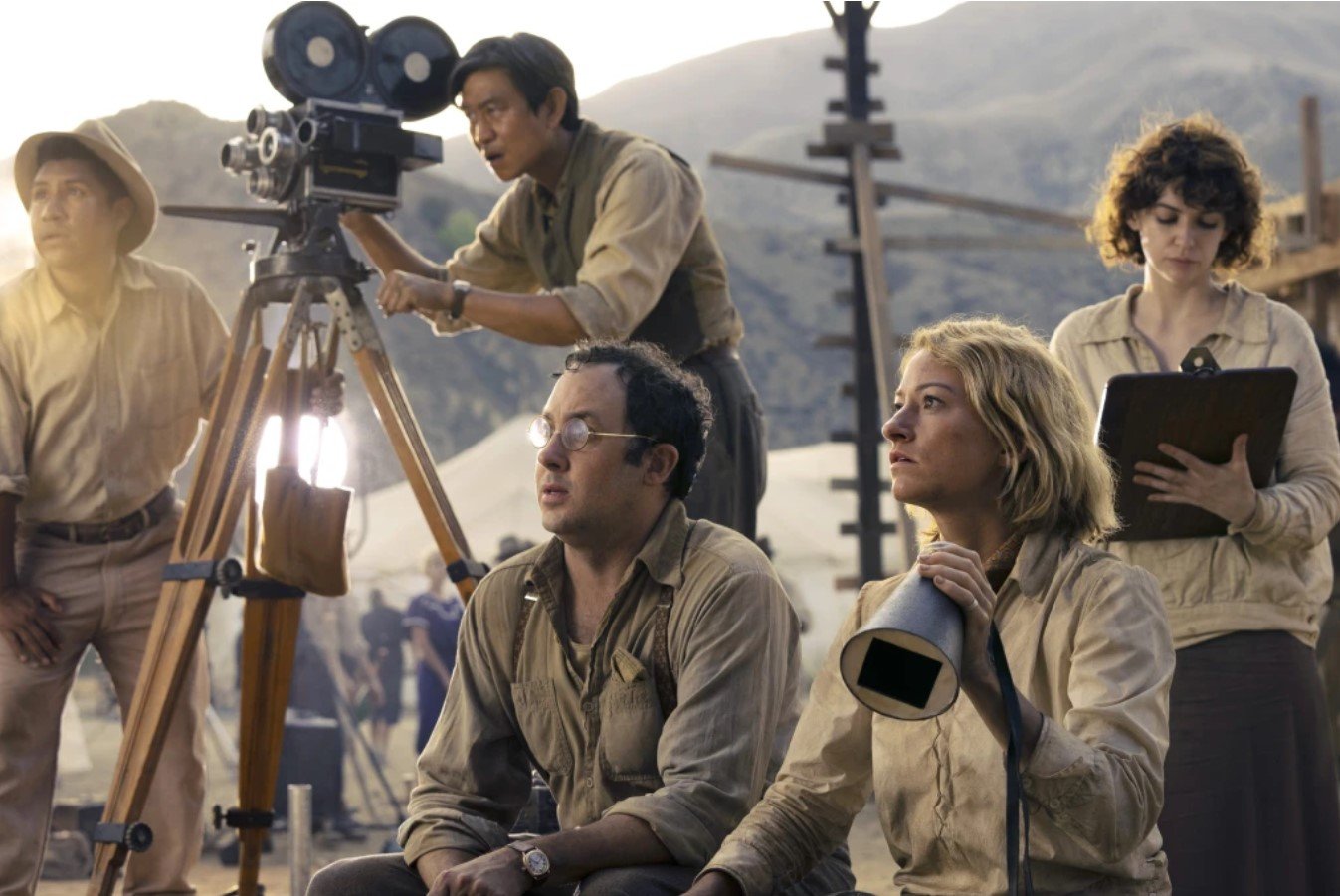
After that, you basically have the pool scene from Boogie Nights, which is a movie set out in the middle of the California desert where several films are being shot at the same time to take advantage of the always present sun. This roundabout, non stop camera opening followed by the nuts and bolts of what it takes to actually film a movie was shockingly good. There is a female director, whom to the best of my research on IMDB seems to be Ruth Adler, which seems to be a fictional construction to convey the fact that early Hollywood employed tons of women in 'above the line' roles like directing, screenwriting, producing, etc. Olivia Hamilton plays this role, and if I have Wikipedia right, she is the current wife of Damien Chazelle. I only convey this because I was trying to find out if Ruth Adler was a real person because the portrayal was so profound. This character pops up again in another sequence I'll get to. To round out this sequence and the absolute chaos these people must have operated in, you have an ad hoc factory churning our scenes by numbers with no studios to speak of because they are simply not needed. In the midst of this is a menagerie of interesting characters including a Chinese director of photography whom I can only assume is the grand master James Wong Howe, who if you looked at his IMDB page, would floor you as the Vilmos of the Golden Age. This type of attention to detail brings me to a point.

This is (obviously) a film about Hollywood, and like a lot of film geeks, I dig films about films. I LOVE F for FAKE to the point that... I really do think it's better than Kane. I love 8 1/2. I love LaLa Land. These introspective films about the business and how it's great and horrible are insanely interesting. There are some that see them as non-productive becaus the majority of the audience has no relationship with Hollywood other than going to the movie theatre and why would they be interested in a single town on the edge of the earth that lives in this out of reach and decadent fashion. I just don't understand this point of view. Why go to the movies at all? Most films are about people and subjects that are unknown. It is the exploration of those stories that create a drive for audience. Why pick up a book? Etc. If in fact people's relationship with the movie theatre should limit their interest in the film industry, then I can't wait to see a riveting docudrama about the success and trials of the distribution industry. Let me check. Oh, there isn't one.

The most impressive section of the film is the deftly written, better executed, brilliantly edited transition to sound in which Margo Robbie's character Nellie LeRoy must perform her first sound scene under Olivia Hamilton's direction. This scene was fucking gold. It had everything. Pacing, ego, attitude, on set pushers, film closets, red lights and not just a little antisemitism. Every actor in this scene, even the ones you come to hate, are doing something special. And when it concludes you realize that this is just as special as the oepning 40 minutes. This is what Chazelle does. he gets a group of actors, and in the opening sequence you're talking a hundred or so actors, to trust each other to the point where they move as one in a tightly co-ordinated group, to ignore everything else around them, even nudity, to perform a long, sweeping, crane or dolly shot and get the one take needed to convey the atmosphere or given objective. The Sound scene is just a microcosm of that opening shot, different in objective but no different in execution. Like the opening scene had reminiscent themes of the Fatty Arbuckle scandal, this scene was reminiscent of hundreds of sets all over the San Fernando Valley, but of a certain scene in Singin' in the Rain in particular.

I have also read a lot of people dumping shit on the LeRoy character and about how she seemingly can't stay in her lane and do this or that or the other and how it would be SO EASY to just do what everyone expects her to do and she'd have everything blah blah blah and I think those people do not understand what it was like to work with Lindsay Lohan. Marilyn Monroe, as evidenced by everyone who worked with her, was an astounding actor... when she chose to be. If she wasn't 'there' at that particular moment, well, then you weren't shooting. So what the fuck is Billy Wilder supposed to do with a hundred people on set that he has to pay and feed and put up in hotels etc.? Wait for her to get into the mood to do her job? Of course, you fire people like that. Lohan was the same, with the same addiction issue and the same attitude towards her art. Wrap that into a bad family, a reality show, legal proceedings and a few stints in rehab... yeah. That happens. That totally happens in Hollywood. A LOT. So no, the character never seemed unreal or unapproachable to me. She never pissed me off or made me angry. It made total sense.

I recommend anyone interested in this subject to read Scott Eyman's unparalleled masterpiece "The Speed of Sound" which chronicled the years 1927-1932 and the revolution that happened in Hollywood. Sound destroyed as many lives as it made. Lives like Jack Conrad, Nellie LeRoy, and hundreds of other people who thought they had found the life they belonged in. But like everything that seems too good to be true, this wound up being the same. Eyeman documents the impact of the change on the industry as a whole. How the independents were swallowed up and how from the hip shooters like D. W. Griffith were replaced by cold, ruthless professionals like Irving Thalberg. Like everything it could have gone better but these people were dealing with something that had never BEEN before. All their passions and prejudices were a part of the rise, the transformation, and the success of the Golden Age.

The second half of the film slows way, way down and though I was willing to go quite far, I wasn't willing to go three levels down in an abandoned sewer tunnel with Toby Maguire (obviously miscast) and to casually toss aside characters that we had grown accustomed to. The person I empathized the most with was Jack Conrad. Having two suicides in the film was a mistake. Conrad could have lived the rest of his life like Cary Grant. The script chose to go the other way and it was unnecessary for it to be that dark. Diego Calva has a great performance as Manny Torres, and this character's backstory is important. When people challenge me, and they will, that a story like this is impossible, I will point out that Raoul Walsh was an electrician fixing lights on a camera set in the 1890's and he died with more than two Oscars on his mantle in the 1960's. Most film directors and producers and even screenwriters were not professionals in the business because there was no business. By the time Babylon takes place, the film industry in California is only fifteen years old. All kinds of people were wrapped up in what was a new industry that made no sense to anyone. For a Spanish speaking truck driver to suddenly make a living producing and promoting 'race' films to blacks and latinos... yeah. That's possible. Because it happened. Early Hollywood made films marketed to Chinese immigrants. They wanted everyone's money - even people they hated. Though it seems fitting that Nellie LeRoy just wanders off in the dark, just showing an article of her untimely demise (like a hundred other starlets for sure) seemed to me to be a cop out because you'd rather show some built dude eat rats. That doesn't make a lot of sense to me. Dante's Inferno should have never left the page, and the entire mob connection could have been more... real. There was a real mob with real threats to Hollywood types and that should have been more realistically conveyed as the threat instead of alligators, people with deformities, and dwarfs. Horrible descent of ideas.

The ending montage is basically a huge failure due to someone's inability to accurately convey what was really important in cinema from 1922 to 2022. There were shockingly good ideas. Tron's light cycles, Gene Kelly, the satellite from 2001. All of these were great ideas, but were absolutely poorly executed. This was not a sensitive assignment. In fact, I'm sure if you thought hard enough, you could probably find a promotional film from the AFI or BFI or one of the studios that did the exact same thing and pulled it off. This film was made by Paramount, and it did not even include a clip of The Godfather, which was their most profitably film in their history. They also had a clip of Avatar, which people did bash, but I will not. Four billion people have seen Avatar. If you hate it, that's your problem.

In the end, Manny doesn't leave the theatre to go walk in the sun. He stays in the theatre and cries. Well, sorry. I disagree with this. But there's a lot I don't like. Again, it's not where they end up necessarily. It would have been moor apropos if Jack Conrad died in a car crash for instance. But the journey to take everyone to the cliff was not exciting, enjoyable or (and here is the key point) re-watchable... at all. And that for me is the kicker. Set your iphone for 90 minutes, then flee. Or in this case.. Flea.

Dressed to Kill (1980)

Oh Doctor, I'm so unhappy. I'm a woman trapped inside a man's body - and you're not helping me to get out!

Umpteenth Viewing. Criterion DVD. I must have seen this film in a hundred times in a hundred parts. It hit cable in late '81 if I remember correctly and I was fucking terrified of watching it for two long. This was crossed with the overwhelming feeling when I wasn't even an adolescent yet of seeing something I wasn't supposed to be seeing, which wasn't Angie Dickenson full nude in the shower in the beginning, or Nancy Allen full nude in the shower at the end, but rather Nancy Allen in black lingerie in stockings in Michael Caine's office. This... was to me at six or seven, full blown pornography and I remember it as such. The fact that it was crossed with such brutal and bloody murder was so over the top for me that it greatly affected my thinking of horror as a genre and specifically DePalma as a filmmaker for decades. I remember reading a book called Lustmord that called out Dressed to Kill and DePalma's not-too-well-thought-out responses to his slasher films. I was part of that crowd. "Yeah, fuck that guy. What a pig!" and the like chorus. So I reluctantly bought this on the last Criterion 50% flash sale and watched it last night having not seen it probably since 83 or 84 at the latest. I was amazed at what I saw and didn't see that I thought I remembered and after watching all the bonuses and reading the trivia and the Wikipedia page, I think I'm going to do a u-turn on this while keeping some reservations about the film.

That Dressed to Kill is a horror classic that calls back to Hitchcock in general and Psycho in particular there is no debate. The idea that it is pornographic is ludicrous, and despite the reputation there is only one murder in this film, the one on the elevator. The other two are fantasies and nightmares. I also learned that the opening, rather lurid shot of Angie Dickenson's character in the shower (actually of a stand-in) was not in the original release of the film. Neither was the up close slitting of Allen's character's throat or her vulgar description of what was in Michael Caine's character's pants. All that was cut, totaling 30 seconds, and I have to say, leaving that out it might make the remaining film scary for a six year old but what the fuck are the adults so upset about?

Given my younger screening of it and my hatred of DePalma's later works, I was actually unprepared for how engrossed I was in Angie Dickenson's performance - particularly the museum setpiece. That was like Janet Leigh losing her shit in the car during the rainstorm. DePalma is actually a master at showing short clips of emotion edited together using the Kuleshov Effect that he doesn't need dialogue. Most of this film is silent, and what little dialogue there is doesn't mean much. In fact, some of the contemporary reviews skewer the dialogue I think because they place too much emphasis on it.

As for the piggish scenes, yes there is a close up of a vagina. If you don't like that, then I don't know what to say. If you think that's more horrible than a woman getting slashed, then I think you're fucked in the head. At no time during the film does DePalma insinuate that women should be murdered because they are women. In fact, he goes through great lengths to humanize the victims so you can think even worse of the antagonist, which brings me to the last discussion point.

To say that I was confused as a six year old to see Michael Caine dress up like a blonde woman and cut people up might be an understatement. Cross this with Nancy Allen in stockings during my proto-jerking-off period and I'm surprised I'm not in therapy. Caine's character as trans I can see as problematic at the time as well as now - the characterization that trans people have some innate evil in them that makes them commit crimes could be traced to this film and possibly others... if you choose to read the film this way and I understand if you do. I was actually surprised to see Caine watching a film whilst doing 'research' on a trans woman discussing her previous life as a man and how absolutely normal the interview was. The interviewer was none other than the amazing shitbag Phil Donohue who actually took sympathy with the trans person and admitted he was trying to avoid bias as to 'normal' or conventional questions during the discussion. This is thirty seconds of the film, but if you're going to show a real trans person in a film like this, why not show one that is not a threat and DePalma chooses to do this. He is differentiating and in a genre picture like this it goes without saying he doesn't have to. I don't blame the audience in 1980 for not living in 2020; I'm sure a lot of people left the theatre disgusted with trans people. However, given the film evidence, I fail to see that as DePalma's point. Dressed to Kill is instead a film of ideas strung together (a dissatisfied housewife, a trans killer, the hooker witness, and the fears and fantasies of all of them). If the plot seems to be sacrificed in favor of style... well... all I can say is... well done.

Blonde (2022)

Marilyn doesn't exist. When I come out of my dressing room, I'm Norma Jeane. I'm still her when the camera is rolling. Marilyn Monroe only exists on the screen.

I've been thinking very hard to write a review for a film that has been so controversial for what it contains, versus a film that came out five days before this, Don't Worry Darling, which seems to be controversial for what it does not contain, but rather how it is made. As I sometimes do before I write reviews, I check a few reviews on Letterbxd to see what other people have written to gain some perspective. On this exercise, I found a review by Brian Scirio that was highly inflected, and I simply do not think that I can repeat or regurgitate everything that he wrote. Please read it here.

See what I mean? A near flawless review. I don't know that I would change anything, but I have thought about a few additives addressing some things that he alluded to which some people would probably want my take on. 

The first is the absolutely beautiful cinematography. It seems like the goal was to make the film as beautiful as Monroe herself and I think it almost succeeds. Since this film is in essence a huge dream, the camera floats in and out of time, space, bodies, and memories without making you nauseous. When I think of this perspective / technical use versus what a lot of filmmakers would do now, which is to do a hand held documentary shaky-cam exercise which is overused and rote, I would much rather prefer the former.  My only criticism is the constant move from black and white to color. I certainly enjoy both, but I thought there was a theme, kind of like (coincidentally) JFK. I don’t think there is one, or I wasn’t smart enough to figure out. Maybe it was simply an aesthetic choice at the time.

As for the dream state itself, it seems fitting and proper for the way in which Dominik is choosing to tell the story. When I was a kid, I remember reading a thousand page novel on Cleopatra which was completely fiction, and recounted all of her 'slutting around' and the misogyny she faced as the only ruler of any kingdom in the ancient world of her day, the first and last in centuries. So to say the author had no right to create an artistic expression of Cleopatra's existence is of course ludicrous. Likewise, it is ridiculous to describe the same effort with Ms. Monroe. The only thing that has changed is the story telling technique, and I am sure more people will see this than read the  Margaret George book. In this vein, we may disagree with it, we may find it distasteful, we may shake our heads at what we interpret to be exploitation. But for the audience to call it 'wrong' is simply not true. 

The open misogyny that Ms. Monroe faced (as well as other contemporary stars such as Jayne Mansfield, Lauren Bacall, or Audrey Hepburn for effectively looking like she was permanently fourteen) was disgusting then, and it is disgusting now. The difference between the other two or three films I have seen on Monroe did not address this. To see it openly confronted on film is something that I have rarely seen in reviews of the film. In one scene, men's faces are contorted as they shout and scream at her. This mimics how terrifying it must have been to be the so obvious object of so many men's desire. And I don't mean many men. I mean, ALL MEN. Monroe had such a hold on men's adam's apple, even priests were jerking off in movie theatres. That level of open sexual desire was not seen since the days of Mae West, and that was never on Monroe's level. It would also never be repeated with any other starlet. This misogyny is hard to watch, and that fact that it seems to have not breached the reviews makes me think male critics would rather not discuss it. 

Instead, what we find is a rather curious mix of racism and sexism regarding Ana de Armas' performance. While I did find one scene in which her accent was slightly noticeable through the entire scene, and there were some vowel pronunciations that must have been hard from an ESL speaker in later scenes, the fact is this performance is gold, and as the film moved foreword you saw Armas disappear into the role. The only film historical parallel I can compare it to is last year's film Spencer, in which Kristin Stewart was nominated for playing Princess Diana. If you read my review of that film, you will find that although I was blown away by her performance in the first half of the film, the second half seemed to be going down the road of sheer parody, and the director was unable to reign this in. This does not happen in Blonde. Armas gets better, and her direction gets better, not worse. 

At last comment, we come to the highly controversial NC17 rating, which I found confusing at the conclusion of the film. The nudity, violence, and gore did not necessitate this rating. There is only one full frontal shot, and it is not of Ms. Armas, and it is not in the foreground. In fact, I am forced to believe the only reason why this rating exists is because of what must be the now infamous blowjob scene in which Monroe services President Kennedy. This scene did in fact cause a marital argument in my house, and I still fail to see how this warranted an NC17. Ms. Monroe was not unknown to oral sex. In fact, a stag film she starred in was discovered in the early 2000's containing her performing fellatio. One of Joe DiMaggio's friends, in an act of loyalty to the late athlete, purchased the film and as far as we know, destroyed it. This is also not the only time in the history of cinema we have seen fellatio on film. In fact, fellatio has been simulated on screen in several films with an R rating. In fact, Jennifer Connelly not only simulated fellatio in Shelter, a film NOT branded with an NC17, but that film also simulated ejaculate on her face. This same fine, academy award winning actress, simulated using a 'double-dildo' with another actress on stage in a strip club with a hundred men in suits throwing hundred dollar bills at them in Requiem for a Dream. Why those films would get an R but this film gets an NC17 shows exactly how broken the ratings system is. I have always been of the opinion, since Henry and June, that half of all R films need to be rated NC17. The rating would then not be a brand of death, and more filmmakers would take more risks with the material knowing their material would not be cut out for the sake of making a softer rating. 

The true controversy people are sometimes admitting to, is the fact the simulation is performed on President Kennedy. For thirty years, Kennedy's image as the savior of liberal democracy for three years as the leader of the free world was not in question. After his father died and his youngest brother failed to replace him as a moral leader, we've come to find out so much about his personal life as to question what it was we liked about his politics. He deflowed virgins without their expressed permission, treated all women (included his devoted wife) like complete shit, had affairs in the White House (in the pool, in the executive residence, in hotels), used Frank Sinatra's mob connections to traffic women to him for sex, and all the while spent most of his private time as an a-plus jack ass motherfucker. If any of us knew anyone like that in our personal lives, we would form very uncontroversial opinions about him. But because Kennedy could smile, talk about Civil Rights, and for thirteen days in October 1962 saved the world from nuclear holocaust... well, then, we'll take him. 

What Ms. Armas simulated in that one scene is no different than the greatest majority of women (or gay men) have done in their lives. To single her out for that is sexist and outrageous. The idea that anyone would defend John Kennedy's behavior as a womanizing misogynist (who's pick-up line was reportedly "wanna fuck?") is the true controversy. There is no penis in the scene. There is no ejaculate in the scene. What there is in the scene, is the realization that John Kennedy was a fucking asshole, and that's what people are upset about. Well, so was Thomas Jefferson. Get over it. And as far as exploiting Ms. Monroe... well that is possible. But I will NEVER think worse of her for doing what everyone else does and enjoys. But I WILL forever think worse of John Kennedy for being the type of man who thinks he deserves that type of servicing simply because he is white, rich, and powerful. 

Blonde is a brave attempt, and it deserves to be screened at a lower rating as long as the MPAA is going to discriminate against sex (blowing a head off and showing brains on the floor, totally okay - just see the remake of Death Wish). 

And finally, as a close, I recommend everyone who is interested listen to Karina Longworth's podcast 'You Must Remember This'  - she did an entire season on Monroe's career and personal life. It was deeply unsettling. She did sleep with practically every photographer and producer in town. She was also subject to mental instability most likely due to childhood trauma and the way everyone looked at and treated her. She was a very complex person, and Longworth tries very hard to wade through those complexities with balance. I don't think there is balance in Blonde. But I also do not think it is a hit job. It is a point of view. Nothing more. Nothing less. 

La La Land (2016)

Sidney Bechet shot somebody because they told him he played a wrong note.

I’m not sure how far I should take this so I’m starting this out on a google doc JUST IN CASE. This is hot off the moment of D to the K to the Motherfucking A to the Third Power texting me late at night after this screening that he had read my Letterbxd review on Destry Rides again and described it as “UNHINGED.” Well, maybe that wasn’t in capital letters. Maybe that was me transposing White House Assistant to the Chief of Staff Cassidy Huchinson’s famous text to a friend in describing what was going on in the West Wing on December 18th, 2020 in which three people who didn’t work for President Trump or work for the government told him to contest the election in some way on the same day Congress was set to certify the electoral vote: January 6th. The protest from a room full of trained and experienced Republican lawyers and politicians ot the President was of one mind and voice: no. The push and pull of that room was what was “UNHINGED” and looking back on my review of Destry Rides Again, well, I think I agree with Dave. It was UNHINGED. Maybe this is one of those reviews. LaLa Land seems like a strange one to dedicate that type of moniker. But you know what, I’m going to give it a fucking try.

Dave and I got into it recently after the Joan Jett/ Poison / Motley Crue/ Def Leppard concert. We left the Juicebox and headed to the IHOP (the full journey is another blog, I won’t repeat it here) and as we waxed intellectual on the meaning of only five thousand people showing up to watch the Queen of Rock and Roll, Joan Fucking Jett, rule for forty five straight minutes, only to have a stadium full of people act like Every Rose Has Its Thorn has more meaning than Bad Reputation, we veered as we always do to film, to musicals, and that’s when I let it drop that it was probably my least favorite genre and I only liked a handful of musicals. Actually, only three. 

“Which ones?” Dave asked.

“Uhhhh, Seventeen Seventy-Six…:”

“Whaaaat?”

“...And Willy Wonka and the Chocolate Factory.”

“Dude, you’re twisted.”

“Oh. And Blues Brothers.”

“Still…twisted. Maybe a little less, but nevertheless.”

I spiked my coke at the Juicebox with vodka I brought in a plastic flask, and hit my coffee with it as I defended my actions. I repeated this conversation to my son the next day who immediately gave me his copy of LaLa Land on DVD. He found it at Half Price Books in the Montrose. Three dollars. I raised this kid. If he’s this smart, I should watch this film. It sat on my desk for weeks. Life went on, more indictments came, more subpoenas. Then a full on house raid by the FBI, just like in the movies. I cried. I laughed. I wished. I dreamed. Just like the movies. And tonight, I sat down and watched LaLa Land and I fucking loved it. 

Dave and I lamented at a time (I am not sure if it made it onto a podcast) about how if you took a poll of the most ‘popular movies’ of the 1950’s, whatever ‘popular’ means, you would see films like The Ten Commandments. Ben-Hur. The Bridge on the River Kwai. And if you looked up the highest grossing films, you’d see the same. On the Waterfront. Marty. The Apartment. Etc. and if you took a gander on the Academy’s website (or wikipedia, which is probably just as accurate) you’d also find the same films were nominated time after time, year after year. Effectively, there was no difference. The popular films made the most money and were the most expensive art. They were nominated because they were the best. That way of doing business, of marketing art, of making art, changed in the late 1960s when Wall Street bought the Studios from the families that started them and gave control directly to the artists who made Bonnie and Clyde, The Godfather, Star Wars, and Jaws. And in this fucked up world, One Flew Over the Cuckoo’s Next wins best picture, not Star Wars. Which one do you think has the higher name recognition? Which one do you think has the higher gross? Which one do you think is better art (I know this is subjective, etc. come on!). When the 80’s came this rarely aligned. Raiders of the Lost Ark lost ot a film no one remembers. Literally, I don’t remember it. Raiders wasn’t even nominated for best picture. Neither was Back to the Future. Do you know what won best picture in 1994? I’ll give you a guess. It wasn’t Pulp Fiction. 

The bent from popular films making huge money and earning huge awards slowly went down the drain until the Academy literally chose a film about Shakespeare to be best picture over Saving Private Ryan, a film that irrevocably changed action movies forever. Wes Anderson now has a better chance at winning an oscar than Steven Spielberg. And although I love Wes Anderson, I would never suggest he was anywhere close to Spielberg, and neither would he. The last two years of Academy winners has been severely skewed by the pandemic, so drawing conclusions is unfair, but if we take 2019, we can clearly see a divide. The top ten earners in that year were:

Avengers: Endgame

The Lion King

Toy Story 4

Frozen II

Captain Marvel

Star Wars: The Rise of Skywalker

Spider Man: Far From Home

Aladdin

Joker

It: Chapter Two

And for the films nominated for Best Picture, we have the enormously high regarded films that follow:

Parasite

Ford v. Ferrari

The Irishman

Jojo Rabbit

Joker

Little Women

Marriage Story

1917

Once Upon a Time In Hollywood

The winner for best actress, Renee Zellweger, starred in the biopic “Judy,” a film that arguably “nobody” saw, while conversely, Joaquin Phoenix won for Joker, a film that based on the evidence, almost everybody (who watches movies) saw. I could sit here and argue valid points or probably waste my breath on other points about how Avengers: Endgame is arguably a better film than Ford v Ferrari, that It: Chapter Two is arguably better that; Little Women or Marriage Story, but we are getting not into semantics, but what I said before about art being in the eye of the beholder. Despite those claims, I think we all know what we are talking about here, and it’s the academy deciding only one film that made it into the highest grossing films of the year deserved to be nominated for best picture. In fact there was only one other in the top 20 (Once Upon a Time in Hollywood) and still one other in the top 30 (Ford v. Ferrari). The next one, Little Women, is ranked as 72. So I do not think that I need to convince anyone who cares to read this rambling diatribe there is a divide between what the audience thinks is art and what the Academy does. And this goes right to the issue of the popular music category that was so briefly lived in 2018 when it was so glaringly obvious that Black Panther had an impact on the viewing public the voting academy could not understand and the organization of the academy could not plan for: the need to recognize this growing divide. The answer seemed so amazing and simple, I immediately was for it: The Grand Prix. 

In Cannes, as well as in other film festivals, the Best Picture Category is divided into two voting structures. The first one is the Palm d’Or, which everyone says is the ‘best picture’ and the second one, the Grand Prix is for what people generally consider to be the best ‘art’ or ‘art-like’ film. In 2019, the Palm d’Or went to Parasite, which shocked no one. It was a shock in America, though where everyone thought the film that should have won was the dark comic book satire Joker. So the upset in America actually lined up with France. The Grand Prix went to Atlantic, an obscure film about the migration crises. The Grand Prix is thus. In that circumstance we could all acknowledge both Joker AND Parasite. Fewer people get pissed off, and more people decide to watch the Oscars the following year. 2011 is another classic case. Terence Malick’s The Tree of Life won the Palm d’Or in 2011 and two movies you never heard of won the Prix. Meanwhile, the Tree of Life was a serious contender for Best Picture in 2011’s Oscar race (It was beat out by The Artist, and even more obscure film which only proves my point). Meanwhile, the top ten grossing films that year was not an impressive year to be sure, but it did rank Harry Potter and the Deathly Hallows Part 2, a not unworthy choice for a split system.  Other choices could have included Super 8 and Mission Impossible: Ghost Protocol. This does seem like I am begging to include blockbuster films in the races to determine the year’s best films, and you would be right. Would I agree that Black Panther was the best film of 2018? No. But clearly there was enough groundswell behind that film in the academy membership to make that impossibiliity happen, but Academy rules simply prevent that from happening.

And here i am sorry to regurgitate something you probably already know which is the Academy is subdivided into voting blocks that do not get to vote outside their category. For the technical fields such as sound design or even cinematography, this makes sense. No one in costume design is going to want anyone in ADR deciding who made a better costume. Film Editors vote for film editing, and so on. This makes complete sense. Unfortunately that also means directors only vote for directing and producers only vote for best picture. If the Academy is going to continue to limit the awards to what is in some cases, only a few hundred people, then they need to find a way to open up the mass of voting members to choose a popular category. Thus, the Grand Prix. 

Don’t get me wrong, Michael Bay sucks, and James Cameron’s Ouvre after True Lies remains to be remarkably mediocre in terms of narrative storytelling, but I will say one thing about even the huge films that I hate: the production quality cannot be touched, even if the story sucks. With the Grand Prix it is entirely possible to recognize the team that made such mammoth projects like Logan or Thor: Ragnarok, which are legitimately important and interesting films that tell a compelling story about human nature but will never be victimized by being included in the Best Picture category. In this case, Mad Max Fury Road, which was famously nominated in 2015 but which had no real way of winning despite its very art house themes and tropes. 

This is becoming ever more important in an age in which the huge blockbuster films are getting less and less respect for being ‘sellouts’ or being ‘popular,’ Scorsese and Coppola are in the vanguard of criticism, but behind them are scores of elitist film makers (and critics) who continue on an anti-cape crusade to distinguish what they do (and what wins) from what other people do, which is namely to make money. This is at the heart of the LaLa Land experience. 

And let’s face it, four pages into a review on LaLa Land, let’s deep dive into this amazing and complicated film that serves as this kind of parallel to the idea that there are art films and there are commercial films and there is not much in between. If that is the case, then I don’t know what LaLa Land is, because I see elements of both. 

LaLa land is special because it straddles this idea that art films and commercial films are separate. Consider the opening, in which it seems a hundred people are in at least a hundred cars stuck in traffic on a flyover headed to downtown Los Angeles on a somewhat clear day doing a song and dance routine of Another Day of Sun. Effectively, there is no difference between this and West Side Story or My Fair Lady or (my personal favorite opening number) Sit Down John from 1776. The choreography, a complicated mix of in between and on top of cars exhibits a thoroughly American experience, complete with jaw dropping camera boom movement which could only have been accomplished with what appears to me to be seamless and hard to catch computer generated images in the background. Having thoroughly pushed you into old Hollywood, the film then entrances you with numbers like A Lovely Night which displays the two leads as akin to Ginger Rogers and Fred Astaire in The Gay Divorcee or Shall We Dance, complete with  an unbroken steady cam that showcases the actors’ unbelievable talent for rote memorization and execution of what seems to my amateurish eyes to be fairly complex and for me unachievable choreography. 

But alas, there are two very important scenes which betray the Old Hollywood and firmly place the film as one musical made after 1970: The dinner break up scene and the City of Stars finale, which is the nail in the coffin so to speak. The evolution of the dinner breakup condenses everything about complex human emotions regarding work and personal life between two people so well that it honest to goodness made me think about Orson Welle’s famous breakfast table montage from Citizen Kane. In five minutes, their relationship was seemingly over, and the smoking ruin of what used to be their love was the burnt roast in the oven. This scene is so good it defies logic, and I’m not sure just any combination of modern actors in this age group could have pulled this off. The ramp up of emotions every thirty seconds was so fascinating, I watched it twice. Not the finale. Not the dream sequence. I watched the argument twice. It said so many things about human nature, and how we humans react in these circumstances when we are so involved with our partner, seemingly inside a bubble of what we thought was trust. It was fascinating. I wrote them both off as pretty people years ago. I was so wrong about both of them. They are fine actors, through and through, the best of their generation. 

The fight centered around the ticking time bomb which was Seb’s (Ryan Gosling) stuck up, arrogant, bullshit view about being a purist jazz musician. The instant he appeared on screen running though jazz tunes on his radio because he couldn’t stand to listen to anything other than what he considered to be perfect music, I had this cocksucker nailed. I know you. The one who thinks Metallica betrayed their fanbase when they put out the Black Album. The ones who shit a brick when Eric Clapton raked in money for After Midnight. You probably are the same people who never heard of Tegan and Sarah until they went Gold in Canada for the first time after ten years and five albums and called them sell outs. Being a musician is like any other job in the world. You get paid for someone to do a fucking job. Do your fucking job. It doesn’t matter who pays you or what you think of them. And as an artist, if they don’t like you, a consumer can just choose not to buy your art. That’s how this shit works. So after Mia so hilariously emoted A Flock of Seagulls’ I Ran (So Far Away) at the pool party (I was in STITCHES) of course Seb said a bullshit line like “I can’t believe you would request such a song from a serious musician.” “Serious musician?” What a fucking asshole to say something like that to Mike Score. What are the the chances of Sebastian whatisname being known other than “that guy who plays keys for the dude who looks EXACTLY like John Legend?” Vs. Flock of Seagulls? You’re nothing next to Mike Score, douchebag. You should be lucky to write a song that has been handed down through history with such pop culture impact. At the time of writing of this blog, I’ve checked on Wikipedia and I still don’t see Sebastian charting… or recording… anything. Maybe he’s running a jazz bar in a fucking basement in west L.A. somewhere.You know, the kind with cheap neon signs? If I were as bad at my job as Seb was at his, I’d probably be in the same place. I have a huge issue with the idea of ‘selling out’ when it means it raises your standard of living. 

At the same time, Mia has a legitimate grievance when she finds out that the man she wants to spend the rest of her life with is going to be gone 200 nights a year. RUSH was on the road for seven straight years, pausing only to record records, usually within a few days. Look at Journey’s tour record. It will shock you.So for her to bring that up, totally on point. For her to pair that with her criticism of him not following his dream - well that was going for the testicles. He had ‘sold out’ and then she called him out for ‘selling out,’ which is total cock. Maybe I should go back to delivering pizzas for pennies in the poorest suburbs of Houston. Or maybe I should have stayed an underpaid school teacher in the slums? As it happens I liked not living slightly above squallor. So fuck that attitude. It was a total attack, and I don’t know what she was intending to gain from it, because it netted her nothing and lost her everything. And let me tell you something, I’ve been in those situations and I’ve had those conversations, and there is nothing to gain from them. There was no way for Seb to get out of that dinner unscathed. Whether she planned it or not, that topic was a trap, designed to destroy what they had, and as women are more experts in relationships, I quite frankly expected more from her.  But then you wouldn’t have a movie to watch or this blog, right?

Mia’s experience as an actor is a debilitating, depressing experience for hundreds of thousands of women trying to make their way as an artist in a very uncaring, numbers driven, and sometimes hostile industry which is orientated to using them until the age of twenty-six before breaking and discarding them for the next hot best thing. Why someone would want to subject themselves to such crushing criticism and unfairness must be the most soul crushing experience. Emma’ Stone’s performance as Mia in the casting office near the beginning of the film shows what a talent she, or Miss Stone, is. The idea of someone looking at their phone instead of someone they deliberately contacted for input is insulting and dispiriting. I understand that casting agents see hundreds of actors, sometimes in a day and giving 100% attention is difficult. But all of those called actors deserve respect and attention. Though the chance of becoming a professional film actor is quite remote, it actually has increased the past few years with the surge of competing streaming platforms. This is the best chance to be an actor in Hollywood since the thirties, when it was about 1 in 65. By the 90’s it was in the thousands and it has dropped a bit since then but you are still looking at an uphill battle unless you have a noteworthy item on your resume like a local television appearance or you just happened to fuck Harvey Weinstien. Those options being eliminated though, Mia had to compete on talent alone when no one would pay any attention to her talent, which was considerable, and watching her fail was heartbreaking.  

When you don’t succeed at anything huge, it is really important that you succeed at anything small, and for Mia it was this one person play she put on basically for her friends in which she described her life. As brilliant as it must have been, we did not see it (but some studio executive obviously did) but as it happened the only person who actually had to be there was Seb, who flubbed up his schedule and missed it. My wife launched all over this obvious loophole. One: just tell her you can’t make it beforehand, via cell phones, Two, tell her after the fact what happened. Three: ritual suicide. What I tried to explain to my wife was this was a no-go in any confrontation. There was no way Seb could talk his way out of this one. First, he should have been there. He either should have kept a better schedule on his iphone (artists are infamously meticulous about their schedules) or he should have just coughed up to John legend: “hey, can we do my shit first…I have to be there for Mia.” Or in the worst case scenario, he could have said “Shit, I’m sorry. I can’t.” and just left. But then there would be a happy ending and we just can’t have that in this modern musical (Which I willo get to by the end, I promise, if I actually do get to finish this fucking article). As my wife pondered these many things, I did in fact lament the fact that the only use of a cell phone in this film was when it was used against the characters, never for them. But effectively, I told my wife, this was the Kobayashi Maru of this relationship. For Seb, it was a no-win scenario. Since he did not plan, and did not react, there was no getting out of it. NMy wife’s assertion that he should have just explained to her after the performance why he could not make it, is as improbable as any other scenario. There are some arguments, that you just cannot win, and it does not matter what evidence you have. Tony Soprano was caught with a strippers fingernail in his pocket that his wife found with his keys when she was doing the laundry. When she confronted him about cheating on her, which Tony was not doing (at the time) she brought up the fingernail. Tony, we all know, got the fingernail by cleaning up evidence from a stripper that one of his soldiers had killed in the Bada Bing. So he wasn’t about to tell his wife He wasn’t fucking a stripper, he was just burying them in the Jersey forests. Let’s get real here. There was no way to win that argument. I’m convinced this is why most women think that men are way more stupid than they actually are. Because men know better than to say “I didn’t make it to the game not because I had to just have one more beer but because Bill had his testical pierced by a stiletto from one of the strippers and we had to take him to the ER. That’s the type of shit I’m talking about. 

My wife likened LaLa Land to being 90% good, and I instantly saw her point. She wanted them to get back together at the end like all the old Hollywood musicals and because they didn’t, well, that’s it. She’s done with it. I, on the other hand, loved the ending, Because anyone who has those contradictions in themselves as these two do, is doomed to failure. They were never meant to be together. Now, she doesn’t have to marry and have a kid with some nameless dude who probably works ‘below the line’ as a grip or something on her first film like a lot of annulled marriages in Hollywood start (it would have been real funny or more appropriate if you recognized the actor. Like maybe Brad Pitt or Jake Gyllenhaal), but the fact that she was with someone who CLEARLY was not NEARLY as attractive as Ryan Gosling in terms of screen presence, well, that did not say a lot for her either.) Judging by her child's age and the time frame involved, this was one of those relationships - it’s not going to last. Despite the fact that if it were not for him, she wouyldn’t have her career and if it were not for the breakup, he wouldn’t either. Sometimes winning or losing everything you have is enough to make you sacrifice everything to get the one elusive element in your life. But if she was going to go live in Paris for a year and make buckets of money, and he was going to go 9on tour ofr almost a year, then what difference did it make. I’d fucking love it if my wife had a job that paid both of our bills in Paris for a year. I’d do nothing bur write stupid, long, uninteresting critiques like this all day, everyday. Fuck my tendonitis. That’s what French universal healthcare is for. So why he did not go with her is pretty stupid. 

The irony of the situation is of course that they both get what they want - just not each other. She becomes a well known movie star and he owns his own jazz nightclub. But they do not live happily ever after. And this irritates the hell out of my wife. Why, she asked, did Hollywood bother making a hollywood musical complete with jaw dropping song and dance numbers, with music that was actually listen-in-your-car-good, if they did not pair them together in the end? Where is the happy ending? Where did you go, Joe DiMaggio? And of course, the long winded hour and a half answer that I had to my wife over that was something to have recorded so I could make this piece of shit review even longer. Because effectively, it’s the audience’s fault. 

You heard me. You decided to stay home three nights a week in the ‘50’s when you bought a television set and when you got a color one ten years later,  you decided not to go four nights a week. By the late 1970’s, you went to the theater twice a month. This coincided with the studio heads retiring or dying, like Jack Warner and Louis B. Mayer. The response by the New York companies who owned the studios was to just sell them to junk bond holding companies. These assholes didn’t know art from a pothole in Fifth Avenue, so instead of trying to find talented producers like Robert Evans who obviously didn’t grow on trees, they just decided to give the money straight to the filmmakers themselves. This was the birth of American Zoetrope. Lucasfilm. Lion’s Gate. The result was a more realistic cinema, as these new filmmakers came to be after the fall of the Production Code. Criminals didn’t have to pay for their crimes (The Godfather). Sin could be rewarded (MASH). Endings could be ambiguous (Taxi Driver). Sex was and violence were more graphic (Last Tango in Paris, Taxi Driver). 

But while the auteurs possibly saved cinema as an art form, they did not do it any favors in the audience department. When cable TV came in the late seventies, and home rentals in the early 80’s, and with the advent of DVD in the 90’s, there was less and less reason to go to the theater decade by decade, and by the turn of the century it was at an all time (fully a century of all time) low. Streaming is largely thought to have been the nail in the coffin, but people needed to be held back from the cinema, and that wound up being the pandemic. Whether or not the theaters can survive without Hollywood superhero super budget films remains to be seen, but the trend is there. Popular films love happy endings…or do they (Infinity War, Endgame)? Happiness now comes with a price, and since the auteur era, that price has steadily risen. It might be that your hero dies (Tony Stark) or it might be the love of your life moves to Paris, doesn’t invite you, and marries some stud who has no business being with her just because he knows who to call for craft services. This is a long winded attempt to explain to you why Seb gets what he wants (his jazz bar) and Mia gets what she wants (a career in Hollywood that may or may not require her to bare her breasts that get captured on PornHub forever), and yet both of them are unhappy. 

My personal take after the credits it she is going to be torn, re-establish contact, and fuck him on the side until her husband / producer finds out. Then a nasty custody battle takes place, involving lots of thrown awards, beaches across the south pacific, and at least one 90-day stint into a drug rehab. In fact, there might be one overdose, three podcast interviews, and at least once episode in which that bitch Nancy Grace pontificates over ‘doucebag Seb’s’ real purpose in playing jazz and being with Mia. I mean, who does he think he is anyway? Then, after all that, at least two more kids, Mia and Seb separate after a HUGE argument on a learjet discussing the royalties of the winery they share together. After an uncomfortable weekend in Malibu, Mia decides to take the kids to New York, and Seb cries over an alcohol induced all-nighter at the club in which he drops dead. Credits. If this is too harsh for you, then he takes the kids to Maui and she overdoses from cocaine in New York. Credits. Now that is a REAL Hollywood ending. 

Mank (2020)

This is a business where the buyer gets nothing for his money but a memory. What he bought still belongs to the man who sold it. That's the real magic of the movies. And don't let anybody tell you different.

I don’t know how many times I started and stopped typing this article. It wasn’t so much where to start it, but whether I should do it at all. Since Citizen Kane rocked the cinematic and publishing world, people have attacked and defended, praised and assassinated, the name of “the Boy Genius” Orson Welles, over exactly how much involvement he had in the writing of what some people rightly debate as “the Greatest Movie Ever Made.”

Peter Bogdanovich, Welles’ scorned lover, spurned friend, whose split with Welles was only recently painfully acknowledged on the Netflix Welles documentary They’ll Love Me When I’m Dead, admitted what so many Welles fans already knew at the end of the commentary track on the Citizen Kane Blu Ray release in 2010: “There are better pictures than Citizen Kane,” he stated, “there are better Welles pictures.” and he’s right. As masterful as it is, and as often as I see it, I am more entranced by the shocking beauty of Othello, or the rapid tension thrill of The Stranger. The Chimes of Midnight, who Welles once said was the film he would want to submit in a bid to get into Heaven, is the most lyrical of his films. His best probably, and I’m being completely serious, is F for Fake, a film that in its totality looks at film and the absurdity of it at the same time. For a man who started so revolutionarily, it seemed like a good way to end his career - being that it was the last film he did before he died, and for forty years the last film any of us thought we would see of his...before The Other Side of the Wind

But despite what we know, and what we love, we admit that Kane is so good, so damned GOOD, that we get upset, some of us downright angry, when we hear bullshit like anything Pauline Kael has to say on the subject, or, closely following her in the past few years, David Fincher. The character assassination has been so amazingly brazen by Fincher and Welles’ detractors, that it seems absolutely downright idiotic to rehash all this in another article, from yet another fan, on yet another nameless website by some douche who hosts a film podcast. 

But I am confused. Utterly fucking confused… about the entire situation. I have no way to understand how Fincher, who is probably one of five of the greatest living auteurs working in cinema today, could possibly take Kael’s side against Welles and Andy Sarris - the very author of the auteur theory from which Fincher is so often praised. 

“In an interview with French Premiere, as caught by The Playlist, Fincher advanced the theories of Mank that the authorship of Orson Welles's 1941 masterpiece Citizen Kane was more collaborative than some people realize. "[A]t 25, you don’t know what you don’t know," he said of the theater and radio wunderkind who stormed Hollywood. He paraphrased Welles saying "it only takes an afternoon to learn everything there is to know about cinematography" then called b.s. on that, saying "this is the remark of someone who has been lucky to have Gregg Toland around him to prepare the next shot." 

This comes from Fincher’s interview published in Vanity Fair on the Mank press tour, and it’s fucking disgusting. First of all, we can blame Welles, for repeatedly telling this story for four decades. Welles had been working in the studio for almost a year, ditching two projects before centering on Kane with Herman Mankeweicz. Toland, known in the studio system as a master of his craft, came to Welles and offered his services. As he watched Welles work, Toland fixed what he thought needed fixing, but left the rest to see what would happen. “You don’t know what you don’t know,” as Fincher said in his interview. When Welles finally wised up to what was going on, Toland came clean and told Welles “there’s nothing I can’t teach you in four hours” regarding cinematography. This blithe statement did not mean the whole of cinematography as Welles accidentally portrayed it in interview after interview. Instead, what Toland meant was ‘any one thing.’ Focus Pulling? Four hours. F-Stops? Four hours. Etc. Considering what Welles was able to do with a plethora of lesser abled cinematographers after Toland, we should recognize that Welles learned well. Fincher, however, slams Welles as if he didn’t understand the entire concept of ‘any one thing’ about cinematography instead of the entire craft. Either Fincher is a fucking idiot (which I do not believe) or he is being disingenuous. My meaning is this: how is it that Fincher prepared for three years to shoot the definitive film about Mankiewicz and the entire controversy about who actually wrote Citizen Kane and not stumble across this simple fact which Welles aficionados had known and understood for decades? I think Fincher knew exactly what Welles was saying, and I think he either thought Welles was lying (it was not outside the realm of possibility for Welles to lie, he admitted lying to Bogdanovich) or he was telling the truth but, like Welles, didn’t so much care about the truth. 

The truth is, Citizen Kane IS a masterpiece. The truth is, whoever wrote it was a masterful storyteller. The truth is, Welles represented the Sarris auteur theory which Kael hated. The truth is, if you could take Kane away from Welles, you would take away the one unarguable film from his cannon that he had received an Academy Award for (with Mankiewicz). Fincher, in trying to call into question Welles’ screenwriting credit, is trying to do the exact same thing Kael was trying to do: assassinate Orson. As the story goes, Fincher gave his father Jack the essay Kael wrote for the thirtieth anniversary ‘Citizen Kane Book’ which included the award winning shooting script (the shooting script is the final ‘Fifth Draft’ which is compiled by what you actually see on screen, NOT what was written when the shooting started). Kael had paid a few hundred dollars to a researcher at UCLA and used his notes to make a startling assertion: that Welles didn’t write one word of the Kane script, and his credit was a fraud. 

Pauline Kael’s Wikipedia entry is hard to refute or better summarize. She wrote for the New Yorker 1968-1991, “known for her “witty, biting, highly opinionated and sharply focused” reviews, Kael’s opinions often ran contrary to those of her contemporaries. One of the most influential film critics of her era, she left a lasting impression of the art form. Roger Ebert argued in an obituary that Kael “had a more positive influence on the climate for film in America than any other single person over the last three decades.” Kael, he said, “had no theory, no rules, no guidelines, no objective standards. You couldn’t apply her ‘approach’ to a film. With her it was all personal.” In the documentary on Roger Ebert, “Life or Something Like It,” Ebert gushes over Kael and the imprint she had on his career and the career of thousands of professional critics and jacklegs on the internet like me. 

The only problem was, Kael was a fucking liar. Historian Robert Carringer has made a career explaining Kael’s unbelievable lack of standard research skills, using only what she purchased (and never cited) to explain her point. In fact, she never interviewed Welles, who shared the credit, was the producer, or John Houseman, who kept Mankiewicz sober in Victorville writing the script, or Welles’ secretary, who wrote an entirely different screenplay. She seems to be oblivious that there were four drafts (One all Mankiewicz, one all Welles, one hybrid, a second hybrid edited WAY down, and the final shooting script made after editing). Carringer identified five major scenes that Welles re-wrote during filming. All of this escaped Kael, because despite her films, she's just a critic and not a historian. She likes pissing on art, not finding out how the art came to be. Ebert was the opposite. 

In a famous reply, Bogdanovich published “The Kane Mutiny” in which he called out Kael’s B.S. It stunned those who read it. It even stunned Kael. In her biography, a very strange scene played out as Woody Allen brought her the article to read. She was flabbergasted at Bogdanovich’s research. His citations were unassailable. He also has hours of tape in which Orson called out “That was my idea,” or “that was pure Mank.” Kael admitted to Allen (who’s sheer presence was confusing, wasn’t HE an AUTEUR?), “I don’t know how to reply to this.” To which Allen replied, “don’t reply to it.” And she never did. Her lack of silence was worse than an open apology. Millions bought the book, read the essay. Who read Bogdanovich’s article? The first stone hurts the most. Whatever you think he might have deserved, Welles lived with the accusation the rest of his life. 

On the second supplemental disc of the Criterion Collection’s Blu Ray celebrating the 80th anniversary, Criterion included a twenty year old documentary using a collection of old interviews regarding the controversy (the film Mank is not referenced anywhere in this edition). Included is a 1990 interview with Kael herself, unfortunately visibility suffering from Parkinsons, and greatly walking back what she had accused Welles of doing.

“I didn’t want to set up a battery of anxiety about who contributed what to this scene or that. I mean I think that’s fruitless. Welles’ reputation as an artist certainly doesn’t depend on whether he wrote Citizen Kane, it depends on the majestic quality of his movies. I think that some of what he shot on Chimes of Midnight is greater than anything he did in Citizen Kane. I think that battlefield sequence ranks with the best work that has been done in the medium. And I think The Magnificent Ambersons has a depth beyond the spirited craziness we love in Citizen Kane. I think the man’s reputation is so secure that we shouldn’t worry about the trivia of whether someone thought of this or somebody else thought it up. Because you can never find out who contributed what on the set… The essay [Raising Kane] was the introduction to the publication of the script, so naturally I wanted to know who had written this script, because Citizen Kane is unlike everything else of Welles’s, he never made another political film, and going back over it, it became clear that Mankiewicz was the important force behind the writing of the script. And then I discovered what a character he was. A marvelous character, really. People really loved him, partly because he was an immensely naughty person, he was a bad boy like Welles, a gambler, a drinker, a man who blew his talent away, even though he wrote or had a share in writing a couple of hundred movies. I didn’t know at the time that he had a hand in writing the Wizard of Oz. It’s amazing how many movies he had an effect on. He produced  the Marx Brothers comedies and a lot of terrific films. And it was the fun of restoring this character into his proper place.” 

This is a remarkable mix of disingenuousness, flattery, very weird assessments, and a revealing moment in which she explains why she did what she did two decades before. For if Kael did not want to start “anxiety'' over who wrote Kane, she would not have written that Welles did “not write one word” of Kane in the first place. [As an aside, she uses the excuse that Mankiewicz was in Victorville the whole time, so Welles could not have possibly contributed to it, apparently forgetting the thirty year old technology of the telephone or the fifty year old automobile, much less that there is a picture of Welles and Mankiewicz working on the Kane script in Victorville). If she indeed thought it was ‘fruitless’ then why did she write such a contemptible sentence? She throws plaudits to him regarding Chimes and Ambersons as if that excuses her crime of libel. She is also ignoring Bogdanovich’s accusation of motive: “if ever anyone got into an argument about him people would respond, ‘well, he did direct Citizen Kane,” Bogdanovich told the BBC in 1983, “and she wanted to say ‘well, no, he didn’t even do that.’” Then Kael says something so misinformed as to shake the imagination - her contention that one ‘would never know’ who wrote what and who contributed to what “on a set.” Breaking this down is crucial. First, we do know who contributed to what as Carringer and other students of history have broken it down. Welles himself was never shy about saying what was Mankiewicz and what was not. Girl on the ferry? “Pure Mank.” Rosebud? Not only was it Mank, but Welles did himself an obvious disservice by saying how much he actually didn’t like the Rosebud motif. He wanted something stronger. The fact that Kael even uses the words “on the set,” tells us she is aware that Welles changed the script during production, which she never acknowledged in her essay calling him a liar. Then she says something very, very strange when she asserts the reason Kane is so strange is because Welles never made a political film. This…is astounding. Perhaps you could see Kane as a political film. He did run for governor and failed due to party politics. That is the only politics in the film, though. Kane’s description on IMDB reads “Following the death of publishing tycoon Charles Foster Kane, reporters scramble to uncover the meaning of his final utterance: 'Rosebud.'” Curious description for a political film. Kane is far more social and cultural. Kael also seemed to not recognize The Trial as a political film, though it very seriously discussed totalitarianism. Near the end of this ‘confession,’ she then starts praising Mankiewicz , whom she says was the true ‘force’ behind Kane and marvels at his credits. To anyone in the industry, nothing about Mankiewicz would have been a surprise, even 20 years after his death, but it was to her because she wasn’t, like Bogdanovich, in the industry or interested in academia. Her lack of knowledge about his impact is even more astounding when you consider she didn’t even do her own research, but paid someone else to do it. Maybe, if like Bogdanovich she had cared to ask those involved in the production what happened, she would not have made such an academic blunder. 

Fincher knows all of this. The man is not an idiot. So why is he attacking Welles and why is he attacking the auteur theory that he greatly benefits from? Not only that, he’s being ghastly when Vanity Fair says he’s being “diplomatic,”

“As to what he feels about the Mankiewicz vs. Welles argument that consumed Kael and Bogdanovich and is now affecting responses to “Mank,” Fincher was diplomatic. “There’s absolutely no argument — Welles was a f—ing genius,” he said. “The fact that this is his first movie is beyond shocking. Anybody standing on his shoulders is in awe of him, but having said that, I’ve seen movies he’s made from scripts that he’s written. They’re not in the same league.”

This from the man who directed both Alien 3 and Fight Club. A man who has shared, but not had sole credit on any film he’s ever shot. This contradiction, coupled with the sheer audacity of this statement, is fucking shocking for anyone to read who has a cursory knowledge of Welles’s projects. 

Kane was a final cut with everything Welles wanted at his disposal: we move on. The Magnificent Ambersons (1943) had 40 minutes cut from the end, a new ending shot and tacked on, and the major set piece cut down. The editor, Robert Wise (who directed West Side Story, Star Trek the Motion Picture, The Day the Earth Stood Still, so you know, he knows what he’s talking about) said Orson’s ‘Final Cut’ of Ambersons was “better than Kane.” The Stranger (1946), a thriller made on time and under budget due to great constraints. The Lady from Shanghai (1947), in which there is not a single scene that is not tampered with after the film was seized, and has at least 20 minutes missing. Othello (1954) is a strange case for Fincher, as this won the first ever Palm D’Or at Cannes. Even Kane lost to John Ford’s How Green was My Valley for Best Picture at the Oscars.Touch of Evil (1959), a film that was cut to such shit that Welles protested in a famous 20 something page memo where he called out over fifty change requests. When these requests were followed and the film re-released, it was voted “Best Picture” by the AFI in 1997… for that year. The Trial (1962) which had such limitations on it, Welles focused on one-shots to save celluloid. Its budget was a fraction of Kane. There are arguably stinkers. I like Arkadin, Chimes, Wind. But as films a lot of people can leave them or take them. The fact remains, Welles never had the ability to repeat what he did with Kane, and Fincher knows that. Listen to any commentary Fincher has done on any film to hear him bitch about how stupid studios and thier producers are. Listen to him rail at Fox executives explaining why he needed more money to finish the end of Se7en. Welles was never able to repeat the vision of what he wrote after Kane because when he turned in his project, others in the system massacred it. Nothing Fincher has ever touched after Alien 3 was ever fucked with to the degree that it completely destroyed his vision of his art. To Welles, this was par for the course. The idea that Fincher is unaware of this history is absurd. It’s like blaming a guy who gets hit by a car for not planning his route better. “How come you couldn’t cross the street?” That type of gaslight bullshit. 

Joseph McBride, another film scholar and friend of Welles, chips away at why Fincher follows legions of Hollywoodites that attack Welles and his waste of a career:.

“After the collapse of his Hollywood directing career and his escape to Europe when the blacklist began in 1947, Welles made films mostly with the money he earned from his work as an actor, so he enjoyed the independence that meant so much to him as a director. As he said later, “I chose freedom.” That causes the resentment of wage-slaves in Hollywood who don’t have the courage to go that route. He paid a price by having difficulty getting his films seen in this country and being unable to finish many of his projects, leading to gloating by smug professional filmmakers and commercially minded reviewers even today.”

Maybe, McBride is saying, if Fincher had spent his own money on his dreams, he’d have a different fucking opinion of the work of Orson Welles. You try making Fight Club on a shoestring and see if people think it’s the masterpiece it is now. Fincher has never, ever been in Welles’ shoes, and it must take balls of steel to shake his finger at Arkadin and say ‘look at what shit that is, it doesn’t come close to Kane.’ Is Fincher wagging his finger at John Sayles, or Richard Linklater? Is he watching Kundun and saying “Scorsese is overrated?” I’m exaggerating, but you can see the hypocrisy in what Fincher is saying. Now let’s look at the absurdity of what he is directing. 

I don’t want the reader to think that I don’t like Mank, because I do, but like all films whether bad or good, indie or studio, I put it into context. The Graduate is a masterpiece work, full stop. It is also full of shit. Listen to my podcast for further explanation. Mank is beset by many of these issues, but I will point out the largest one to drive home Fincher’s mind blowing sanctimoniousness and false virtue. Mank actually has a scene in which Marion Davies (wonderfully portrayed by Amanda Seyfried in what may be a career defining role) actually drives out to Victorville to see Mankiewicz, and the two have a nice little picnic, just like Charles Foster Kane would have on the beaches near Xanadu with Susan Alexander. And there, in this absurd setting, Marion not only forgives Mankiewicz for writing a screenplay that calls her a money digging no-talent whore alcoholic, she then proceeds to reaffirm their friendship. Friendship! Let that sink in! The pivotal piece of Kane is the famous sled, lovingly referred to by the young Kane as Rosebud, affirmed by Welles to Bogdanovich that yes, indeed, inside San Simeon circles everyone knew that this was Heart’s nickname for Davies’s pussy (Welles actually said “cunt! It was her cunt!’ somewhat indelicately). No one knows if Hearst or Davies ever saw Kane, but Frank Mankewiecz (Herman’s son) confirmed other well reputable reports that Mankiewicz had indeed given his full first finished draft to Charles Ledherer, a screenwriter Mankiewicz used to work with, whom Welles was neighbors with in San Pedro, and whom happened to fucking be the nephew of Davies. Ledherer duly handed over the screenplay to Heart’s lawyers, who eviscerated it with legal opinions and threats. When it was returned to Mankiewicz (via Lederer), it was heavily annotated with red ink from the Hearst legal team. The point of this diatribe: don’t think for a second Hearst and Davies didn’t know Rosebud was in the film. They knew, because they paid people to find out. Ask yourself if having been the subject of such a character assassination (not nearly as bad as the one on Welles, I would add) if you would drive out and have a picnic with the person whose intention was to tell the entire world what your married boyfriend called your vulva. The idea that Marion and Mankiewicz were friends is absurd. Fantasy. Storytelling, ha! Storylieing is more like it. The idea they met in this context is grandiose bullshit. The idea that Fincher directed this fabrication is absurd. Thus, the film is absurd. 

They are storytellers. The idea that Welles can make Kane and Fincher can make Mank is protected by law and should be protected by the sheer virtue of art. Censorship is one of the most vile forms of oppression, and I am certainly not advocating anything of the sort. Anyone has the right to make the art they want to make and to dress it up how they like. The one huge difference I have about the difference between Welles assassinating Hearst’s character and Fincher’s assassinating of Welles’s, is at least Welles changed the names when he lied to tell a story. Fincher doesn’t even bother. And while he uses the opportunity to point to Kane’s script and call foul, he also admits that he himself edited his father’s script. So, if I am not to believe Welles when he said he helped write Kane, why should I believe Jack Fincher because his son gave him credit?

The final insult is right before the credits, but again we must put it into context. During the scuffle, so Kael rightly documents and has been confirmed by historians, Welles offered Mankiewicz $10,000 in hush money to drop his screenwriting credit. Apparently, Welles’ behavior was his typical boarish over the top ape act, well documented by John Houseman, Robert Wise, and others. Mankiewicz turned it down. Kael presents this as the smoking gun. Why would he have tried to bribe Mankiewicz if not for his own self-aggrandizement? Ego, one can infer. Welles was always over the top, always out of control, always after blood. Or, if one cared to interview Mankiewicz’s son Frank (PBS did), you understand that Welles’ contract with RKO pictures was to “write, direct, and produce '' a film by himself, thereby saving what little money they could on the boy wonder. If he did not fulfill this term in his contract, Welles had justifiable fear (Frank Mankiewicz conveys his father’s opinion) that RKO would not pay him, or use the opportunity to not pay him as much. I’m willing to bet the losses would exceed $10,000. 

Welles didn’t just give Mankiewicz shared credit for the screenplay (which according to Carringer was entirely appropriate given Welles’ direction of the narrative with edits and rewrites), but put Mankiewicz’s name first. Welles later told Bogdanvich this was fitting in the order of effort. But right before the end of the film, Gary Oldman’s Mankiewicz accepts his (shared) Oscar for writing Kane, repeating Mankiewicz’s real refrain that he accepted the award in the spirit in which Citizen Kane was written, that is, “without Orson Welles.” Mankiewicz did indeed say this, and this newsreel was indeed replayed. But what Mank never did was contest this screenwriting credit. And why Mankiewicz , who had fought giants like Mayer, Thalberg, and Selznick, would lay down in a fight over a credit over the greatest film of all time, is puzzling. There are only two possibilities; either the film didn’t mean that much to him, or he was lying. Read a biography of Mankiewicz and tell me if this alcoholic gambler who hated slumming for Hollywood riches and turned his nose up at hard work was capable of lying. Including this scene was rubbing the salt into the knife wound. 

Fincher could have done many things with Mankiewicz’s story. Perhaps with so many interpretations of stories already out in the ether (RKO 281, The Battle over Citizen Kane, just to name two), Fincher was perhaps looking for something with more meat on it, more controversial - as if the real history wasn’t enough. Welles’ innovation with Toland over lighting, montage, in-camera effects, optical printing, and back and forth editing would have been a marvel to convey. I remember seeing Jim Carrey, channeling Andy Kauffman, trying to get CBS executives to approve the use of horizontal hold lines on one of his comedy specials. Occasionally, TV sets receiving weak signals would lose their horizontal hold, sending the square rolling upwards, sometimes at a dizzying pace. Kauffman wanted to do this on command to make viewers get up out of their seats and fiddle with their TVs. I saw this in Milos Formann’s film Man on the Moon, and laughed my ass off. That must have been what it was like for Orson to run around RKO. You want to do what? Back project and forward project at the same time as a live shot? Are you out of your mind? That would play much better than Liev Schriber throwing food at Chas’ Restaurant screaming “Everything I am is in that picture, and everything I’m going to be!” But really, we know why Fincher made the decisions he did, don’t we? We could chalk it up to ego, or id, or curiosity, but we all know what it truly is.

David Fincher is, beyond a shadow of a doubt, the most subversive film maker barring hard core pornography working in the film medium today. In the span of his storied career he remade Madonna’s entire career in three and a half minutes (Vogue), told us a crazy story about Incest (Aerosmith’s Janie’s Got a Gun), confronted society with it’s very real out out of control morality (Se7en), told us everything that was corrupt with social media (The Social Network), and then pointed out that, let’s face it, some women are just fucking evil (Gone Girl). From one project to another, if Fincher isn’t leading you into what is wrong with our society, then it’s not a Fincher film. In Se7en, John Doe forces a man to put on a phallus with four blades and fuck a woman until she bled to death. In Gone Girl, Amy Dunne fucks Desi Collins until he is literally about to ejaculate, locks her ankles to trap his semen, and cuts open his jugular, his blood coating her entire nude body. This is, after all, the moment when all men are most vulnerable. In The Social Network an entire person is fictionalized to convey to the audience just how much Mark Zuckerburg (the character) can’t emote emotions on any level other than success because he is a 21st century nerd competing against 20th century jocks. He’ll show them, right? Machismo has been replaced by feminized nerdity. Fincher famously said “You know I don't try to piss people off, right? It's just always been the right thing to do.” And from his first movie to his last, he has definitely kept to his words. 

I want to make it clear, like Kael did to Chimes, that I absolutely love Fincher’s films. Even Mank, which is breathlessly filled with bullshit, I cannot turn away from. From the production quality, to the small homages he made to Kane (the bottle dropping by the bedside, a direct lift from the snow globe), to the astounding walk-and-talk steadicam shot of Arliss Howard walking through the MGM studio shouting at people and holding his balls as Louis B. Mayer. Mank is masterfully made, shot, and though I abhor the invented suicide and the sudden importance of the California Governor’s election of 1936 in Mankiewicz’s life (as his grandson TCM’s Ben Mankiewicz described to Frank Santopadre on Gilbert Gotfried’s Amazing Collossal Podcast), one cannot turn away from the extraordinary job Fincher is doing in destroying Welles’s career. Because, unlike Kael’s essay ‘Raising Kane,’ Mank is a film. And though throughout time the essay has diminished as Welles’ impact and influence has grown stronger, we all know that film is forever. The libel that Mank is, however disprovable, will always be pointed to as truth, because that’s what audiences think of film. It doesn’t matter that there wasn’t a bayonet charge at the end of The Battle of Ia Drang Valley depicted in We Were Soldiers. It doesn’t matter that slavery was a horrible existence if you’ve seen the clean white version of it in Gone With The Wind. It doesn’t matter that no one has ever proved an ounce of evidence indicating that Lee Harvey Oswald did not act alone. What matters is JFK. What matters is film. Film is fact, even if it isn’t. And out of everything subversive about society he is saying in his films, it does seem like this is a strange one to pick out. But the fact is there are perverts among us. Serial killers. Split personalities. Billionaires without emotive morals. These things are true. And the film, Mank, is not. 

Citations:

https://www.thewrap.com/mank-feud-pauline-kael-peter-bodganovich/ https://www.indiewire.com/2020/12/mank-what-happened-after-ending-ben-mankiewicz-interview-1234602709 

https://www.wellesnet.com/mank-welles-mcbride

Bogdanovich, Peter. This Is Orson Welles (1987)

Empire Records (1995)

I don't feel that I need to explain my art to you, Warren.

What a fucking catastrophe of a movie. It does not even attempt to make any semblance of sense or critique. Instead it is a flat attempt at whatever the fuck you think Reality Bites is, an even worse attempt of commercialism to criticize commercialism of the current youth culture. Filled with cliches of personality types, clothing and even what we must be listening to, and floor to ceiling with shit that simply does not make sense. This is the most expensive independent record store I have ever seen. Amoeba Records in Hollywood is a shit stained warehouse in DMZ surrounded by homeless people and filled with overpriced blu rays. It’s also filled with shit tons of ‘45s, laser discs and videotapes. I’ve been to Virgin Music Megastores in the mid 90’s that were smaller than this ‘Indie’ store somewhere in rural New Jersey. Other than the nostalgia of Malcom Young, long boxes, and when short skirts could be worn by smart, feeling women with no irony, this film sucks. Checked sweaters, agora shirts, and yet no vans. Four of every five songs literally sucks, and they throw in Dylan for the fifth because they need it to be legitimate. No one has heard of any of the bands featured on wall posters for specific effect - none of the audience is supposed to be cool enough to know these bands. And even if you do, let me remind you, let me remind everyone, NOBODY LIKES GWAR. FUCKING NO ONE. I had a friend of mine that had them on tape. Yes, I copied it. Yes, I listened to their shit. Once. That’s it. No CD. No iTunes. And ask anyone now, in this Oliva Rodrigo-Dual Lips world we live in, if they’ve heard of such ‘trendy’ and ‘edgy’ 90’s music….and prepare to be underwhelmed. In fact, I’m pretty fucking sure 99.9% of people who are reading this have never heard of GWAR. I’m also way into objectification and sexualization as long as it doesn’t get me in jail. However, the jail bait shit in this film is one step from Blue Lagoon and two steps from Pretty Baby. And what is really upsetting is the seeming okay nature of it all, especially in front of an Endless Summer II poster. And what I really don’t understand, will never understand, is why, after masturbating to a rock star for all of her sexual life, would Liv Tyler’s character walk out when said rock star pulls out his cock? This happened sixty seconds after she was rubbing herself through her skirt. Zero sense. Usually the regret comes after the rock star is done fucking the debutante, not before. This was done solely to move us into the third act with the idea that we were somehow more serious than the bullshit that got us this far. And how the film has women turning on each other over slutshaming is, well, shameful. The only honest person in the whole cast is the worst name a David Cassidy stand-in could have when he was dressed like an Elvis that looks way too good, even for Elvis: and that is the name of a football athlete who got caught getting a BJ from a tight end and offed himself on a freeway after the cops found him. Instead of something mid to shit like FM or Airheads (we must save this “X”) we have instead a series of scenes someone thought would lead somewhere if we staffed them with different type of characters. Exhibit one, the opening at the casino in which the luck runs out after the third call… leads you to the wrong conclusion of luck instead of lunacy. The unlikely scenario that a worker whom everyone knows stole 9K from the register is not immediately turned into the police, but the kid who stole five CD’s totaling a hundred and twenty bucks, well, we have to call the cops. Then, when said person shows up with a .44 and starts letting them shots fly, well, let me tell you what really happens when you fire a .44 ANYWHERE in the world. People get the fuck down, and get the fuck out, not wonder ‘where did that gunshot come from?’ Unfortunately, the thinking seems to be that “if we just shorten the skirts and have different hair styles then everything it will make us think we have a diverse cast, like say, the Breakfast Club” or (should I fathom to reach) High Fidelity. And by the way, I know this is suburbia, but are there absolutely NO minorities here? I went to school in whitie whiteville, and even I had 15 South Vietnamese classmates and knew at least three Jews (maybe more, but they don’t exactly advertise it, do they? They just don’t show up to Saturday meets). The worst lines. The worst. It’s like teenagers don’t know how to talk to each other, or maybe they’re all in drama class and have practiced talking to each other this badly. My favorite worst line is “It’s always about her” which is the only unintentional joke in the movie, because every character is so fucking selfish as to push everyone else away. No one, who hates other people, would choose to stay around those other people, And each person in this store hates at least four other people in the group. Which reminds me…. There are, let’s count seven fucking employees of this music store, and the owner wants to know why he’s bankrupt and has to sell out to a huge chain. The Sam Goody that I used to frequent at the mall: two employees. The huge Hastings Records across the freeway? Two people. The Tower Music on Alabama that had every known media known to man? Four (on weekends, the ‘Gay and Lesbian’ section had an extra staff member, but I don’t think they were paid. The list of frivolities that make you think “why, Jesus, why did I choose this over Liquid Sky?”: The mock funeral, complete with the friend make-up, which happens way too early in the third act. The rock out with your simi-cock out in the middle of the store - to a song that is not even good in its badness. If you’re going to do this, a la, Heathers, do with Teenage Suicide by Big Fun. There’s movies, and there’s movies that give you a suspension of disbelief if even to show you a good time, which is all good and in good fun, and then there’s dogshit like Empire Records. I also understand why there is an impromptu concert - we must save the store. But how exactly does the rest of the fucking rural know to come here to save the store? Yes, it’s aesthetically pleasing. Navels and Anthony LaPaglia certainly are nice to look at. But you know what would have been better? A story.

The one star is for Dolores and The Cranberries, and their B-side presence on this disaster of a soundtrack, which at the very least, deserved to be good, but unfortunately, was just as bad as everything else. And two fucking guys arguing about Primus...YES. GENIUS. Too bad it happened behind the credits on the fade out instead of stretching that magic out during the entire film. Then this would have been more like Clerks with a good soundtrack instead of, well, this steaming pile of shit.

Batman Begins (2006)

But I know the rage that drives you. That impossible anger strangling the grief, until the memory of your loved one is just... poison in your veins. And one day, you catch yourself wishing the person you loved had never existed, so you would be spared your pain.

Umpteenth Viewing. Blu Ray. Kino Room. Don't laugh, but I have a background with this. In the summer of '89, I met five of my fellow fourteen year olds and we walked, caught a ride, or risked our lives hitchhiking down to the Point Nasa 6 Cineplex to see the thing that was the summer blockbuster to be, the reason for life itself, that film called BATMAN directed by the God himself and starring the dude from Gung Ho and Mr. Mom. That was our frame of fucking reference. And what we got was pretty much what you think you would get from that combination. And while I watched it, I thought to myself, "holy shit, this is fucking awful."

As a fan of everything that is Adam West, I thought for sure, it was going to work. SURELY they wouldn't fuck this up. Robert Wuhl? Batdance? I was so fucking put off, I went back to see it again JUST TO BE SURE I wasn't wrong. And boy, i wasn't wrong. Repeated viewings on cable and not one, not two, but three sucky sequels pretty much told me this was a franchise I was not willing to invest in or enjoy. Instead, i was pretty sure I was going to spend the rest of my life arguing all of it, including good decisions like hiring Joel Schumacher and bad decisions like whoever wrote Shwartezenegger's lines, all of it, was indeed shit.

Fast forward to 2005. Why, why, why, God, Cosmos, Buddha, why would I waste my time or my money on a fucking Batman movie. I more than ignored it. I told people to go fuck themselves. 'Want to see Batman Begins?' "Want to have me as a friend? Make a decision, asshole." was my typical reply. "It's go Ras Al Guhl as a villain!" "Ras Al who?" "You know, from the comics," "No, I don't know. And you don't either. Because you don't read fucking comics. At least I have Frank Miller at home in TPB, but I don't know anything about that dude and there is a 100% certainly this film is going to SUCK" "Buy why?" they would scream, and i would always scream back the same, "BECAUSE IT"S FUCKING BATMAN!" It was, by it's nature a SUCK. It should have been called SUCKMAN. No other WB movie had taken my money so dishonestly. At least with Independence Day, I knew what I was getting into. Like my friend D to the K to the motherfucking A to the Third Power says, "No one ever says Roland Emmerich made my favorite movie." And to that I would add the truth that all Batman films sucked. I never went. I never bothered. When people told me it was good, i thought a) they were fucking stupid or b) they were drug addicts or c) they obviously went to the wrong movie.

And so, about a year later, I'm on a job, in Newfoundland of all places. I'm getting ready to go out on to George Street with some friends. And in the hotel room, the TV is on. And when I say TV, I mean this is Newfoundland in 2006. This is a tele fucking vision. A bulb. Maybe it's seventeen inches. And on one of the channels that has shit cable reception, where the color is fucked up and the horizontal hold is not too good (occasionally it wipes up diagonally for all you people who remember such things), I saw a scene. An amazing scene. A child was hurt, and his father came for him.

This is where normally I some other writer would inject some sob story about their relationship with their father. I'm not going to, other than to say it was deep, emotionally painful, and hard to square with. My father wasn't abusive, but he was impossible to handle. he would also have done anything for me, and that's why this father reached out to me. I recognized Linus Roach, who once had the pleasure of fucking Helena Bonham Carter on screen, and anyone who could do that to the wife of the mother fucking son of a bitch who destroyed Batman, well, I'll give him five more minutes.

I had no fucking clue where this was going. The yard fight. The monastery. The audio wasn't too good, tinged with static, and occasionally would go out. So I missed certain important words like "Wayne" and "Alfred." I swear to Christ I was about forty minutes in when it finally occurred to me this was the Bat fucking Man, and this made no sense.

This movie was supposed to suck. I fought with the cable. I logjammed it. I failed, but I continued to watch. I probably should have shut it off and waited until i could go back to Tejas and watch it on a real screen. But no, i had to watch where this was going to go. And when that fucking Tumbler came out, I fucking lost it.

Fuck Tim Burton. With a big rubber dick. Because of him, I admonished the WB for having no ingenuity, cursed it for not taking seriously any aspect of entertainment. I sentenced to the dustbin of cinema any possibility of enjoying comic books on screen .The best I could get was the Rocketeer (underrated) and Broady and T.S. discussing the Kryptonite Condom in Mallrats (also underrated). Because of him, I never gave this film a chance. I passed it by like bad smelling garbage. So I never went to see it, and I was robbed of the chance of watching this unfold on the screen and seeing the Tumbler race across rooftops and mow down concrete barriers.

Robbed. I was robbed, I tell you. Maybe if someone had told me Nolan had directed it, I would have gone to see it. MAYBE. But most likely not, despite being such a big fan of Memento. No. I was robbed. Robbed of seeing what the Scarecrow saw, fucked up on that blue flower powder, the face of vengeance..."The Batman..."

This film is brilliant. I'll break it down some other time in some other review. The only reason why I didn't ace it out is because The Dark Knight is obviously better and The Dark Knight Rises is obviously worse. But not as worse as people think.

If you have not seen this...seriously...suspend all your prejudices. Give it a chance. There is no way in hell it can compete with the pure trash that exists between 1970 and 2004.

Get Back (2021)

“The truth is, when we started this, it’s been largely your band and we’ve done things your way.”

Even I, despite being an enormous fan, was dismayed at the run time. It’s all fine and dandy to THINK that you’d like to see The Beatles in real time drink tea, eat toast, and mess with amps. In reality, that wears off after about an hour. So while I was initially excited to hear that Peter Jackson had decided to make a series of Get Back including unseen original footage from Michael Lindsay-Hogg’s film instead of just a film of, say, two and a half hours, I was not really interested in sitting down for the entirety of this. And yet, it was so brilliant. Don’t get me wrong, I’m convinced the first episode had about fifteen minutes of fat, the second about half an hour, but the third had about thirty seconds. I can’t much argue with that, at least not in the same way I complained about The Hobbit. 

But it WAS genius. It WAS original, despite reusing most footage from the failed 1970 film. And it WAS ground breaking - not in necessarily showing us The Beatles how we had never seen them before, but the narrative was different. In fact, the narrative Peter Jackson showed us  is all together NOT the narrative we have been sold all these years. In fact, Get Back exposes most of the history of Let it Be as a lie, and that is doubly insulting considering the disservice that lie does to the band’s musicianship, to the band’s history, and to the history of pop music. If Let it Be exists in a vacuum of no context, Peter Jackson has firmly put Get Back into a world of context, considering the history of the band on either side of the Saville Row Sessions. Not everything is remarkable, but everything is different, and we must reevaluate what that is using this film. How many documentaries do that?I mean, we’re not Errol Morris getting people off death row, or anything, but this film does change the history of pop culture, and I’d like to understand why.

Let it Be, despite being an enormous success for The Beatles in terms of sales, is forever marred by it’s consistent mishandling by The Beatles themselves and by historians wishing to confirm many things historians want to believe in their nature as contrarians. The very existence of the album and the horrid film that followed it (at which premiere, none of The Beatles cared to show up) seemed proof positive that the band was at its end, had been falling apart for years, and was an auditory (and the film a avisual) history of how a band breaks up. This outlook ignores certain truths that happened around the album, and the narrative itself falls apart under examination. Following the upturning of this theory, the album has had a turn around in the last fifteen years, which I will get into, but at the release of Get Back more context is needed. 

The Beatles, as they existed from 1955 to 1967 was, in essence, John Lennon’s band. He formed the Quarrymen. He asked Paul McCartney to join his band. He chose the name The Silver Beetles, and he changed it to The Beatles (being more reminiscent of The Crickets and other like minded names with a vowel change - which carried on to The Monkees). If he had fought for his good friend Pete Best, the original drummer would have stayed. But as George Martin gave an ultimatum of ‘the drummer goes or I don’t record’ Lennon sacrificed his lad for his success. This does not mean that there is no Ringo without John Lennon, but Lennon’s ascent was crucial to the future of the band. The fact that everyone else agreed to go along with it was no surprise. They knew Ringo was a better drummer. After this enormous change, the band basically stayed on the same trajectory under the management of Brian Epstien, the only person in their orbit who had vision and a modicum of management skills and ideas (he lacked plenty, as research will tell you, but he gave them direction). And it isn't until his death during Sergeant Pepper that the band undergoes a transformation that puts it virtually on edge for the remainder of their short career. From the release of Sergeant Pepper in the summer of 1967 to the recording of Abbey Road in the summer of 1969, is a very short two year period in which the band cranked out an unbelievable five studio LPs. JUST LET THAT FUCKING SIT IN FOR A SECOND. Pepper, Mystery Tour, Yellow Submarine, The White Album (really the White Two Albums), Let it Be, and Abbey Road). This is the output by a band that journalists called in the summer of 1970 “washed up.”

If the band was anything by January of 1969 when they showed up at the agreed upon location of Twickenham studios outside London, it was exhausted. Paul, who for the first time exceeded Lennon’s compositions on Pepper, who tried to replace Brian as the idea man to give focus for the band on the Magical Mystery Tour, and whose leadership, however ill suited he was for the job, led him to demand the release of a double LP instead of a single White Album, was the only one in the group that still had steam to go on, and as evidenced by Get Back, he kept it throughout the Savile Row Sessions. It was this band, who had kicked out seven studio records from 1962 to 1967 (let that sink in as well) who wanted nothing to do with going on stage, much less a tour, whom all had found a wife or a future spouse to start a family with in their late twenties, that decided to record the experience making their next album not simply because it was Paul’s idea, but because as The Beatles, every album experience should be different, and they wanted Get Back to be different, too. 

The fact that the cover of Get Back was initially going to be the same staircase photograph of their first album, Please Please Me, in which the fab four look down the EMI staircase was supposed to show the longevity of the band. It was a gag - “Get Back,” get it? In tune with their sense of humor. John later mused in a band meeting that it was proof The Beatles had run their course. They had started and ended with the same album cover. This, too, was thwarted. The Please Please me cover was used on the Red Vinyl, issued after their breakup in 1971 to satiate the masses who wanted a greatest hits album (the Red Vinyl was 1962-1967). The Get Back cover was used on the Blue Vinyl issued in 1972 (1967-1970). This set was never reprinted except for Cassette in 1984 and for CD in 1994, causing a scandal because although all of the songs from the Red and the Blue could be put on one 74 minute compact disc, Capitol EMI decided to issue the double CD out of ‘continuity’ raising the price from $17.99 to $34.99. In fact, the Get Back Sessions, started in Twickingham and ended in Saville Row, became just as convoluted as the cover that was meant to package it. 

By all written accounts, Twickingham was a disaster. Every book I’ve read, including the seminal work SHOUT! And everything Mark Lewisham has written, has portrayed Twickingham as a badly planned experiment that almost broke up the band. What we see is rather different in Peter Jackson’s documentary. Within a span of fifteen minutes, while waiting for John to show up at his normal ‘11 to 11:30” time frame, Paul plays guitar chords on his famous Hofner bass to search for a new song, since the band has a shortage of songs for their new album. At the end of the fifteen minutes, Get Back emerges and judging by the finale of the doc, becomes the one song that ties the band together. Watching the other Beatles is telling. Ringo yawns and George looks disinterested. They’ve seen this before, I’m sure. It’s the first time we’ve seen it. It was like Pual pulled a hit record out of the fucking ether, based on old blues baseelines, and hammered it home. In fifteen minutes, Fifteen fucking mintues, and Paul write a song that is famous sixty years later. Twickingham can’t be all that bad. It’s at least 5% good. 

George complained miserably about Twickingham in the Anthology series. Cold, damp, unorganized. After a famous argument with Paul over how George was playing, George gives it one more day, then takes off at noon with this famous “see you around the clubs” remark as he leaves the studio. The Beatles don’t know what to do. So they go on. They keep playing and making dry jokes. “If he’s not back by Tuesday, we’ll get Eric Clapton” John said, but it is not clear how much of a joke this is. Cream was kaput by January 1969, and Blind Faith had not yet started. Clapton was in limbo and touring with this band and that band, recently with Bonnie and Delany and….George. John jokes again how they’ll split up Georges’s instruments. Sometimes you use humor to work through situations. 

The Beatles could have ended right then and there. John and Paul could have thrown their hands up and said “well, that’s it.” But they didn’t. What occurs, which I’ve never read about and have never heard about, was that John and Paul went to the studio cafeteria to talk about what to do next and unbelievably, Michael Lindsay-Hogg taped the conversation with a microphone to record what was going on and what to do next. On one end of the spectrum, you can see George’s (and John’s) point. George felt like he was being harassed and micromanaged as an equal member of the band instead of someone who had excellent musician skills and was starting to compose some real breakout tunes. On the other hand, and one can certainly see Paul’s point, it was Paul’s song. And Paul wants George to play it a certain way. The Beatles had always been that way. George had always played songs the way they had wanted them. What was so special about now? Paul’s rebuke, played over and over again in history, seems quite light in response to George. Americans would probably get into fist fights, but not these proper Englishmen. And George leaves, not destroying equipment, but by simply saying “I’m done. See you around the clubs.”

John and Paul don’t rehash any of it in their secret conversation. In fact, John takes responsibility with the way George has been treated. Paul, shockingly, agrees with John, and then says something revealing about the band that we as fans have only suspected and read about for sixty years. “The truth is, when we started this, it’s been largely your band and we’ve done things your way, (I’m paraphrasing here),” to which John replies “that’s not exactly true,” and although John may believe that, we as fans don’t. The friction is coming, Paul explains, because he rather than John has emerged as the “leader” of the group, and the group is fracturing under this transition BECAUSE there is no Brian Epstien to keep them together. John admits this much in the open during the Savile Row Sessions when he and Paul openly about “Mr. Epstein” with such reverence. The solution they agree upon, is to go to George as a band and ask him to come back. There is no discussion on what they do if George refuses. In my opinion, if George declined, that would be the end of the group - but at the time a reunion before 1980 would not have been ruled out. The meeting, which took place on a sunday at Ringo’s house (ostensibly so if George wanted, he could leave) did not go well. In one of the most remarkable sequences of the film, the cameras capture a wandering conversation in Twickingham when Paul comes in to work before any of the others show up. Apple Corp employees, EMI staff, and a load of Hogg’s camera and sound men that forever crowd the frame, are milling about as Paul, Hogg, the legendary producer George Martin, and the equally legendary sound engineer Glyn Johns, all discuss the crises of the moment. It begins by someone asking Paul how he was composing with John, which was basically not at all. In the early days, Paul explains, they were forced together via hotel rooms, trains, or long drives with their faithful rock of reliability the roadie Mal Evans at the wheel. Composition work came in an endless flow for years. After the Revolver tour, in which not a single song from the album could be played live because there was no current technology to amplify it, The Beatles were largely left at home, worked at Abbey Road, and settled into  a twelve hour day that started roughly at eleven A.M. on a cycle that lasted for the next four years. There was no obligatory reason for John and Paul to spend time together, so their collaboration period waned. With that, their songs, starting with Pepper, started to become largely solo affairs. John wouldn’t write a bridge for Paul and Paul wouldn’t help with lyrics for Lennon. What made the first five albums go so fast, in fact, is the band had already written them by the time they got into the studio (Please Please Me, for example, was written in a lighting 12 hour session). 

The conversation then switches to George when someone, probably Martin, asks Paul how it went at Ringo’s house the day before. Paul’s mood doesn’t change. You can tell he is worried. It looks like he is biting his fingernails and he nervously digits. “Not well at all,” Paul finally says, and shifts in his chair. He starts to enumerate the problems in the band very generally, until someone, whom I believe to by Glyn Johns, brings up Yoko.

And this, folks, is why you paid your monthly fee to watch Get Back on Disney Plus. 

I can not recall how many times I have read in countless books and spoke to people in every possible setting about Yoko Ono’s involvement with The Beatles and her culpability as the culprit that broke them up. Thirty years later, on That 70’s Show, Topher Grace screams at Mila Kunis as she comes into the basement to smoke weed with his friends. “You’re breaking up the band, Yoko!” This has become so fact as to become undeniable. Yoko’s introduction to the band was while John was still married to Cynthia Lennon, with whom he had a child Julian (named after John’s mother, Julia). Yoko’s constant blithering in the studio to Paul about his songwriting composition. Yoko’s irritating presence everywhere John went. In the late 1960’s, “John and Yoko” replaced “John and Paul.” It did not help matters that when Paul released his first solo album “McCartney” right on the heels of Let it Be’s release and announced he was leaving the band (the third to do so over the preceding year - technically Ringo never left the band finally, though he briefly left during the White Album), Paul included an interview sheet he wrote himself - questions and answers. “Will The Beatles make another album?” “I don’t know” was the response. “Will Paul and Linda (Eastman) become another John and Yoko?” “No, they will become a Paul and Linda.” This seemingly innocuous rejection of the media’s characterization of Paul’s relationship was absolutely misconstrued as Paul’s judgement of John and Yoko’s - completely unintentional. But it was three years too late to do anything about it. The evil myth had been born. 

So when Glyn Johns asks about Yoko, there is already a history going back 18 months of Yoko’s presence in the group. She sat next to John during the entire White Album recordings. They were inseparable. John had even taken Yoko to Ringo’s house the day before to talk to George about coming back to work and, as Paul explained it...John spoke through Yoko. This, admittedly, was not helpful. John is his own person, and despite his experimentation with human relationships, could have chosen not to experiment with George’s feelings at this particular moment. This interaction led to George’s refusal. So that, on the face of it, put Yoko in the center of the situation if you don’t think through and realize that John PUT Yoko in that situation. That was shitty for John to do, for Yoko to consent to, and especially for George to put up with - from a friend he’d known since he was thirteen. But as this comes to the fore, while the cameras are rolling, something amazing happens that puts a full stop to this way of thinking. Paul, without hesitation or any ambiguity, destroys the myth in two minutes of dialogue. “They want to be together, what’s wrong with that?” and he even clairvoyantly describes the final analysis: “50 years from now, people are going to be talking about The Beatles breaking up because Yoko sat on an amp. It’s absurd.”

The Beatles did not have a plan on going into Twickingham. What they had was Ringo going to start acting in a movie that started shooting on January 30, and their winter holidays ending on January 2nd. In 28 days, they were trying to write, record, rehearse, and perform 12 songs in a venue. This is a Herculean task, even for the most successful rock group of all time. They did not have a theme, nor a tone, nor did they even decide, at any point during the recordings, what the sound of the album should be. They didn’t even have proper equipment, as we find out in the first episode - leading everyone who is a moderate if passing fan of pop music in the 60’s, why does the richest record label in the world not have an 8 track recorder? They borrow George Harrison’s for fuck’s sake, and plug in two EMI 4-tracks. This is insanity on a grand level. They’re arguing about the PA system for ten whole minutes.  In effect, Let It Be is a miniature White Album, widely hailed as the Chaos Theory production of the group. The idea that For You Blue is on the same album as Across the Universe, that The One After 909, a song John wrote in 1955 for an Elvis audience, is turned into a Billy Preston quick rhythm trip and on the same LP as The Long and Winding Road, is a joke. Those songs do not belong on the same album as much as Helter Skelter and Goodnight, Goodnight belong on the same playlist. They wanted to film a movie but they had no direction of the album. They had no direction of the film. First the finale was in an amphitheatre in Libya (Ghaddafi’s Libya of all fucking places!), then a TV special, then a concert right there in the Twickingham studio itself booked for Ringo’s film The Magic Christian later that month. All these plans were jettisoned. All of these ideas or non-ideas - even the rooftop concert. There’s even footage that goes on forever about the rooftop concert. Like everything else, George doesn’t want to do it. He doesn’t want to do anything, really. John wants to do anything to keep George in the band. Ringo’s up for whatever. Paul doesn’t want to go on the roof because he wants the big TV ending instead of the rooftop. This argument goes on forever. Finally, Paul caves, and George consents. This is how The Beatles managed themselves after Epstein died. It’ a fucking miracle Pepper is regarded as one of the greatest game changer albums of al ltime. It’s a miracle they survived the Mystery Tour, or showed up to the White Album AT ALL. The Beatles were winging it, day by day, hour by hour, through the rest of their careers. And everyone wants to blame Yoko. 

Paul was right, it’s absurd.

Alongside all of this is an underlying belief that the cameras are affecting the performances you see on screen. They are all aware of what is going on. That they are being recorded. They are guarded and in many cases, filtering what they say and what they do. One gets a sense that John is suffering from some sort of fatigue, or, as Chuck Klosterman pontificated, most likely in the throes of a heroin addiction with Yoko. He’s silent for several reasons. Ringo alternates between having fun, being bored, and sleeping. Paul is the one that seems hyper aware that it is all up to him, to be that draw power on screen. To write. To perform. To be that thing that audiences want to pay a movie ticket to see. It’s very apparent that Paul was the only one trying to save the band. It is an irony that he got the blame for ending it. 

There are other gems in Jackson’s menagerie of 1960’s culture. Peter Sellers, Linda Eastman, and Billy Preston grace the camera for periods of time that personally I feel are too brief. Is there an interview with Linda Eastman regarding her point of view of these events? I would very much like to hear it. Glyn Johns is a joy to see dressed in the era of swinging London. The hero of the film, though, is Mal Evans, The old reliable roadie, constantly with a smile on his face, bringing coffee, writing lyrics, tuning pianos. Footnoted during the documentary are references to Beatles lore to help the non-fan through their rise to fame, their trips to India, the Rock N' Roll Circus, and in many uncomfortable times, their first meetings with Allen Klein - the real reason the group broke up in any kind of accounting. Finally, there is the finale, with breathtaking footage of their final performance. All we have seen to date is endless repeats of Don’t Let Me Down - officially the only single from the album (which is why it was issued on 45, but not on the LP). Whatever we may say about Michael Lindsay-Hogg, and there is a lot of unflattering things to say about hism based on our observance of him here, he must have been the one that set a camera across the street. This was pivotal. Without that camera, everything looks to tight. There is no scope, no sweeping vistas. The Beatles are just playing to the street below. With that camera across the street, they are playing to London, and the world beyond. And when the cops come up, as they repeat songs, as the stakes start to rise, they all start to REALLY get into it. George, who didn’t want to do this at all, magically turns when he sees a band and then he REALLY doesn’t want to get into it. Mal unplugs an amp, and Lennon plugs it back in again. They play Get Back one more time while the polite bobbys finally bring it to a stop. 

When I was in college, in the 90’s, the album had a horrible reputation, ranked near the bottom of their hits - The Long and Winding Road and Let it Be being the only two stand out songs. The Beatles themselves made decades of sneering remarks about the album. Lennon even called it shit in his Playboy interviews with David Sheff released the month he died. Part of the blame was hurled towards the fact that Lennon and Neil Aspinall, the head of Apple Music who had joined the band as a roadie, had authorised Phil Spector to produce a mix of the album for release the following year to coincide with the film. With the output the band had achieved, fans would start to get nervous if too much time had followed an album. The White Album having debuted in the summer of 1968, Abbey Road marked the longest time between albums the band had yet let lapse - an entire year. Lennon left the band in late 1969, and by the summer of 1970 it appeared to insiders the group, which had not stood in the same room in almost a year, was not going to reform. To give the band more time, Spector was given the Twickingham and Savile Row Sessions to make something out of nothing. What he did has always been controversial. Having invented what he called “the Wall of Sound,” an orchestral effect mixed with harmony or choir vocals that filled out the song along with fills and echos, Spector proceeded to change Let It Be from The Beatles’ raw, urban achievement of love angst and pain (For You Blue, Don’t Let Me Down etc), to a dated, 1960’s pop album complete with an angelic choir during the Long and Winding Road - which Paul detested. Across the Universe, the only song completed before the Twickenham Sessions, is the ultimate pinnacle of the Wall of Sound. It has every right to be on The Plastic Ono Band or Imagine. It has no business being on Let it Be. 

The response to the album was decidedly mixed, the ‘worst’ the band had done since The Magical Mystery Tour. Don’t Let Me Down was not even on the album, much to everyone’s anger. If you wanted that, you had to buy The Beatles Past Masters, Vol II (the Black vinyl) or the Beatles Greatest Hits Vol. II (the Blue Vinyl) or in the late Seventies the double album re-release of all their hits The Beatles Rock’n’Roll (The Silver Vinyl). Why the fuck, you wondered, was that song omitted, and Maggie May and Dig It, useless rambles, were listed? Ugh. Even with the included power ballads and the long, interesting riffs from Don’t Let Me Down and Dig a Pony, the album failed to hit the mark, and a lot of people blamed that little stamp on the back of the album embossed on the first five hundred thousand copies of Let it Be: the Wall of Sound.  I was once in a pub with a guy who claimed to have tracked one down from a store owner who did not know what it was in about 1997. He saw the stamp and the price of $25. The owner thought he was over charging. For the Wall of Sound stamp on Let it Be, you’re in the $1000 range then. Much higher now. The purchaser lamented to me how he was waiting for his next drug test at work so he could bake hard and listen to Let It Be “for the first time, on vinyl.” I felt sorry for him that I Got a Feeling could only be induced by drugs. 

In Houston, in the same time period, there was a radio station called the Arrow, at 93.7 FM, that was your typical classic rock station you find in any city in America. My best friend and I used to joke that you only needed five albums to run The Arrow: Elton John’s Greatest Hits Volume II, Physical Graffiti, Super Tramp’s Greatest Hits, The Eagles Their Greatest Hits, and Let It Be. If you listened to The Arrow long enough, you could check off every song on Let It Be except for Maggie Mae and Dig It. They even played Dig a Pony, and not just on Sunday morning’s eight A.M. perfunctory Breakfast with the Beatles. I think it was this standard rotation of the entire album that started to gain it fame throughout America. No one played ALL of Pepper, or ALL of Abbey Road, for instance. No one dared to do that to Revolver, or even Rubber Soul. Even A Hard Day’s Night has one or two songs you skip. But not Let it Be. 

You accepted it, with all its flaws, and you took solace that The Wall of Sound wasn’t THAT bad, and there were three tracks that were recorded live on the roof, including Get Back and I’ve Got a Feeling. I must admit that I asked my brother to buy my Let it Be on CD for my birthday thinking ‘well, I don’t want to waste money on that’ when in fact, next to The Cranberries’ second album, CCR’s Greatest Hits Volume II, What’s the Story Morning Glory, Nevermind, and Fleetwood Mac’s Green CD (never released on vinyl), Let it Be rarely, if ever left my ten disc changer. 

Just before George Harrison died in 2002, he consented to a stripped down version of Let it Be to be remixed and re-released. Three producers waded through hundreds of hours of audio to find the original tracks that Spector used, and in some cases made composite tracks from two recordings of the same song to the same beat to make up for a flaw in either recording. George’s guitar was missing on the Long and Winding Road, and Lennon flubbed a line on Don’t Let Me Down, though the instrumental on that recording was flawless. The answer? Take one and mix it in with the other. All of Spector’s work was undone. What arose from the ashes was an amazing drop that was the best of everything. Critic reaction? Just as mixed as the first time. 

The Wall of Sound, so hated for thirty years, I guess had finally grown on people. Famed record producer Rick Rubin claimed to have really loved Spector’s work on the title track, but still other musicians preferred it. Rolling Stone, which dogged the first release, gave Let it Be… Naked three stars out of five. And though we should always recognize that Beauty is in the eye of the beholder, I guess we also have to recognize no one can please everybody ALL of the time. With the Beatles has a higher rating in Rolling Stone, than Let it Be…Naked. And that’s is completely fucked up. 

I’m not going to lie and say I don’t listen to Let it Be, but I prefer Naked. And one of the best things about the Get Back documentary, is that Phil Spector is nowhere to be seen. Not in the corner, not in the background. His name isn’t even mentioned. Instead, we have Glyn Johns dressed as Austin Powers, and George Martin dressed as the Prime Minister, giving their ultimate advice as experienced gurus, and if you watch - The Beatles listen to them every time. They just don’t like to listen to each other much. Despite this, look at the result. The result in Let it Be…Naked, and the result in Get Back. Those are the Beatles, in all their fine glory and not so cool manners. They are exciting, and they are boring. They compose greatest hits, and they argue over things that don’t ultimately matter. In the end, this towers others as the greatest documentary of The Beatles ever, and it might be the greatest documentary about music ever. It blows Gimmie Shelter out of the water. And, considering his catalogue, this might be the greatest film Peter Jackson has ever ‘directed.’ He sure as shit put Lindsay-Hogg to shame. 

A Star is Born (2018)

Look, talent comes everywhere. Everybody's talented, fucking everyone in this bar is talented at one thing or another. But having something to say and a way to say it so that people listen to it, that's a whole other bag. And unless you get out and you try to do it, you'll never know. That's just the truth. And there's one reason we're supposed to be here is to say something so people want to hear. Don't you understand what I'm trying to tell you?

I don’t even know how to start this fucking review other than to tell you what a friend of mine said when he saw this film: “hey, Dylan, I saw they finally made a movie out of your first book. You didn’t even push it. What the fuck, man?” To which I had to inform said “friend” that A Star is Born had been made not once, not twice, but this was indeed the fourth incarnation of a very successful story that had been around longer than a century, and in fact was so recycled, you could find elements of it in many different works of fiction and film. Then, to put myself into further Jackson Maine-like depression, I also informed him that my first book was misleadingly called “Humbucker Pickup,” and it had sold just as well as you think an Indie author would sell. To make matters much worse, the film was a huge hit, guaranteeing that i would never fucking see it.

Until tonight when my son came home after discovering Bradley Cooper and Lady Gaga’s song ‘Shallow,’ described it as ‘Bangers,’ and insisted on watching it. So I drank a fifth of Jack, settled down, and informed my son about every fifteen minutes “that’s in chapter 3,” or “that’s in chapter 20” or in one case, “that’s in chapter 15...of the fourth book.” A Star is Born, or ‘Countdown to Rehab’ as the storyline is so non-famously known as, was so good, it made me take my book off Amazon. It’s embarrassing how shite my attempt was at telling such a simple tale. I had six hundred pages and I could not get near what Cooper had in two hours.

The same thing happened when I saw the trailer for Interstellar. ‘FUCK ME,’ I thought. ‘That’s my novel, which I had published that year. I got my ass out of bed on a VERY cold day in Newfoundland to go to the theatre just to make sure it wasn’t too much like my novel ‘Threshold,’ about the scientist who had managed to solve the faster than light travel problem. It was different enough for me to sigh, drink a little, and enjoy the film. I drove home in two feet of snow.

But enough about that dribble. This fourth go is straight on the map. Everything here you’ve seen before, but here it seems to be better. The disappointed family member (mine was a best friend), the trip to rehab (mine was in the South of France), and the public crash (mine was of the Pont Neuf in Paris). In these ways, this story plays our like a thousand stories about movie gods and rock stars. You’ve heard it all before, but you haven’t seen Cooper’s brilliant direction of Lady Gaga, of Sam Elliott, and even of himself. The first hour is an out and out comedy that is uproariously funny and puts you very squarely on the side of the lovers, making the crash that much harder to bear. The crash is cringy, probably more than it needs to be. It’s not so much of a train wreck that you want to watch but more like a homeless man shitting on the sidewalk. You wish you didn’t have to see it. Horrible. Horrible.

And the performances in the last hour designed to pull you through are masterfully crafted by a man who understands not just where to put the camera, but what to do in front of it. I remember him from Alias. I thought he was awesome then, and he’s fucking triple power now. Gaga’s final performance, like most of the songs, was underpowered compared to her performance up to that point, but it boggles the mind what she was able to achieve in what is really her first feature film. Her voice, paired with the humor and Cooper’s crafting of a downward spiral made this far better than any attempt of mine to tell a similar story, even if I thought my characters were better (bias, of course). But, hey, this film was rock and roll.

Radical Evil

The depravity of human nature, then, is not so much to be called badness, if this word is taken in its strict sense, namely, as a disposition (subjective principle of maxims) to adopt the bad, as bad, into one's maxims as a spring (for that is devilish); but rather perversity of heart, which, on account of the result, is also called a bad heart. This may co-exist with a Will ["Wille"] good in general, and arises from the frailty of human nature, which is not strong enough to follow its adopted principles, combined with its impurity in not distinguishing the springs (even of well-intentioned actions) from one another by moral rule. So that ultimately it looks at best only to the conformity of its actions with the law, not to their derivation from it, that is, to the law itself as the only spring. Now although this does not always give rise to wrong actions and a propensity thereto, that is, to vice, yet the habit of regarding the absence of vice as a conformity of the mind to the law of duty (as virtue) must itself be designated a radical perversity of the human heart (since in this case the spring in the maxims is not regarded at all, but only the obedience to the letter of the law).

This review started like most other reviews in my head: what is the film? Define not by genre, but preferably by purpose or potential. What is the purpose of Radical Evil? To inform? Certainly. To entertain? That’s a tough call to make on any film about the Shoah, but after all Schindler’s List did an excellent job. So yes, to entertain. But let us say that to do so is highly a secondary concern with such a topic. You want it to be watchable, for sure. You need it to be or else no one will watch it to be informed. If people just wanted to be informed they would just read the collected works of Christopher Browning, Timothy Snyder, and Raul Hilberg just to name a few. No. Radical Evil is not such an undertaking. It’s a very specific call to recognize certain elements of human nature that we don’t really want to recognize most days: what does it truly take to kill another human being? So this review started like most others, but ended quite differently.

When I was an undergrad, the whole campus was reading John Keegan’s famous book The Face of Battle, which for thirty years had been upturning the narrative style of centuries. Since Edward Gibbons’ The Decline and Fall of the Roman Empire, almost three thousand pages and millions of words, had set the pace of historiography all the way into the twentieth century, even past the Shoah, with a ‘top-down’ emphasis of great men doing great things. Horrible things, yes, Harry. But great. Keegan’s supposition in describing Agincourt, Waterloo, and the Somme, all within walking distance of each other as battlefields, concentrated on what it was actually like to walk into a wall of metal whether it be a knight’s armor, a hundred cavalry sabers, or ten thousand maxim bullets per hour. Keegan found more or less that the great authors telling stories about great men and their followers marching off to death really didn’t know what the fuck they were talking about. Agincourt was too narrow, too muddy, too risky. Waterloo too stretched out with too many combatants, and the Somme with it’s men grouped not at all like it had been described for half a century. Never were they lined up. Never were they fatalistic about going over the top. The details matter, Keegan would claim, and the details are everything to a historian.

Killing is nasty business. It is butchery. Keegan studied what it took physically for an army to march at double time or trot with full armor. It was exhausting, like it was going over the top with eighty five pounds on your back. Now try to kill another human being, another herculean effort to overcome physically. Then came Lieutenant Colonel Dan Grossman’s in depth psychological torture of a read On Killing, that jumped off the deep end when it described the mental act of preparing soldiers to shoot to kill. It wasn’t target practice. It wasn’t winning. It was mental violence just as much as physical. In the Second World War the army found that only about twenty percent of it’s men could actually overcome the moral barrier natural in all human beings. Killing a person meant overcoming this barrier. The answer was training, and train they did. By Vietnam, it was 40%. By The Second Gulf War, 70%. Killing is easier now than ever before, and inversely, fewer people are dying now than in over a hundred years. Irony.

That doesn’t mean that it’s easy to grow up in Shithole Countries like Syria or even what is now the failed ‘republic’ of Venezuela. But it does mean that killing is reduced to these countries and in the high schools of America. What does it take to make someone’s head cleave open in the streets of Aleppo, or the alleys of a favela, or in Stoneman Douglas High School? I abhor violence, but I love films like The Outlaw King on Netflix that does not shy away from the hard labor of taking a hatchet and burying it into someone’s skull. It’s exhausting, like it is described in David Fincher’s Mindhunter, to kill someone. The slaughter is demanding work. It’s worse than changing an engine out of your car or moving your friend into a second floor apartment. You must get something out of it in return, or you wouldn’t do it.

Radical Evil faces these tough questions, examining cases like the rape and murder of Kitty Genovese, which is still greatly misunderstood, and studies like the Milgram Effect where people were perfectly fine to watch other people suffer, as long as someone told them it was okay. That’s the world we live in. It’s okay to put stars on their coats. To make them live in outlined neighborhoods. To ban them from our public lives. To give them less food. To corral them like cattle. To force them to do hard labor. To put them into a van with a funnel of exhaust. To clean out the remains of that van filled with bile and vomit and evacuated bowels. One man, who loaded those vans at gunpoint, pulled out his wife and children, wailing for their executioners to put a bullet in his head too. No, he was told. He was needed to get rid of the bodies. There were more Jews coming. Killing is tough work. Most Germans couldn’t do it. Enter the Sonderkommando.

Enter Stefan Ruzowitzky, the Austrian filmmaker trying to unravel how you get from A to C and at the same time, have a ball doing it. Just as it is described in the book The Good Old Days, most Nazis viewed most of the war as a positive experience. It was only the last 18 months that really sucked and before then, it was just the Eastern Front that featured in the top five places no German wanted to be. Maybe they didn’t want to be in Riga. But they killed eleven thousand Jews there all the same, just in one pit. They stacked them like cord wood while they were still alive. A ‘volunteer’ would use a Luger to plug one in the head this way, then that way, since they lay feet to head in the ditch waiting for their bullet. They all cried. Then they all died. Witnesses provided water to the Germans and lunch to the Latvian Fascist Volunteers, the Ukranian Nationalist draftees, the Lithuanian Patriot street fighters...whoever volunteered to do the killing for them, for killing was a nasty business and they all knew it.

It’s these details that drive historians crazy, reading sentence after sentence of disbelief. I had to reread Synder’s statement that most Jews who died were shot, not gassed. Just like Arendt’s statement that because the NAZIs had so mismanaged their foreign and domestic policies, and because of how they enforced the enemies of their culture war to be stateless citizens, the bizarre circumstance arose that if you were a jew who stayed in Germany throughout the war, your chances of surviving the Shoah were better than if you were born in France, or Poland, and definitely, most definitely, most positively, most certainly Romania. Browning, who appears in Radical Evil thanks to his intense portrayal of ‘normal’ Germans doing extraordinary killing in his seminal work on murder Reserve Police Battalion 101, opens an article by writing that by 1942, only 20% of all Jews who had died in the Shoah were dead. And exactly eleven months later, only 20% were left to die. So the great majority of Jews who perished - shot or gassed - died in that eleven month period to 1943.

Simple questions I grew up with while watching Ben Kingsley play Simon Wiesenthal in Murderers Among Us were framed like “how can you line up seven people to try to save bullets?” In college, I wondered what it was like for a twenty two year old officer to berate a man twice his age near a cliff outside Kiev by saying “you’re handling those children too rough. Stop holding the infants by the hair as you shoot them in the head. It’s not humane.” In post grad I read Arendt; it was “how can you fathom the murder of seven thousand Jews a day?” Browning and Snyder are way past this. “Where do you get the staff at the train stations?” They ask. “Who pays the overtime?” What’s the increase in the Sonderkommando staff to handle the increase in ash pounds from the crematoria? Hilberg wrote an entire book on how the trains were managed, and how each Jew paid for his passage to the chimney.

Radical Evil evokes Browning as they show soldiers laughing, drinking, swimming, playing cards, whoring, all the while talking about balancing the bayonet just under the shoulder blade so the bullet would hit square in the back. He writes about how some soldiers couldn’t do this. They were so nervous they blew heads off. The blow back was horrible, covering the executioners in brains and blood. Not one or two. Not three or four, but dozens of dozens of victims. Their grey matter and their spatter all over the soldaten clothes, faces, hands, weapons. It saturated the grass, Syder wrote in Bloodlands. It pooled. One concentration camp guard described to Claude Lanzmann how in the summer, the gasses expelled from the thousands of corpses came up through the top soil and rippled the ground so that you could not walk on it, so strenuous was the terrain. And in 1944, after most of the murders had occurred and after the Battle of Kursk meant the Wehrmacht were in free fall, it was time to dig up all those hundreds of thousands of corpses and burn them all as fast as possible...before the Red Army found them. Radical Evil stays true to the spirit of the details, splitting the screen and showing the detailed reports of the Special Aktions that happen town after town, village after village, hamlet after hamlet, all over eastern Europe. Four thousand, three hundred and nine Juden Mann. Three thousand one hundred and fifty Juden Frau. Nine hundred and fourteen Juden Kinder. Next village. And so on.

This juxtaposition of smiling faces talking about the horrible deed of butchery is only made possible by brilliant editing and like Lanzmann, fascinating story telling. It has to be good. No one would watch it. Like Hitler’s Children on Amazon Prime (a great primer for Jojo Rabbit), the documentary pulls you in with great detail outlining a great narrative and not backing away from the chilling point of view of the psychologists and historians and soldiers. Only the victims and perpetrators are missing. And maybe that’s okay.

The black and white reports changing on screen as the soldiers drink their beer and celebrate being jaegers was truly captivating. What does it take, I began to ask like Snyder and Browning, to do such a thing to another human being? What does it take to rip a toddler from her mother’s arms, to kill a child then her wailing mother? To machine gun a village then use a tank to drive over their legs to make sure? What does it take to watch it all, all that killing? To find the children in the local towns to help dig ditches, fetch water, keep the dogs away from the killing pits? What does it take to say no, only to participate later? What does it take to say silent, or to tell everyone who would listen? What does it take to write a report to the commanding general of army group center, or to the pope, or to your wife bragging about how many Jews you shot in the face that day? What does it take to sit down after such a day in front of a typewriter, light a cigarette, and start to tally an after action report for the regimental brass? What does it take to exhale, hit the return arm of the typewriter and tap “Fourteen thousand seven hundred and eight Juden, comprising five thousand three hundred and fifty Juden Mann, three thousand four hundred forty Juden Frau, the remaining all Juden Kinder. Jozoraw, Poland: Judenfrei?” This disgusting, bankrupt morality is masterfully balanced in Radical Evil, which everyone should see.

Bernard Schlink, in the famous novel The Reader, put it best when he summed up a generation’s frustrations with those who knew, and they all knew. “It wasn’t a question of whether you knew or not,” Schlink’s outraged proto-hippy says as he expresses his later day German anger, “the question is why you didn’t put the fucking gun in your mouth when you found out?” One might defend the Germans of 1945 by saying it was a crime to even speak of the Shoah, much less protest it. Ask Sophie Scholl, goddess of German resistance and someone who should be the moral voice of everyone - of course she didn’t live long enough to develop flaws we could criticize. The Gestapo cut her head off. One could also say, well, there weren’t many guns in the German populace during the war. But you get Schlink’s point as I’m sure you get mine. What does it take? And what does it matter? Is it a question of whether or not you know? Who doesn’t know in today’s time? Everyone knows.

Despite what people may think about the current state of our nation, it is not (yet) a fascist dictatorship. The future may not be very bright, but we’re not in the dark days of Lodz yet. I am hesitant to draw too many parallels between an idiot from Bavaria and an idiot from Fifth Avenue. But my question still stands. What does it take? What does it take to separate families, to hate all the time, to accuse, accuse, accuse, those who are different than you? To be constantly Othering? To call whole peoples rapists and murders, and excuse white supremacists as very fine people? What does it take to call a Neo Nazi a very fine person? It’s a disgusting, bankrupt morality. And as you go watch or read the news, as you decide what to do in the short term for your family, for your job, for your business, for your whatever, remember that after it is all said and done, whether our republic is strengthened by the trial or in the dustbin of history because of the rebirth of special aktion squads and Commissar Orders, ask yourself ‘did you know?’ Who knew? Everybody knew. Every single Democrat knows, as every single Republican knows. And when we dig up the bodies, however many of them there are, and wherever they be, it won’t be a question of whether you, John Q Citizen, knew what you were doing when you voted for Donald J. Trump for a second term. Of course you knew. The question is, why you didn’t put the fucking gun in your mouth after you did it?

The Rhythm Section

“Her near-incompetence in the face of danger makes her relatable in ways very few cinematic assassins have ever been. Paramount is opening the movie in January, the month where Liam Neeson is typically the one to do this kind of dirty work. Lively is hardly the actor’s obvious substitute, though the character she plays — a rock-bottom junkie prostitute — absolutely convinces she has nothing to lose.” - Peter Debrgue, Variety.

A quick update. I’ve started posting short film reviews on www.letterboxd.com. I’ll be tweeting these out as I remember to do so and only use this format for my longer more rambling reviews. Posting short ones to www.thatdylandavis.com is laborious and does not allow the unique dashboard that letterboxd has. If you’re into films, letterboxd is a great platform to refer and post to. I’ll also be keeping track of the Super 70 Podcast’s progress there. Thanks for Mike White of the Projection Booth for letting me know about it.

This is a pretty good film that suffers from some typical problems in Hollywood. 1) There seems to be too much emphasis on the tragedy of the family. There is a 20 minute opener that explains this, and tons of flashbacks about every 20 minutes thereafter. It would have been better to either cut back the opening and have all the flashbacks or cut all the flashbacks down to one and keep the opener. 2) Stephanie's affair with Serra confuses much of what is going on. Firstly, as someone who was introduced as a traumatized prostitute, it would seem that sex is the last thing she would want. Secondly, that point was reinforced when she tells Proctor they can't have sex and then is completely uninterested in B. So her 'falling' for Serra doesn't make sense. Thirdly, there was no time spent on why they fell in love or the motivation of either to commit such a grand transgression as spies. Fourthly, the shots comprising the affair do not make any sense. They look like they are shot in a hallway over the span of an hour, almost like it was an after thought. I suspect reshoots. 3) Though we all have hard times when family members die, and although I cannot imagine going through what Stephanie has gone through, there is a huge difference between that and deciding to get fucked twenty times a day for crack is better than facing grief. The prostitution strain was unnecessary and insulting to the character. 4) There was no lead in. The film could have benefitted greatly by showing Stephanie's decline over time and using a montage to bring the viewer to the brothel (if you left it in). How did she get from suburban upper class London to working in a brothel? Did the insurance not pay as much? Did the family not have insurance that paid triple on air travel death? Was there no settlement from the airline? I'm guessing as the last kin she inherited her parents house and all. What happened to that half million quid? Did she spend it all on crack? Then did she run out of cash and start giving hand jobs at the mall? I hate Boogie Nights, but it did this type of storytelling better. 5) I understand the problems of marketing films. I saw only one trailer for this film in the theatre and it was the same trailer for six months. In that trailer is the finale, which was simply amazing to see. I was very disheartened to find out the trailer exposed the finale and ruined the film. I was waiting for resolution only to find the same thing I saw six months ago. When ten minutes passed, the film was over, and the final scene I thought was around the corner didn't come because it had already passed. 6) This thus did not weight the 'reveal' enough and it made no difference. We simply did not have enough investment in Serra as a character to care like we did in the character of B. I'm not saying B should have been replaced; that would have been an even worse decision. 7) The killing of children, in any context, should be handled with kid gloves. We shouldn't ignore the evil, but we should be mindful of the morality of exploiting the death of children for the purposes of entertainment. Doctor Sleep has a harrowing child sacrifice that is difficult to sit through, but it is handled with such enormous respect for the evil that is happening and the tragedy of such an innocent and potential life that it gives the film enormous weight that is hard to find. Respecting this morality can do that for the story. The death of children in The Rhythm Section is unnecessary, and when it happens, it is quickly glossed over by everyone except Stephanie, who then never brings it up again. It would be best to just leave it out and declare the New York hit a fiasco because of the high profile nature of the bombing. 7) the introduction of Serra's house is rushed and off putting. It's the only scene in the film in which we wonder 'why are we here?' 'How did we get here?' 'What's going on?' It would have been better to spell those issues out for the audience. I'm not an idiot, you don't have to connect the dots, but I do need motive. 8) Apparently I missed the entire correlation between anything happening on scene, and the title of the film. What is the Rhythm Section, exactly? A Black on Black hit squad would have been perfect. 'Because of all the hits.' This explanation is lacking, or I missed it, which is greatly possible. 

Despite these huge minuses, the film has several things going for it. Stephanie's motive is solid. Her 'training' is not a Rocky montage. The acting from nearly everyone but especially Blake Lively and Jude Law is well above par. The desperate nature of Stephanie's struggle against men more powerful than her and in most cases smarter than her reminds me of Atomic Blonde. In reality, how Can a petite woman who weighs maybe a hundred and twenty pounds fight a man twice her size and weight. The fight scenes were very well done. There is also a chase scene in the film that is done almost entirely in one shot, and it is extremely impressive. If more of the film was done in similar creative ways perhaps it would flow more. The focusing of the film, near and far, then far and near, and how it careened back and forth not just in the dramatic scenes but in the action scenes as well, was a fantastic tool to emphasize the duality in Stephanie's actions. I know I've listed more of the detractions than additions, but I did like this film, and I'd like to see it again because of all the pluses. The minuses just stuck out more because it has enormous potential and seems like it could be solved with dropping one or two scenes, a bit of editing, and perhaps the introduction of a new ending but not anything radical. Serra's end could have had more weight if we had more time with him. More 'hits', more moments to get us to like this like we liked B. A lot of bad reviews constantly mention Blake Lively's hair. I think the focus is wrong. It's just as fucked up as she is and it's fitting. Everyone who has something negative to say about it seems to be hung up on the second season of Felicity. 

This is a good film. Give it a shot. You sat through the Rise of Skywalker, didn't you? This film deserves to be seen more than that.

“Rocky Five...Thousand”: American Mediocrity in Film

Stay in school and use your brain. Be a doctor, be a lawyer, carry a leather briefcase. Forget about sports as a profession. Sports make ya grunt and smell. See, be a thinker, not a stinker.

I’m not ashamed to admit that I have never seen any Rocky film all the way through, and what little memory I had of the films were Mr. T’s fight with Rocky, Hulk Hogan’s fight with Rocky, and Drago punching various inanimate objects. Everything else is essentially a blur. I do remember a program back in the 90’s running the Rocky title across the screen with that tremendous theme song, but I never saw anything after that. Rocky was for my cinema loving soul, a joke. A ‘Yo, Adrian’ answered with a ‘Pity tha Foo,” “Yo, Stallion,” or “I must break you.” I know there was a lot of pigeon holing with Stallone: many in the audience were not keen on translating the ghetto personality on screen with the clever young man underneath: the screenwriter, the director, the producer. Ultimately, Sylvester Stallone’s success came to bite him in the ass. He had a long draught in the 90’s when it seemed independent cinema, which he started in, seemed to shut him out. His comeback has largely been a result of his embracing the hypermasculinity of the past (The Expendables, etc.). It is strange that such an actor who was so recognized for his talent early on and in my opinion should have received an Oscar for his role in Copland in the 90’s, has such a low reputation. When my son wanted to see Creed II I reluctantly recommended we watch all the Rockys and started ordering them through Netflix DVD, of which I am a proud member. The following is my quick rundown of the franchise.

Rocky (1976) is an almost independent film by John Avildsen not known for anything before Rocky but well known for notable hits after that including the offbeat cult comedy Neighbors (1981) all the Karate Kids, Lean on Me (1989), Rocky V (1990) and the biggest surprise of all 8 Seconds (1994). So he is capable, but he doesn’t really stand out. What does stand out is Stallone’s screenwriting and acting chops and how they change over the films. Rocky is so chock full of ‘Yo, Adrian’s’ that it boggles the mind. This is coupled with scenes that make you recognize what a great actor Stallone is, but why he or Avildsen thought it would be a good idea to include is also beyond me. Foremost in my mind is the scene where effectively he is talking to himself for five minutes in his apartment. We get that he is lonely. We get that he has a dream. We get that he is Italian. This is not an uncommon set piece. Gillian Anderson did the same thing in her first episode of The Fall, she just didn’t yammer on like an idiot for the entire time. Effectively Rocky is full of these types of scenes, and other elements that underline the cheapness of it all. The plot of the film is ostensibly this: Apollo Creed, the heavyweight champion of professional boxing, challenges a street fighter so low on the ladder that no one expects him to make it to the end of round one. To everyone’s surprise, the champion slacks on his training and the street fighter with the dream throws himself into a tough regimen that doesn’t win him the fight, but wins him the respect of the boxing world. To emphasize the difference the training is making in Rocky, there are endless montages of him walking down a street, then running down a street. First no one is there to greet him. Then there are multitudes. First he is unable to make it to the top of the stairs at the impressive Philadelphia Museum of Art, then later he is able to make the leap in a single bound. The montages are effective, but lazy. They do the job, but Avildsen does not even bother to move the camera much less dress Stallone in a different outfit to make us think perhaps these two shots were not performed on the same day. Same with the butcher’s chiller. Same with Paulie’s apartment. Same with almost every setting. We know the economics of film demand you shoot out of continuity. I expect that. I also expect not to tell by the finished project that that is indeed what the crew is doing. It pulls you out of the film when you can figure out the magic. Zemeckis is perhaps the ultimate master of this, but that’s a different essay.  The whole movie, in fact the whole series, is marked with economical if unexciting photography, despite the director. The camera barely moves, which is fine, but what it is looking at when still is simply not exciting. The boxing matches were noteworthy at the time and I understand it was the first time a crew actually worked out the steps a boxing match would take before they filmed it - in contrast to previous films in which they just filmed a fight and cut it together after the fact. In this day and age it is easy to criticize the choreography. I won’t do that, but I don’t particularly find the matches as a whole very exciting.

The other thing that bothers me is the off putting romance of Adrian and the seeming squirrel like nature of her existence. Adrian is definitely sheltered, shy, and unused to courting or communication. This I can buy easily due to the beautiful Talia Shire who stands on her own talent despite being a sister of Francis Ford Coppola. But the super awkward kiss followed by Adrian’s lack of lines is disconcerting. I am however, heartened by the official poster which has Rocky holding Adrian’s hand. It might as well be “Rocky and Adrian.”

Talia Shire can sell anything, and her character is so different than the vibrant if also oppressed Connie Corleone, it really makes me wonder why she isn’t in more films. She acts the pants off everyone else in this film. The other star of the film is Burt Young, still stage acting today, who unfortunately has created an image in our cinematic mind of a misogynist Archie Bunker type as Adrian’s uncle. In this form he is stereotyped much like Stallone, and it’s a shame. I think if more directors challenged him he would be one of the greats. Lastly, I was completely and utterly blown away by the tour de force that is Carl Weathers. Weathers was not an actor, I was informed by my brother, but a pro football player (Wikipedia says he played for the Raiders in 1970), but as you see him first wear a three piece suit and then boxing trunks, I was amazed at how he disappeared into both with such ease. When I was a kid, I was struck by such a sight. A black man has business smarts, was financially savvy, and could kick some Italian ass. This was my only memory of Apollo Creed. It must have meant a thousand times more to kids growing up in Harlem or Roxbury. Creed famously wore American Flag boxers into the ring. As a kid this made complete sense. As I grew more educated about the African American mindset in the 1970’s, I find this patriotism not necessarily shocking (African Americans have always served this nation with honor) but I did find it in stark contrast to the treatment blacks suffered in the years during the success of the films. We live in times now when it is fashionable to kneel during the flag. In fact, you can sell products doing this, but in the 70’s blacks felt recent abuse from the American government: Their uneven drafting in the Vietnam War, the slow enforcement of the Civil Rights Act of 1964, the disclosure of the Tuskegee Experiment - every single one representing ten more reasons why a black man would not want to wear an American flag proudly in a ring.  But not Apollo Creed. It was as if Apollo was proud of his flag in spite of the obvious prejudice he undoubtedly experienced, and that was something to admire. The finale in which (Spoilers) Rocky loses was real and sold the reality of the situation. It also solidified Rocky’s skill at endurance as opposed to strength. Creed was stronger than Rocky, no doubt, but he could not last. The fact that the fight did not end in a Knockout was a credit to the screenwriting. A KO would have been lazy.

Rocky II was a fucking disaster. I don’t mean to say that it was a horrible movie. It wasn’t. But it was a disaster in the sense that it did absolutely fucking nothing to add to the first movie. By the first hour, my son asked me if we were rewatching the first movie. The only difference was Rocky was driving a TransAm and living in a house instead of an economy flat. Having spent his money, Rocky is now forced to fight Apollo in a rematch not to prove that he still has the chops (that’s why Apollo wants the rematch) but rather because bills have piled up and financially he is in dire straits. This honesty was refreshing, but it was really not that dissimilar to the first film. Even the rematch seemed like I was rewatching the finale, which was played back at the beginning of II. This happens so often in the series that it makes me think they are reusing footage only to take up screen time. All the Rockys are under two hours. Some are close to 1:45. Everything else was practically the same. The montages, especially. The more normal than normal camera work. As a character, Rocky developed only marginally. Stallone must have been inundated with ‘Yo Adrian’ jokes. There’s only about seven in this film and one of them is the repeat from the first film’s finale. Still, at one every seven minutes it seems like a lot. Rocky is uneducated, but he’s not a dunce. He knows the difference between right and wrong and he knows when he’s taking a risk and making a mistake (remember he starts out as a small time enforcer for the Philadelphia mob - I wonder if he ever took a fall for cash). In this fashion, Rocky gains experience over the films, but never grows a brain overnight. That’s a smart and deliberate choice on the part of Stallone.

The only reason to watch Rocky III is Mr. T. The man is so saturated with hypermasculinity, my son openly mocked him much like he fell out of his chair laughing when Stallone sharpened his knife in Rambo: First Blood, Part II. Pity tha fool who don’t go on YouTube and watch Mr. T’s greatest hits. Here, T plays a fighter who came to prominence much like Rocky and wants the title, which Rocky took from Apollo at the end of II. Rocky has no sense of what it takes to keep the title, so he makes the same mistake Apollo made in the first film. So in a sense we’re watching a different version of the first film. The plot is so symmetrical it’s unreal. Rocky is beaten in the beginning and wants a rematch which T’s character gives him because he is so arrogant he doesn’t think the Italian Stallion can best him. As for the training, Apollo takes Rocky under his wing in the ghettos of Los Angeles where we see the same exact problems in the cinematography and continuity of the first two films replay as if those problems were never recognized. Apollo and Rocky running on the beach. Apollo wins (which feels right. In my mind, Rocky never could beat Apollo). Later, after having a moment with Adrian in which somehow Rocky finds motivation (a true head shaking moment) Rocky then beats Apollo. Same race, same time of day, same camera placement. They probably shot one take each and were done in fifteen minutes. This is efficient movie making but really makes you think only the minimum was spent for my ticket. No fan wants to feel that.

Pluses for Rocky III are rare. Seeing Mr. T is always a treat. But when do we stop laughing with the character and start laughing at him? Mr. T was a famous pro-wrestler and his in-ring persona closely aligned with the film version that didn’t respect the history of the sport, the icons of the sport, or even the black trail blazers who came before him. But as impressive as Mr. T is, he doesn’t come anywhere near Carl Weathers on a bad day. At the end of II Rocky and Apollo are slathered in baby oil, and Apollo is aptly named here. He looks like a Greek God. Stallone is hunched over like a longshoreman. Which I suppose makes sense, too. III also opens with the ending of II, which is endearing but when you watch them in a row repetitive. I’m further convinced they’re just trying to take up screen time with something.

The most striking image of the films in my youth is Drago, the committed Communist, the superior specimen, the drugged out, brainwashed punishing machine. I try to convey to my son now what it was like to grow up in the Cold War. We knew as fact that World War III was going to happen in our lives. That it would kill most of us. That the Soviets were inherently our enemy. Although we were raised to believe in the exceptionalism of the American Experience and the American Dream, none of us thought we would win in any type of head to head with the Communists. Red Dawn (1984), Fail Safe (1964), By Dawn’s Early Light (1990), Wargames (1983), The Day After (1983), and Dr. Strangelove (1964) had taught us that. Drago represents this idea of Soviet superiority. The idea, therefore, that Rocky could go ten rounds with something like that does play into Rocky’s talent for endurance in the ring, but becomes absurd in the larger picture. Apollo Creed couldn’t last three rounds against this...Thing. Rocky should have lost against Drago. But then, we should have lost against the Soviets….

The most amazing thing about Rocky IV, and the most amazing thing in all the Rocky films, is Apollo’s death at the hands of Drago. Carl Weathers comes to the fore, pushes his character further than most, and is utterly convincing as the consummate professional who realizes he is in too deep, but just can’t bring himself to the shame of quitting. Apollo takes Drago’s punishing hits as if I were taking them from even a novice. Because I’m a pussy. Apollo’s panicked reaction to realizing his plight and his too late strategy of running away from the Killer Commie completely sell his unfortunate demise. It’s this character sacrifice that not only shows Stallone’s excellent storytelling skill, but sets up Ryan Coogler and Michael B. Jordan’s successful Creed run, to which I will return. Unfortunately, once Apollo is gone, the detractions start coming fast and hard; for this film, and for the series.

The negatives in this film are astounding. All the usual problems are there. Repeat footage. Uninspiring camera work. The repeat montage issue is skirted due to the fact that Rocky is apparently training in Siberia, but other things just don’t make sense. Communists don’t drive Mercedes, they drive Lladas. There’s no way in hell with Paulie’s criminal record he would ever be allowed a Soviet Visa. Rocky’s speech at the end ‘we’re better but we need to get along’ is pure shite. The stand in for Gorbachev (and the rest of the Politburo for that matter) is sickening, Drago’s “I fight for me” is meant to convey how Drago starts to turn against his masters, which completely betrays the idea of the film as a whole. If Rocky defeats an individualist, he is defeating nothing more than another boxer in another ring. If he defeats a communist, he is defeating an idea. That’s what I signed on for after I saw the stars and stripes against the hammer and sickle. I didn’t sign on for a communist to suddenly discover himself as an independent athlete. That’s a different movie.

Up until now, the series has been unfortunately mediocre with a few items of interest but nothing that didn’t showcase some other element that cancelled out the advantages. Rockys I through IV weren't’ bad. They just weren't good. But Rocky V sucked, and there’s no way around it. First we open with the standard repeat of the finale from the previous film. Then we find Rocky basically can’t fight anymore due to medical reasons. Then an accountant steals all their money and they have to move in with Pauley. Rocky opens Mickey’s gym which was willed to his kid and for some reason the montage that shows this was never developed or cut out. It was a lost opportunity. The idea of the gym becoming a success that was able to keep the Balboa’s fed was another bone that could have been thrown. Adrian goes back to work at the pet store. It would be more interesting if we had ever returned there after that thirty second clip. No follow up. The plot, that an up and coming boxer incredulously named Tommy “The Machine” Gunn (I know….I just...I know) becomes Rocky’s ungrateful protege who later is impatient with his manager’s patience, is undermined by a Don King big shot promoter who poaches the Gunn (see what I did there?) and turns him against his mentor. The finale, in which a Rocky who is medically unfit for the ring takes on Tommy in a bare knuckle street brawl is just as unoriginal as the rest of the film. Like all previous Rockys, the ideas are not bad, nor even the settings or story. Instead the narrative is beset by uninteresting dialogue, absolutely horrible acting by everyone but fucking horrible by the real boxer Tommy Morrison playing Gunn, and a complete lack of a visual style. These deficits mean side stories such as Rocky’s son trying to adjust to the inner city of Philadelphia are never truly fleshed out. Shire, who has more lines here than in all the previous Rockys combined, shows she's the finest actor on screen closely followed by Young. Unfortunately this film, as all the previous films, suffer from the same deficit: an above board director. Stallone’s talent at paying attention to story and character doesn't fully pay off because neither he or Avildson, who directed the first and fifth films, show any real charisma other than a few fast dolly shots.

If you look at Stallone’s credits from 1991 to 2006, you would be wrong to suggest that he did not work or that he wasn't popular. I saw almost all of his major hits in the theatre, although if you ask me now I could not tell you why. Oscar, Cliffhanger, Demolition Man, The Specialist, Judge Dredd, Assassins, and Daylight, are the bottom of the barrel when it comes to Hollywood storytelling. It does not mean these films were not popular. With the exception of Oscar, I remember these theatres being crowded. But it does convey an artist in trouble. Outside the Rocky and Rambo franchises, what, exactly, will Stallone be known for?

The answer should be Copland, full stop. I argued then, and will argue until the end of time, that Stallone deserved not only the Academy Award for best acting for that year (1997) but that decade. Possibly the last quarter century. Unfortunately he followed up a role that no one remembers him for a bunch of films that no one saw or remembers him for - not even a decent Get Carter remake. What to do except bring Rocky Balboa in 2006 followed by Rambo in 2008. Those in turn led to The Expendables, which might as well be extensions of Rambo, and interest in taking Rocky in different directions. Rocky Balboa is was the greatest Rocky film to date, helmed by Stallone himself (also as the writer again) and this time shot with someone who knew his way around a camera. I don’t know who shot the first five Rockys, and I don’t care. Even if Steven Soderbergh operated the camera himself, I would describe the cinematography as complete shit. Rocky Balboa was shot by Clarke Mathis, a man whose checkered history included lots of TV, three movies, and then lots of TV (one of this other ‘films’ is the disastrous Eddie Murphy vehicle Norbit). However, if you are going to brag about one film you shot, Rocky Balboa isn’t a bad one to go by. I was floored at the difference between this and the other Rocky films. It was night and day, and it really conveys the power of having someone behind the camera who understands style. I don’t know anything about Mathis, but I know he did Rocky Balboa, and for the first time I was impressed. Even Burt Young looked great. Rocky Balboa was also the first time fights were shot as if they were filmed for HBO Pay Per View and this certainly brought a lot of realism to the event. Balboa also brought a touching side to Rocky that was missing in previous films. Having lost Adrian to Ovarian Cancer (“Woman Cancer” as Rocky identifies it) Rocky opens a restaurant named after his wife and tells boxing stories as an aging and some would say pathetic second rate celebrity. Rocky has no shame. He will do whatever it takes to survive. The idea that he never got back on top really struck a chord. He lived with being poor. He stayed in East Philly. He sent his son to college. That was it. His nagging spirit, though, the one that told him he still has something left in him, that he wasn’t a has-been, drives him to the ring for one last round that will set him up for the rest of his life so he won’t think he was forced to early retirement. Rocky loses twelve rounds, but no one thought he’d last one, so his legacy is secured. He bows out spiritually on top and not having to worry about retirement. That’s more than what we started with. So to me, the franchise takes a turn here. I’ll never own this film, but I will say it’s the first one that didn’t disappoint me.

Which brings us the the hammer that is Creed. Mind you that i did not see Creed until after I saw Black Panther, so my introduction to Ryan Coogler’s work was a rather ambitious 100 million dollar film celebrating not just a breakthrough diverse cast but a story intricately woven into a larger universe. I like Black Panther, and I understand it’s cultural and financial importance, I just don’t think it’s an awesome film, and I think it ranks towards the bottom of Marvel production near Iron Man II and the Hulk (neither of which are ‘bad’ movies but they are not the stellar jaw droppers that Iron Man and Doctor Strange are. The style and substance Coogler does have, however, is immediately on display in Creed, and it floored me. In the ten years after Rocky Balboa, the champ is still running the restaurant, but Apollo Creed’s illegitimate son Adonis (ha, got you there) is an up and coming boxer that Rocky (successfully this time) takes under his wing. The direction therefore is the direction Rocky V was moving towards but never got there, and where people thought Rocky Balboa was going, but wound up going someplace else. Altogether these were good choices in the creative process, and a credit to Stallone to switch gears after four very predictable films.

Adonis, or Don’s, rise to fame over a desperate heavyweight boxer is punctuated by several positives that I found compelling. First and foremost, is Coogler’s direction. Clearly he is the visionary here, and in between his superstar Michael B. Jordan and an increasingly aging Stallone, he’s able to weave together a consistent image that, like Rocky Balboa, has style, but it far exceeds anything we have seen before in the series. This film is slick. It moves like no other Rocky film has moved. Time flies by. At 2:13 it is also the longest Rocky, so timing is everything. Don’s second fight at the midway mark against a more seasoned opponent in a professional match is mindblowing. Even though there are some sleight of hands there appears to be no cut from the dressing room through two rounds of boxing. The camera is literally over Jordan’s shoulder and follows him through every struggle in the ring. The match was incredible in terms of the ingenuity used to show it. This was far away from the distantiated fights from the first film and even the wide pull back shots of the second and third. It was ten times as good as the finale of Rocky Balboa. My son and I were so impressed with it, we watched it again. If anything gets you out of your seat, it’s a director who puts his care into his product like Coogler does.

This is not to sell out other positives of the film. Coogler’s amazing cast flies high. Jordan himself, though impressive as Killmonger in Black Panther, absolutely slays as Adonis Creed. His inside and outside personas - how he acts with the door closed as opposed to how he acts with other people - is indicative of how we all are with ourselves in private. Tessa Thompson, who would gain notoriety as the ass kicking Valkyrie of Thor Ragnarok (2017) moves with a style and finesse on screen that makes it hard to believe she hasn’t been acting for forty years. She looks as natural onscreen as Meryl Streep or Kurt Russell. It’s nice to see Phylicia Rashad in anything these days. I grew up thinking she was my second Mom, so her as Don’s adopted mother fits with me well. In the end, though, it is Stallone’s true to form acting that sells Rocky as they guy Mighty Mick was thirty years ago. Stallone under someone else’s directing is putty in a better artist’s hands. There’s nothing wrong with saying other people elevate his art. The simple truth is, someone else should direct his screenplays and someone else should direct him. He’s proven that with Beverly Hills Cop, Copland, and Creed.

Proving this point further is Creed II, a remarkable film in many aspects that fails in the same grand manner as the rest of the franchise because of the subject matter. With Coogler passing in order to dominate the Marvel universe with the staggering milestone of Black Panther, Creed II is directed by Steven Caple, Jr. a television and short director who seems to be a diamond in the rough. I actually didn’t know Coogler didn’t direct Creed II until we went to the movie and then I forgot within twenty minutes that was the case. It is remarkably like the first Creed in every way and there’s nothing wrong with that or the casting (I was floored to see Dolph Lungren looking so good and Bridgett Nielsen at all being she is Stallone’s ex). The ability for the film to focus on the relationship between Adonis and Bianca is remarkable considering the plot is so focused on revenge: Creed for the murder of his father in the ring by Drago, and Drago’s of his defeat by Rocky. In the new era of asking how women fit in our lives, Bianca’s point of view is just as relevant as Adrian’s and a like Deadpool 2, a brave choice for writers and producers creating a sequel. The finale, Drago’s heart stopping dropping of the towel in order to save his son’s life, is topped just seconds later when he tells his son it is okay that he lost as long as he is alive. As a father, watching that with my son, I can tell you that was the most powerful moment in any Rocky movie. That made up for a series of strange scenes: everything shot at Apollo’s gym and the bizarre desert training montage that ruined hopes of another Siberian sequence a la Rocky IV.

Nothing however has changed in the course of the films. And this leads me to laugh even louder at the line in Spaceballs when the TV anchor announces a film review of “Rocky Five… Thousand.” They are all the same at the baseline, and they will never change. Through all of the films I am still struck with an underwhelming sense of audience. Although I didn’t necessarily hate the Rocky films, I didn’t necessarily like them, either. I do enjoy a good underdog story, but I found it hard given the limited story arcs and technical work behind the camera to get into the Rocky saga. In the end, it was about a dude who fights, and that’s about it. Try as they might to interject other plot lines; the friendship with Apollo, the death of the Mighty Mick, the disappointment of Tommy, it completely fails to elevate any of the films, including Creed, to something higher. Creed II was the best shot by far, but not enough to balance the films out. They are all mediocre, despite the talent behind and in front of the camera, because they are all just about some dude who fights. In the end the ongoing trials of a boxer, however impressive the storytelling is, is just not that interesting.


Understanding The Last Jedi

At the height of their powers, they allowed Darth Sidious to rise, create the Empire, and wipe them out. It was a Jedi Master who was responsible for the training and creation of Darth Vader.

I wanted to start this essay by swearing on a stack of bibles that I’m not some left wing patchouli stink hippie wearing berets and reading Dylan Thomas in the nearest star bucks knock off. But then again, I actually do wear berets (a hold over from my college years) and I have read Dylan Thomas but I can’t think of the last time I was at a Starbucks (but I have been there) and I am definitely not what you would describe as left – wing (not that I have a problem with liberals – “some of my best friends are democrats”). But having said all of that, and reading a lot online about how the Star Wars fandom has apparently split following The Last Jedi, I thought that I would attempt to bring together some thoughts on the history our Sacred Space Saga and try to explain (not mansplain, but just more of a layout) of some of the issues derived from The Last Jedi as well as answer some of Rian Johnson’s more notable critics. Not for the sake of argument, and not for the sake of being right, but just for the sake of understanding what it is we are all so upset about.

I am a huge Star Wars fan. It was indeed, the first time I had been in a cinema. It is the first commercial I remember seeing on TV. I remember being heartbroken when Empire was sold out, and I remember being absolutely smitten with Return of the Jedi. I named my son Luke, for Christ’s sake. So I think my credentials as a fan boy are valid. The seeds of the fandom split were born in the special editions in the 90s with not only the bad adding-on of deleted scenes that were cut for good reasons, but the addition of good for then, bad for now CGI that was completely unnecessary, including the legendary mistake of Han’s showdown with Greedo in which Greedo shoots first. Yes it changes the character. Yes it is a mistake. Did I really let it upset me at the time? No, because it’s just a fucking movie.

Harder to explain to the fandom was the introduction of Jar-Jar Binks into the saga, opening a divide between those who refused to dislike any Lucas creation and those who saw a fundamental problem with telling such a dark tale as the turning of a child of good into a paragon of evil with a fully CGI character that looked bad, sounded worse, and interacted with live action with no rationality. Flat acting we could tolerate, but not with bad Asian accents, a plot about a trade war that we couldn’t understand, and the first character we truly started to hate. This is not the fault of Ahmed Best any more than it is the fault of Eric Stoltz when he was replaced midway through shooting of Back to the Future. Best did his Best, and it wasn’t a question of ‘was it good enough’, it was a question of ‘what the fuck was George thinking?’ The next move after the first edit was to eliminate Jar Jar from the plot – completely possible given that fanboys had made a ‘Phantom Edit’ of the film and posted it on torrent sites before the summer was over. It would not have been a loss. We would not have noticed it. The next worse thing in the film is the bad acting (we could say bad directing) and if you didn’t put up with that, then you weren’t a fan. The last 30 minutes of Phantom were so good, you could have gotten over it. Best did an amazing interview with Matt Gourley on the I Was There Too Podcast in which he discusses the film and when it came to the controversy had only this to say: “My job as an actor is to provoke a reaction, so if you had a reaction, I was doing my job.” To which we should all nod and say “yes, it was a great job, Ahmed, and it is not your fault you were miscast, given bad directions, and your footage used regardless.” Best was not the problem with Phantom. Jar Jar was, and we shouldn’t persecute Best for that.

It seems remarkable to see a featurette on Attack of the Clones in which Lucas is directing his animators during Yoda’s famous shit-fit fight over Count Dooku, the finale of the best film in the three ring circus that is the prequels. “This has the potential to look ridiculous,” Lucus warns his animators, “and we don’t want it looking that way.” Instead, we have a bad ass and reverential warrior monk Yoda we all screamed at in the theatre and clapped. George almost pulled it off, but the Sith had their revenge. The lava fight between Anakin and Obi-Wan, outrageous and off-putting, gave the weird sensation among fans of admitting to themselves “I know this is a movie about laser swords and light speed, but it just seemed a little fantastic to me.” Yes, it was, and it’s why Revenge of the Sith sits next to Phantom as the worst film. More than ten years passed. I never thought my son would see a Star Wars film in theatres again. But it happened, and though we both thought the first hour of The Force Awakens was absolutely solid, the minute Han and Chewie show up it all goes to shit. The saving grace of the film – the awakening of the force in Rey and the revelation that she rather than Poe or Finn will be the crux of the saga – comes too late to save an awkward battle on an Endor-like planet despite thoughtful long shots, and is ruined when, holding the lightsaber in her hand, John Williams music is not given another bar to make the emphasis of the moment truly take hold. It’s rushed, just like the screenwriting. On top of this are weird costume choices for Rey, a Kylo Ren that doesn’t look bad but doesn’t exactly look good, and Charlie fucking Weasley as an admiral. The Empire was old and decrepit just like the men who ran it. The Emperor. Anakin. Admiral Viedt. Captain Needa. Governor Tarkin. These seasoned strong men were replaced by a corps of what looks like young lions. The oldest actor was Captain Phasma, a character that was definitely cool, but who has no purpose and was only added in because Kathleen Kennedy came up with the idea and everyone thought it would look cool.

What The Force Awakens should have had as a third act was which I thought was going to be obvious and thus would not need to be said. Luke is found, but it is too late for Han. As Han lies dying in Leia’s arms in a chamber of your choice after a battle of your choice between Kylo Ren and the Rebels, the walls of the chamber start shaking, the storm troopers look around getting nervous, and Leia starts to lightly laugh. “You’re in for it now, Ben. My brother is here.” Enter Luke, in a scene of complete bedlam, crushing shit with one hand and tossing his Seven Samurai Saber across the room with another, slaying storm troopers and closing exits, but not fast enough for Ren to escape. Luke saves the day, but not Han, who then dies. The film closes with his funeral. Credits. It seemed obvious to me, like it seemed obvious that Anakin would actually see his children before he turned to Vader, and actually killed Padme in his rage to find Obi-Wan. But then, I suppose, why write the obvious ending?

Contrast this to what is the force of Rogue One: the strongest Star Wars film since Empire and currently the 10th highest earning domestic release in history. Rogue One had it all: the decrepit old men, the solid plot being the weakest link in the first film. The only thing I found distracting was Forrest Whitaker and Rez Ahmed whom I found miscast and out of place. Rogue One was not without problems. The script was in trouble. Godzilla director Gareth Edwards was replaced and the entire ending reshot with Tony Gilroy at the helm. Fear was in the air. But as it happened Kennedy made the right call. Gilroy had written four Bourne films and directed Bourne Legacy as well as legal thriller Michael Clayton. He fired some minor department heads, rewrote the ending, and shot for twelve weeks. For some fans, it was confusing. Most of the footage from the first two trailers was not even in the film. But the result could not be argued with. I was giddy after seeing Rogue One. It was the film I hoped The Force Awakens could be. Kennedy pulled the trigger again on Solo when dailies and early edits clearly showed the film was not headed in the direction she or Disney wanted. She made the right call, the call Lucas never had the guts to do. Solo was saved, and though I have some issues with Alden Ehrenriech’s acting not really lining up with Harrison Ford’s (come on defenders, Ewan MacGregor studied Alec Guinness’ accent for months), and while I thought Woody Harrelson was miscast, I do love the film, and I fear what it could have been. Kennedy should have done the same to save the legacy of The Force Awakens, which I fear over time will slip on the audience tomatometer, if not the critics.

But what to do about The Last Jedi? Every time I watch it I am both more impressed and more depressed. It reminds me of what the literary censors in the Soviet government said about Doctor Zhivago. Although a towering work, the themes in the book were central and long running, and heavily anti-Soviet. Due to the purpose of the book being so ill aligned with the goals of the worker, the censors informed Boris Pasternak that there was nothing he could do: no paragraph to strike, no chapter to delete, no subplot to change. The book could not be published for the inherent nature of it could not be changed.  Can it be that The Last Jedi suffers under the same circumstances? Can we excise some scenes, delete certain shots, perhaps insert a few minor scenes, with the effect of turning the film in a comletely different direction? Or is it that the theme running through the film are inherently tied to what the film is and what has been done cannot be undone? Most of you reading this I am sure have noticed by now an independent movement, real or imagined, to reshoot the entirety of The Last Jedi for this distinct purpose. Perhaps a 100% reshoot like Solo is not necessary. Maybe we only need 10%. Can it be that we can have true hope to do this, or are we stuck with the version we have (most likely) for the only reason that Johnson should have listened to Mark Hamill?

Hamill’s interview with Jonathan Capeheart on the Cape Up Podcast didn’t reveal a lot we didn't already knew. Hamill strongly objected to what Johnson wanted to do with Luke’s character, but felt ultimately he was an actor, like any other, and the role did not belong to him. Hamill was right about that, but he was also right in thinking what he wanted, a more Yoda-like Luke helping a more Luke-like Rey, would be much more preferable to breaking Luke down to a disgusting old man uninterested in the galaxy’s problems and completely disengaged from the Force. Considering the structure of The Last Jedi, it was not impossible to fix the film’s apparent shortcomings (the entire Canto-Bight Casino subplot) and fix the narrative direction Luke and Rey take.

The answer to Canto-Bight is obvious. Cut it the fuck out. Twenty minutes of screen time is wasted on a place we don’t care about with people we don’t get to know doing bad things just to make a modern day point (yes, people get rich off both sides of war) – which becomes pointless in the grand scheme of Skywalker’s return (which is supposed to be the focal point of the film).  The deeper narrative issues, Luke’s seeming unwillingness to do anything for the sake of the Rebellion, is not a complete failure (after all, Luke does come in some form to help the Rebellion), but it could be turned with very minimal additional shooting, to be what Hamill thought it should have been from the beginning. The only problem with turning Luke into another Yoda, Aach-To into another Dagobah, is that The Last Jedi already looks too much like The Empire Strikes Back, which in of itself is a huge help, and a huge problem.

Johnson of course did this on purpose. Instead of involving Rey in the opening battle sequence like Luke on Hoth, he starts with Rey on Aach-To. This is in part due to necessity since the ending of Force Awakens puts her there (they didn’t have to, see my above ending proposal to Force Awakens). This is also partly a mistake because then Rey has no clue what is going on with her friends. Luke used the Force to divine what was happening to Han, Leia, and Chewie on Dagobah. Luke then becomes a master asshole on Aach-To, his lessons to Rey not false but used for wrong purposes. His defeatism is equated very much to Kevin Flynn’s game theory in Tron Legacy: “the only way to win is not to play.” This, of course, is very true on an individual basis. Flynn was stuck for thirty years inside the Grid, but the arrival of his son Sam changed the nature of the game which he failed to immediately see. But Flynn did turn in the very next scene when Flynn was in danger, and the third act of Tron Legacy is very much father and son fighting CLU for the very nature of the Grid. Flynn’s sacrifice then has meaning. The Last Jedi could have learned from this. Instead of Luke waiting until the last ten minutes to decide he wanted to do something, he could have been more like his Master Yoda or Master Kenobi and been that teacher for Rey. After all, Rey’s sudden presence means the game has changed. Luke can play again and even more, this time he can win. His refusal means a complete breakdown in the Jedi narrative, and the fact that it comes from the sacred cow of the Star Wars story makes it a bitter pill to taste. Luke turning his back on the Force means he is turning his back on Kenobi, on Yoda, on everything that farm boy left Tattoine for in the first place. And that is complete bullshit.

As it is, R2 convinces Luke to help train Rey but it is a bit of a betrayal, since what knowledge he gives her is intended to push her away from the Force, which of course back fires. A master such as Luke should have known the genie cannot be put back into the bottle. A master would have known with the Force it is everything or nothing. Even when he was appalled at how Rey reached out to the Dark Side he didn’t even care to teach her why she shouldn’t. The hole in the ocean floor was nothing more than the cave at Dagobah; the mirror only a reflection like Luke’s face in Vader’s helmet. Her flight back to the fleet mimics Luke’s flight back to Bespin. Luke’s square off with Ren a repeat of his fight with Vader, only this time he dies. Even the ending of both films is the same: a catastrophe has occurred but the Rebellion has survived. Thus the arches of both films are extremely similar.

What are so different between the two are the nature of Luke and the projection of his narrative. It is like he has given up. Considering his being upset about Han we have to wonder what did he think was going to happen? If he knew Kylo-Ren was corrupted, was going to rise in the Dark Side, was going to raise others in an attempt to restart the cult of the Sith, how is it that Luke’s outlook changes to ‘well, I guess I just won’t do anything about it.’ His look back on the history of the Jedi is correct, blaming the rise of Palpatine and Vader squarely on their shoulders. In effect, this is a direct conflict that criticizes Lucas’ entire trilogy plot for episodes 1-3 since finding Anakin was supposed to “bring balance to the Force.” Well, if the Sith were in hiding, what would ‘balance’ mean if the Jedi were running the show? Likewise, what ‘balance’ did Luke think was possible if he became the last Jedi? This is beyond puzzling. It makes you wonder why Kennedy, who is by far the most powerful studio head in Hollywood history, who has forty years of filmmaking experience, who has by now replaced two directors during production and replaced three directors before principal photography, and scores of writers along the way, why, why, why, did she just not tell Johnson to cut the casino, reverse the Luke narrative, and give every fan boy (and girl) what they always wanted since they saw Rey hold that lightsaber for the first time? And if Johnson said no? Well, I hate to say this to the director of such a fine film as Looper, but then he’s got to go. Call in Gilroy. The entire Luke-Rey narrative would need additional scenes, but not a third act reshoot. The finale might not even need changing. The Rose character would have been minimized for sure (I am not anti-Rose like most other fanboys, but I find her purpose confusing), but that’s not a loss. The entire purpose of the film would not have changed, but the journey there would have changed fundamentally. Instead of walking out with a bunch of questions (not always good), people walk out with a sense of “wow, what a story.”

There are other things that put me off. Laura Dern is a great actress, but she looks lost in this movie, awkward, definitely miscast. She looks like she’s wondering why she’s there. And why, when everyone including Leia is in a uniform, is she wearing a weird dress out of Blade Runner? I am not a fan of the mutiny subplot itself, but if you cut out the casino, it would stand out more and a few more scenes could give it more meaning. The bombs supposedly ‘falling’ in outer space brings us back to the arena of absurdity. It reminds me of the ice in GI Joe that ‘fell’ to the bottom of the ocean. I know we are watching a fantastic spectacle. But if you betray the laws of physics, please be very careful in how you present it. How Johnson worked in many aspects of the original trilogy was masterful (Han warned in IV that if you weren’t careful you could fly into a star in hyperspace) and the lightsaber battle in the throne room has to be, hands down, the best in all the Star Wars films. The Last Jedi is good, but it could have been so much better, with minimal more expenditure. And while we should be happy that as a whole, they are getting better as they go along (Solo is much better than The Last Jedi), we have to wonder why are they not as good as we want them to be? Budget is not the issue. Getting actors is not the issue. Getting the writing talent is not the issue. So why are these films (VII and VIII) so marginally better than mediocre? Is it because I’m a fan boy who’s not getting what he wants? Maybe that’s it. And is that bad? I’m not talking about Incels bitching about a girl being the center of attention. I’m talking about ‘where the fuck is Chewie in this movie if he’s Rey’s sidekick,’ and ‘could there have been a better way of Leia getting back to the ship other than deus ex machina Mary Poppins bullshit?’ Star Wars can be better than this. The question is why isn’t it? Is it because, like Doctor Zhivago, the nature of the beast cannot be changed?

Do we admit defeat by saying, as I concluded at Greedo, “It’s just a fucking movie?” This might be hard to do for an entertainment franchise that holds ten spots in the top fifty highest earning films of all time. I don’t know. My son and I were walking out of The Force Awakens, premiere night on Thursday, when he wrapped his arm around me. It was about minus twenty outside, so like everything he does there was an ulterior motive. He asked me ‘so, what did you think?” I considered his question while I started the car and waited for the heater to kick on. ‘I think that what I experienced as a kid was special to me because of that time and place. And however much I want it, it’ll never be the same again. And as soon as I admit that I’ll never be that fulfilled at a Star Wars film again, the better off I’ll be.” And by extension, the fanboys too. Luke pulled his seatbelt on and clicked it, shoving his hands in his pocket. “Jesus, Dad,” he shook his head at me, “that was deep.” I shifted the beret on my head and we went home.

The Complicated Birth of Blade Runner 2049

When you're not performing your duties do they keep you in a little box?

The rumors were always held in high caution. First there was the intention of Ridley Scott to revisit a painful project, having been fired from Blade Runner after principal photography went over budget and over schedule in 1981. This caused an initial good feeling followed by a sigh among fans who were greatly disappointed in Prometheus:  Scott’s attempt to revisit the Alien franchise that made him one of the most respected contemporary commercial/cult directors. The salt in the wound was Scott taking the Alien production out of the hands of Neill Blomkamp, whose involvement spurred outrageously good feelings among those who thought the District 9 director was a perfect choice to helm the project. The result was a Scott movie Scott fans didn’t want, and the fear was Blade Runner would go the same route. To everyone’s surprise, perhaps because Scott’s Alien occupation was more fruitful than he thought, or maybe he just wasn’t that jazzed about arguing with Harrison Ford for another three months, Scott passed the project to Denis Villaneuve, the Quebecois extraordinaire who hit the ball out of the park with the cheaply made Arrival which took everyone, including the box office and awards season, by storm. Could this truly be it, fans like me asked. Could I finally get a modern Blade Runner with all the charms of the first movie and hopefully none of the baggage?

We’ve all been down that path in bars and in the backs of cabs. I myself had an extended discussion on a rig in the Mediterranean once, trying to explain the major differences between the Theatrical Version (worshipped in my grad school), the Director’s Cut which cleaned up a lot for its time that was possible, and the near perfect Final Cut, which streamlines the story and sanitizes the continuity errors so that you can finally, after thirty years, enjoy the story. The great fear is that we would spend another thirty years hoping to see another Blade Runner that hopefully would be better than the ‘Denis’ sequel. So when the initial reviews came out, I was nervous that critics thought it was so good. I did the same thing with The Force Awakens. I was so used to expecting a bad Star Wars film, my hopes ran the ropes when it could be…just could it be possible, that it wasn’t going to suck? Then the week long media blitz Ford did with Ryan Gosling, in which Ford looked like not only was he pushing the film hard, but that he actually liked doing it. Weird… So I went to go see Blade Runner 2049 with my son, a week after he saw the Final Cut for the first time and was mesmerized, and we both held our breath.

I think the tension is fair. For those of us cinemaniacs, Blade Runner is a milestone standing in a junction of Sci-Fi Street and IT Avenue. The 3-D camera technology, the floating spinners, not to mention the replicants themselves, are just small examples of hope in a dystopian world. Video phones would be pretty cool, but paying 1.25 to call my girlfriend would still suck. This cross pollination of the future was termed CyberPunk, and Future Noir was born. I have so many books on Blade Runner, I’m almost embarrassed. When I found the original film on laser disc in the Half-Priced Book Store in the Montrose, I instantly paid the high sticker price so I could have the hard to find digital version. There is nothing special about me. There are thousands of us, enough to make an entire subreddit on the film, which is now ballooned to thousands of subscribers.

2049 was more than awesome; it was everything the first film wanted to be. On the surface were all the cool items we were expecting: the tube technology retrofitted much like the cars in the background of Ridleyville. The imaging teamed with optometry optics much like the 3-D photography. JOI was more than a stand-in for Rachel, but integral to the story of the film’s main theme: More Human Than Human. Like 1982, 2049 asks us very important questions about what life is, how we should treat it, and when do you start to call something alive as opposed to programmed. If you do,  then do you you, stop being human yourself? What is an Ubermench? What do we consider to be sub-human, or not human at all. The religious debate about souls is tiring, but everyone in the theater I was in felt a chill in their spine when K thought about what it would be like to be ‘born.’ It is a world of a new type of racism, a different world of environmental disasters but familiar enemies (Product of CCCP), and to sell it all it takes the familiar and repackages it not for the nostalgic but for the nostalgia of meaning. There’s a bunch of shit on screens these days, and I am happy 2049 does not get lumped in with that lot. There also seems to be a dichotomy of science fiction now, which is either the sci-fi fantasy type that Star Wars and even the Marvel Universe lives in, or the dark, brooding, catastrophic apocalypse that seemingly gets worse and worse with every Mad Max sequel or Walking Dead episode. Inside the latter, Blade Runner seemingly stands alone. Like 2019, 2049 is primarily a mystery, a detective story, a Future Noir; original in its intent, harsh in its ardor. I don’t buy into everything, the scheduled predisposition of Deckard and Rachel for example, surely is a throwaway line that distracts everyone, but the main theme of the film, that to be human and to protect life is still something worth fighting for… in some cases worth dying for… even by someone whom does not stand to benefit from a system tilted to the born… is intact.

What is 2049, then? A dystopian future? A Film Noir? A Sci-Fi masterpiece? A contemplation on the Human Condition? For those of us who were afraid to admit to ourselves it just might be good, it just might be everything we were waiting for, it was all of these things. The Baseline Test. The wooden horse (note, not a unicorn). The badass Spinner, the entire idea of JOI and everything good and bad it says about artificial people, the real people they copy, and the replication of the evils of the male gaze. I recently read an article about the low box office performance of the film being directly related to the laziness of the audience. In the era of super hero films, people didn’t want to think during a sci fi like this. They just wanted to be entertained. I think this is harsh on the audience, but I also think like a lot of criticism there might be some truth to this. Blade Runner was never meant to be a fun passover. It was always meant to challenge, and like Shakespeare’s Hamlet, it has invited praise, scorn, scrutiny, and wonderment at why it was attempted in the first place. 2049 is not a perfect film, as pretty as it is. I do not believe it was ever meant to be. 2049 is just as loaded with problems as 2019 is, only we get to enjoy it way, way more.

LOGAN – The Most Anti-Trump Movie Yet (SPOILERS)

You do know they're all bullshit, right? Maybe a quarter of it happened, and not like this. In the real world, people die, and no self-promoting asshole in a fucking leotard can stop this.

We know the modern world of film making tries to stay as current as it possibly can given the circumstances of a delayed release. We know that something ‘hot’ in times in January can be written about in February, if green lit immediately can be shot in June or July and if it wraps in September or October you can schedule a release date right after post-production ends…perhaps by the following summer. Outside the world of independent film, actually, it is hard to get a product from Page One to Premiere in 18 months. We know this. We know that Logan was approved in early 2015. We know that principal photography began after the enormous and unexpected success of Deadpool on St. Valentine’s Day 2016. We know it wrapped last summer and extra scenes as well as extra dialogue was shot as a result of Deadpool’s success as the highest grossing R-rated film of all time and the dramatic decision at the WB to create an extended R version of Batman V. Superman – not fast enough to get into theatres but could be found on the subsequent special edition Blu-Ray. We know therefore that the script James Mangold approved and then added to himself was mostly complete about the time Donald J. Trump, real estate mogul, reality TV star, and local New York doucebag was seen as a joke on the fringes of the Republican Party. We know that during principal photography both the unexpected primary season as well as his GOP nomination unfolded. We know that during post-production on Logan, the downward spiral of ‘The Donald’ could be seen on every smart phone as tough editing calls were being made on what was already in the can. We know that by inauguration time, the only items left to complete on Logan was the sound, sounding editing, music, and marketing. We know this. That Logan cannot be a commentary on Donald Trump. We know because though it was made during his meteoric rise the outcome could not be predicted…as we all failed to predict it…including me. Yet, when I re-watched Logan with my son, only his third R film after Alien and Hacksaw Ridge, I am reminded… constantly reminded through every scene… that Logan is though unintentional in most parts, the most anti-Trump movie yet.

There are the obvious parallels. The shots of the border, of business cowboys and elitist rich kids shouting at an ICE bust: “USA! USA!” as if they were cheering on an Aryan Olympian in the 1936 Berlin Games. The accents. The porous border where Logan simply says ‘hi’ and his limo can cross one of the most heavily fortified international gateways in the world. We can see how easy it is to score illegal prescriptions and smuggle them…south instead of north. A curious activity as in Mexico you can get a legal prescription for just about anything you need within minutes. This is not an anti-Trump movie without dissent. Mexican gangs go about at will taking everything they want without even bothering to speak English. Obviously these are not elements native to the US or that better our country by their illegal migration. But Logan has so much more than the simple Statue of Liberty hotel where immigrants go to hide hoping like in centuries past the US will accept them, the tired, the poor, yearning to be free. No, Logan is much deeper than this.

The uncomfortable truth about Stan Lee that people conveniently forget now and not one is keen to bring up is his earlier comic books, particularly Captain America and other short issued series were quite racist. It is easy to chock this up against the war – racism against Japan was in overdrive for decades after Pearl Harbor – and Spanish speakers weren’t particularly welcomed anywhere in the US after the Mexican War. But somewhere along the line, Stan Lee changed. I am not a biographer and I have not done any research so I can’t tell you if it was an epiphany he had as a middle aged man watching the fight for integration live on TV, or being a witness to Freedom Summer of ’64, the riots that tore apart this country for ten years. I’m not sure when he started to look at the world differently. Perhaps it was the Fantastic Four, his first brainchild that escalated to stardom. Clearly, though, the X-Men was more than just about mutants. It was about different people. And in the age of Blaxploitation we saw Black Panther and other minorities creep into the growing consolidated universes that came to be under the giant Marvel banner. This was not original to comics, DC was doing the same. This was not original to the entertainment industry. Film, TV, literature, all started to express the opinion that full integration was the future of America where we argued over the merits of the failed Equal Rights Amendment. Though culturally forward this seemed to be a financial no-go. Marvel came close to bankruptcy in the late 90’s and was forced to undergo a fire sale to movie right they can no longer get back. This is why Spiderman, the Fantastic Four, and the X-Men are at Fox and the rest of the Marvel Universe is at Marvel Studios (owned by Disney, of course).

I’m not sure how honest Stan Lee is being in current interviews when he claims the X-Men was really about the color barrier and the struggle of minorities. I don’t doubt that Stan Lee is sincere in his liberal multi-cultural views now. I just don’t attribute much in the Marvel films to that liberal attitude. I think that plays much better now particularly since the first three X-Men movies made this argument pretty solid – coming off the diverse democratic Bill Clinton era of the ‘90’s. But as the franchise went on past the initial three films, the strange tale of the Wolverine and his place as an archaic tool in a world that no longer needed him became profound. The Origins film did what it did, revealing the Wolverine as… a Canadian… and thus immune to most politics that consumes the world. The Wolverine fought because he was a fighter. The sequel, an out of place tale in Japan that unveiled more of Logan’s personality than all previous installments combined, we find the antiquated tool has walked away from the fight from injustice only to be involved in the petty disputes of the elites. In reality, Logan should have just given up and died in The Wolverine, sealing the fate he sought since he was forced to kill Jean Grey. But being incensed at injustice is not just limited to race… it is simply a method of determining what is right and what is wrong in any given situation regardless of the circumstances. In this way, Logan chose the hard road through the Days of Future Past because he became the ultimate judge. Schooled in the mind of Professor X, sharpened by the fight against Magneto, his durability tested by his constant evasion from the military-industrial complex, Logan at Winchester became that which he wanted nothing to do with: a man with a conscience.  Not a perfect man, not a man with a mission like Professor X. Not a man with a chip on his shoulder like Magneto or someone trying to find himself like most X-Men like Quicksilver, Raven and even Mystique. And not a man who had the answer to everything. No. Logan had what most didn’t, probably the one thing Professor X failed at teaching most of his students: Logan had scruples.  Logan knew who he was even if he didn’t remember his name. Cage fighters don’t join causes. And in a way, that didn’t change even in this film.

Scruples are hard to find these days when we’re confronted with political appointees who can make up ‘alternative facts;’ when the President of the United States and tweet whatever he wants off the top of his head to purposefully or not throw government, which craves stability, into chaos. Scruples are not held by people who look the nation in the eye and when caught with something unfeasible or illogical answer with the ubiquitous: “so?” Scruples lead people away from the illogical. They turn away from discussions that are no longer rational, much like millions turned away from voting booths last November. Scruples lead people to instead, defend their children, any children, any way they can, even if that means voting against the party they grew up in. They will vote against platforms that are mostly familiar and though they risk alienating their family, their friends, they cannot vote any other way or come to any other conclusion because they cannot compromise their moral values.

Every time Logan is faced with the fork in the road, he chooses the right thing to do over the wrong thing. He has scruples, and this son of Canada chooses to return to his homeland with kids who had no choice where they were born or who raised them but want to choose where they can go for safety. Not in the United States, because the United States is no longer safe. No longer a depository for the world’s tired and poor, the yearning masses to be free. If you want to go somewhere to make a life for yourself, according to a recent Freakonomics Podcast on opportunities in the world, you must go to Canada. This notion is new in American film. It is the rejection of American exceptionalism and though this is not a first in American film it is radical to suggest that the land of the free and the home of the brave is somewhere to flee from not to. Though the big bad corporation in the film is based in Mexico, there can be no doubt that it is an American company that is exploiting the resources of the third world for its’ own ends. Though this concept is not new Logan does deal with the concept of the hypocritical: it is okay to be different if we choose to be okay with it. It’s like a Nazi saying don’t worry if your grandmother was Jewish…we decide who is Jewish and who is not. And if you think I’m stretching the impossible check this out. Canadians are having a debate about immigration, to be sure. But they are having a debate, not a denial contest…because they have scruples.

After several lifetimes of running, Logan chose to try to help people like himself, children who were different on the outside but the same on the inside. He chose to help a dying man who needed a special kind of care that perhaps Logan could not provide…but he tried. He chose to help children fleeing a war they barely understood reach a land of safe opportunity and when he succeeded they honored him…not by burying him on American soil, which rejects people with scruples, but on Canadian soil, where the free of the future now live.

Taking the Gun and Leaving the Cannoli: Finding what’s wrong in The Godfather Part II (1974)

Oh, this is too violent for me!

As is wont to happen when you start a new job and are surrounded by new co-workers, I found someone almost as much into film as myself. And so we bounce back and forth throughout the week. What do you like, what do you not, did you see this. What’s your thing. And that’s when he hit me with a stunning assertion: The Godfather Part II was not a good movie.

As any good Redditor would, I asked for proof. And thus, like the President in Corman’s Death Race 2000 he sent me...this…

http://archive.spectator.co.uk/article/24th-may-1975/18/violence-please

http://www.rogerebert.com/reviews/the-godfather-part-ii-1974

http://www.nytimes.com/movie/review?res=9901EFDC1E31EF34BC4B52DFB467838F669EDE

Please feel free to read the above articles. I might note that Ebert had a stellar career and he would re-watch films and write new reviews and being a man who recognized when he was wrong he often changed his reviews when he saw things he didn't see the first time or admitted some oversight. It takes a true critic to be flexible with art. I loved Patrick Nagal when I was a kid. Now I think he’s shit.

Reading through the reviews, I found myself at first puzzled, then agreeing, and in the last review, laughing hysterically. I typed out the response below and when I was done (not in a slow work day, mind you) I found it so worthy I decided to make a blog out of it.

And so I give you...this...

"Not that it matters, but I found a remarkable amount of holes in these reviews. As I go through them, keep in mind the following points:

1       Although the Godfather Part II was a ‘sequel’ it also was a ‘prequel’ due to half the film being in flashback. This was at a time before ‘Jaws’ made sequels profitable, and thus unless you were watching B-movie horror shows (Bride of Frankenstein, Abbot and Costello meet Dracula) the audience was simply not used to sequels, and this was a sequel and a prequel at the same time.

2       And although the Godfather Part II was a pretty expensive film at the time, it was made by one of the most famous auteurs ever to have any money, Francis Ford Coppola, who essentially shot a 40 million dollar movie as if he were still in UCLA Film School, and this makes the structure of the film very deviant for the time. Reading the first article by Robinson honest to goodness makes me remember of those poor fucking souls who walked out of Pulp Fiction and asked me on Monday “did I miss John Travolta coming back to life?” Robinson actually admits, after a narrative paragraph at the beginning shot, that he is confused who the little boy was, even though he is called ‘Vito’ and later ‘Corleone’ at Ellis Island. This is lazy viewership.

3       In that Coppola is an auteur, I’m sure you’re deft enough to understand that he made unbelievably high tier films at a time when the auteur theory was under attack. Pauline Kael, whom I hate with every inch of my cinema loving soul, was the founding influence of film analysis after the death of the twin super star movie-social columnist elites Hedda Hopper and Louella Parsons. Kael spent her life watching films “only once” and attacking the French auteur theory so savagely it actually destroyed careers and legends (Orson Welles to name one). If you read any book of Robinson or Ebert’s fantastic ‘Life at the Movies’ they praise Kael and everything she did for them, which was make sure that watching movies could be a job. I say this because auteurism, in its greatest extent, would deny that, Pulp Fiction for example, was Quentin Tarantino’s movie. That it could, in fact should, exist without him. In this mode of thinking, the Godfather Part II could exist in a universe without Coppola. And that notion is fucking insane.

But on to the reviews and the strangeness within them:

1)      Robinson actually complains about the setting being ‘too well done.’ The setting which inspired Scorsese’s Five Points in ‘The Gangs of New York’ and more recently Spielberg’s Brooklyn Bridge neighborhood in ‘Bridge of Spies.’ Too well done. Then you’ll never be satisfied. He ends the article by commending the films’ look but says he feels like he looked at family snapshots in the wrong order. This is amazing because that’s what Coppola did to plan several shots. So the effect was there, he just didn’t appreciate it because it looked…too nice. Strange for a reviewer of Hollywood film.

2)      I didn’t read the ’08 4-Star Ebert article because I wanted to stay contemporary. It’s hard to look at modern reviews of older films. I do it a lot. So I went back to 1974 to see Ebert’s review – a masterful criticism, surgically explaining the problems of the film:

“Coppola was reportedly advised by friends to forget the Don Vito material and stick with Michael, and that was good advice. There’s also some evidence in the film that Coppola never completely mastered the chaotic mass of material in his screenplay. Some scenes seem oddly pointless (why do we get almost no sense of Michael’s actual dealings in Cuba, but lots of expensive footage about the night of Castro’s takeover?), and others seem not completely explained (I am still not quite sure who really did order that attempted garroting in the Brooklyn saloon). What we’re left with, then, are a lot of good scenes and good performances set in the midst of a mass of undisciplined material and handicapped by plot construction that prevents the story from ever really building.”

This is the problem in a nutshell, and if you watch the Godfather Part III you’ll see all of these problems simply enhanced by another 40 million dollars. The ’08 review (which I read much later) makes sense as most things roll forward with either gaining impressiveness or gathering ire. I have to forget that I’ve seen Part II possibly 60 or 70 times, possibly since the age of 10 or so. Distance is hard.

3)      Canby, a Kael-worshipper who probably REDACTED, starts his review by insulting Coppola personally, laments the absence of Brando, then fails to adequately describe the structure of the film and this I take back to point 2 above. Remarkably, the point of the film (Michael’s failure to become anything like his father) which Ebert nailed in one sentence, Canby misses as “spiritually desperate,” and while he focuses on bad dialog, he glances over racism, the stand in for Meyer Lansky (in fairness, everyone misses Lansky), Ebert’s point on the garroting, and instead proves he has no understanding of the film as a whole.

This is not my first trot with Canby. The man is vacuous. I would pull his reviews in film school and show them to the class so we could have a good laugh. This man saw the final shot of Michael in the end of the film contemplate his whole life as a failure and called that evidence that the film, and Coppola, is “spiritually desperate.” When I read that, I had to re-read it, because I thought he was calling Michael spiritually desperate, and that kind of makes sense. But if you go over it again, he calls the whole movie a desperate attempt to be something. Kind of funny, since this film is immortal, and no one knows who Vincent Canby is except laughing film students.


Pete's Dragon (2016) and Problematic Nostalgia

There's magic in the woods, if you know where to look for it.

Nostalgia is a powerful drug. And after trying to make it through fifteen minutes of the first Pete’s Dragon from the 1970’s with the kids, we had to abandon all hope of ever liking it for the following hour and fifteen minutes. This is sad, but it is indicative of what happened to Disney after Walt died. To say the company lost direction is an understatement. They literally (not figuratively) reused old slides from the forties and fifties and inserted them into Robin Hood and The Rescuers. The color was from a horrible pallet, the outlines were vague, and the voice acting was on par with Peanuts (which I love, but come on). So when I went to the remake of the horrible original that opened with a musical number of redneck hobos singing about child abuse, I went with caution.  

Caution turned to trepidation after the first fifteen minutes was over.  We all knew going in that Pete’s parents were dead meat. It’s the Disney way to commit fratricide and matricide at the beginning of their films. So the kids were not shocked. In fact, they were expecting it. But I was not expecting a camera style that respected Pete’s point of view, displaying the tragedy and risk of the moment in a light that didn’t just pull at your heartstrings, but put you into a plot without needless emotional blackmail like most films…Disney’s included. This style wraps around the character of Pete like a warm blanket that makes the audience feel secure, too. This is done so effectively that when we are reintroduced to the human world, we feel off, and this is where the film may fail.

It’s not that the camera stops while the loggers are killing the forest; it’s just that it makes us feel uncomfortable. Bryce Dallas Howard and Karl Urban are capable actors, but miscast in this adventure. To be honest, Jessica Chastain would have shone in this role. Urban would have been better deployed in Wes Bentley’s role. It is at this juncture, with these characters that I first looked at my watch. 30 minutes. Not a good sign.

There are bright spots: the actor Oaks Fegley is an inspired choice for Pete that could be one of my son’s friends. Oona Lawrence as Natalie whom he is paired up with shares the cake and is not sidelined as a girl. And Howard may be the star but real reason why most people are seeing this film is the acting powerhouse that is Robert Redford, and when has this man not delivered? He’s extremely rough in this film and I have to say I like it better when he doesn’t shave or comb his hair. Redford has cleaned up for some gigs in the past, including Captain America: Winter Soldier and though I loved him in it, I have to say I prefer Sundance to The Sting. Redford probably put in a weeks’ worth of work but he made it count. And he’s not the reason if the film suffers.

The film is pure fantasy of course, but it is fantasy that a lot of people need right now. I’m trying not to let my late experience in California bias my opinion of the film (see my blog ‘Fantasyland’ on the Docking 94 Blog) but we’re having a hell of a time up here in Alberta and it was nice to see the Fantasy Machine in Hollywood is alive and well. It was kin to seeing Star Wars in the middle of a bad bout of StagFlation. In this vein, Pete’s Dragon is a good film, but not a great one. The middle hour isn’t horrible but very predictable and punctuated with scenes by actors who could be replaced and conventional shots that are not on par with the opening and close of the film. Disney’s live action franchise is suffering quite badly considering they are flushed with cash from Marvel and Disney, and unfortunately their only plan forward is a series of live action remakes of older films (Cinderella and Jungle Book in the past, Beauty and the Beast and Mulan upcoming) that show how deeply conservative the company is in wagering money on their own films. I will always believe original storylines will go farther than rehashed material but we also must recognize that studios are spending their hundred million, not our hundred million. What then do we expect them to do? Of course they are going to play a safe game – as would you with your money. It’s risk mitigation with scripts and casting. Disney seems to have the right idea in hiring challenging directors like the brilliant Kenneth Brannagh, and XXXXXXX here. However it also seems they need help in screenwriting, editing, and casting. These are the outstanding problems in Pete’s Dragon. Hopefully these issues will be corrected before Disney asks me to spend another hundred dollars to entertain my family. Halfway doesn’t cut it when you’re on a limited budget.