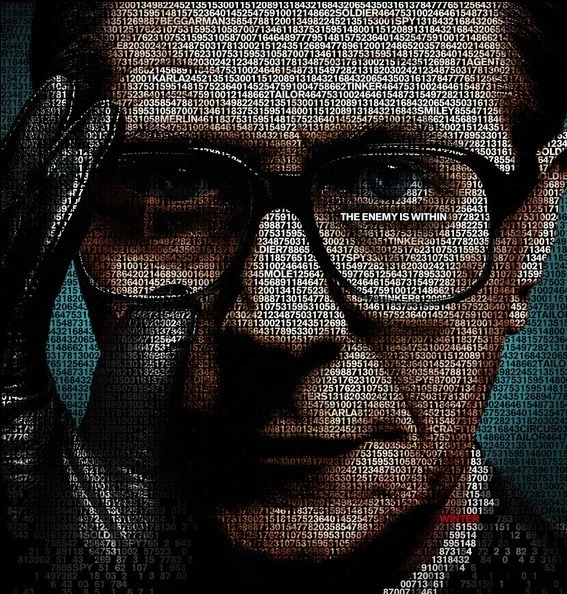
“I will do my utmost.”
Third Screening. Blu Ray. An incredible powerhouse tour de force of every conceivable element of film production coming to the fore in the sole purpose of storytelling. The source material being important, is vastly overshadowed by the visual conveyance of the themes: the decline of Post War Britain, the disastrous reign of Edward Heath, the destruction of the British Empire, the obvious losing of the Cold War. Wrapped inside these huge themes are extremely personal controversies that tear human beings apart: love, infidelity, personal responsibility, and the over arching importance of staying loyal to one's friends - even over country.
Britain was wracked by thirty years of decline when the Cambridge Spy Ring ruined public trust in all things: the entire National Security setup, the ruinous actions of the corrupt blue blood establishment, and the incompetency of democratic elected officials. Bill Haydon's impressionist art painting mimicking Anthony Blunt's career as Her Majesty's personal art curator is just one Easter Egg that points to connection after connection of insidious leveling of sides. Scene after scene, this descends from the clouds of ideology ("Englishman could be proud then..") to personal tragedy ("If it's true, don't let me know. I want to remember my boys for what they were."). Historians Al Murray and Tom Holland recently related on the The Rest is History Podcast about how everyone in power in Britain in the 70's had an impressive run of bravado and a razor sharp wit from 1939-1945 and afterwards, it just went all downhill. This untangling web of deceit can be seen in the Profumo Affair (Haydon and Ann, Haydon and Polykov) when real relationships are burnt to a crisp.
Smiley himself, cold, calculated, focused, unnerved, represents everything Britain should be despite his flaws. He loves Ann to a fault, and he is loyal to Control to a fault. He takes the fall though he had no part in it, and he contributes to the renewal of the Circus as Control had intended. This is Gary Oldman's lifetime performance out of a lifetime of performances, and his nuances can be missed. His grave disappointment at his close friend Control listing him as a suspect in mole hunt. His drunken confession to Cumberbatch's Guillam as he looks into the camera (we are Karla) and saying "we're not much different, you and I...", Le Carre's long held fictional theme that the two sides of the Cold War were really quite equitable, which is blown away with Irina's brains all over the walls of the Lubyanka, telling us in no certain terms THERE IS A DIFFERENCE BETWEEN SMILEY AND KARLA and that difference is on the plane, back to Moscow, to face his fate.
Oldman's apex scene is the attic in White Hall, where he begins by telling Stuart Graham's Minister exactly what Witchcraft is and exactly who is doing what. It starts with "There is a house... in this city..." and it ends with the dramatic mike drop "It wasn't to lure you. It was to lure the Americans." And here, starting the third act, is what every Briton has come to dread.
They are a stepping stone in the real world war against the United States. Britain is not only in the way, they don't matter. They are a tool to be used rather than feared.
I have read that the ending of Tinker Tailor Soldier Spy is Le Carre's fantasy - as if the Cambridge Spy Ring didn't happen because it was stopped. It was his way of wishing they had done SOMETHING. Le Carre, a spook masquerading as a cultural attache for fifteen years, was enamored wit the service but disappointed in it and in his very below par achievements. Smiley's triumphal return to the Circus, to Julio Iglesias' La Mer (itself a rip off of Bobby Darin's Beyond the Sea), is evidence to this mirage. The Circus is permanently damaged, and reading into it, by the politicians and not necessarily the spies. I see this as true, but not the complete story. Smiley never smiles in this film, not really. Oldman's dead face when he promises to do his 'utmost' (a most British word) to exfiltrate Irina when he knows perfectly well via Pideaux that she is dead is perhaps the most striking scene of stoic focus. But to me, Smiley's even mouth, at the last second of the last shot of this film, is where it finally turns.
It took the Church Commission and the airing out of America's four decade crime spree to unleash reform that finally, after decades, produced a truly professional spy service that attained victory after victory for the twenty years preceding the monumental catastrophes of 9/11 and The Second Gulf War. Here is MI6 ready to change, led by the old guard for sure, but leading men who could do more than find their own faults. They could do something about them. Smiley could forgive. Forgive Ann. Forgive Bill. Forgive Control for thinking he could be a mole. For the new guard who stayed around, the Guillams of the world... they would be free of the Jim Prideauxs who suspected and did nothing and the Ricki Tarrs who would go off half cocked. They would be more like Smiley. And for the next seventeen years, they would fight like hell.
They couldn't control Britain, but they could control themselves. And that, under Oldman's non-existent smile on Smiley's face, is what this is all about. Control.