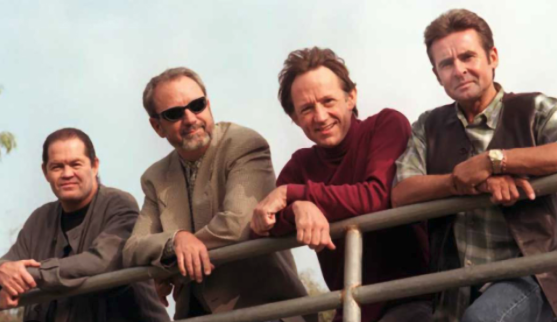
“What you have seen you must believe if you can… if you can…”
Second Screening. Criterion DVD. My bedroom. Allow me to utter my sheer shock and surprise at my own rating, for which I take full responsibility. For those who wish not to travel down the lane of wishful nostalgia, stop now. For I remember when I saw the old Monkees reruns on Nick at Nite, and then saw Val Kilmer wear a Monkees T-Shirt in Real Genius (1985) and knowing I was the only person under the age of forty who understood the power and glory of the Pre-Fab Four. Much to my consternation, I did not like Head (1968) when I saw it on the Encore channel in the early 90's, but that was most likely because of the permanent crop, non-sensical whimsy skit structure (pre-Groundlings, pre-Monty, etc.) and the horrible monaural. But when the soundtrack came out in 1994 and I bought it as a Monkees completionism, I have to say I did not remember and was enraptured by Purpoise Song and as the CD turned, Circle Sky blew me away. How was it possible this song came out the same year as Helter Skelter and no one noticed it? It remains one of my favorites to this day. But still, I avoided Head (the CD had a faux chrome cover so when you stared into it, it was vaguely a mirror = so you could see your own... head. These guys...
So when Criterion, of all platforms, put out this failure of a film, I didn't even give it a chance. I finally wasted my money on the package BBS story because I wanted to give Jack Nicolson and Bob Rafealson a chance (besides Head, they failed with me). By this time I had already seen the forty year anniversary Monkee Doc and the made for TV film that documented the struggle the group had in trying to be taken seriously. It all seemed cruel. Mickey Dolenz once defended the band from the criticism that they didn't play on their own songs by saying "The Beatles didn't even play on their own songs..." which was only true if you counted the orchestra in Sgt. Pepper or the violins in Eleanor Rigby - but he had a point. By the time Pet Sounds came out, The Beach Boys were incapable of creating what Brian Wilson wanted not just in the studio, but on tour as well. The Wrecking Crew, that melodious model of music, did that for them. And for Phil Spector. And for a thousand other bands and artists, including Neil Diamond.
For the Monkees were actors, not musicians, was the greatest crime they were charged with. In fact, they were actors who were musicians on the side (excepting Nesmith, who had an unnoticed career before the Monkees as Michael Blessing). Generally speaking, Peter York was better on piano than bass, but Davy Jones couldn't learn bass so he had to learn on piano. He was also better at drums, but Mickey didn't have a musical instrument other than his voice, so he had to learn drums FAST. With the help of ABC, they became stars for exactly two years while they struggled episode by episode to push their own agenda into the show and into their music. Basically forced to lie about performing on albums, they were refused rights to even play the songs written for them, never mind WRITING new songs for the band. FUCK THAT said ABC and Capitol. When Dolenz finally got permission to direct an episode, it was their last. When Don Kirshner finally agreed to release a Monkees-own written single...and did so in a limited release overseas... he was fired, and The Monkees went on their own way.
But without a show, no one followed them but one of their directors, Bob Rafelson, who always found charm, meaning, and an undercurrent of the counterculture which the hippies always deemed 'fake' and 'plastic' in the Monkees. Jack Nicolson, ten years into Hollywood, helped pen the irreverent 85 minute comedy, alternating in between subversive skits and traditional set pieces, pushing the Monkee narrative from corporate manufactured pop group (read the Stock-Aiken-Waterman creation of the 60's) to the band that definitely had something to day. About Vietnam. About America. About themselves.
The Monkees weren't going away with out a fight.
That's why Head (1968) opens with Mickey committing suicide (and closes with the band following him. And that's why the acid trip opening shouts acid trip lyrics while Mickey is being pulled into a fantasy re-creation of what leads to his suicide ("the porpoise is laughing, goodbye, goodbye..."). This is followed by a mind numbing criss cross from one bad idea to one that blows you away. Nesmith shouting Circle Sky to ten thousand people while York and Co. try to keep up cannot be re-created. It's why there is a live version on the disc. It's why Nesmith put it on his solo album. It's why the Monkees re-created it as the opening track to Justus (2020). Did they need the Wrecking Crew? Not necessarily, but it helped. No one saw Head (1968). No one bought the soundtrack. No one bought their next "contractually obligated" album. But now there ere six special editions of their LPs and six greatest hits compilations. Even Daddy's Song, Davy Jones' hysterical treat which I would skip every time on my CD, is on one of them. Once I saw what Jones did with his feet and Tony Basil, in Rafelson's unbelievable black and white set piece cutting back and fourth with tempo, I was sold. I've been listening to it all week.
Mickey has always been, more or less, the front man of the group, though he is perpetually like Don Henley, Gil Moore, and Phil Collins, in the rear. Nesmith's southern accent (he once twanged a reactionary pro-Vietnam song as Blessing) was less welcome though he garnered sympathy and hits with his earnest voice in hits like "What Am I Doing (Hanging Round)?" Davy was the 'Paul' of the group in that he was the lady-killer, as nervous as he was. Daydream Believer remains their Greatest Hit of all time. The solid Peter Tork, beloved by millions, poured his heart and soul, like they all did, into trying to become that thing they thought the audience wanted. Nesmith was the older brother. Tork always there. Davy smiling. But Mickey was the bold in-your-face provoker shouting subversive lyrics like Pleasant Valley Sunday and Last Train to Clarksville.
This subversiveness is in Head (1968) when Mickey stops a Western film shoot and walks through the paper backdrop. Peter is subversive in the diner when he forces the real "film crew" to show themselves when he refuses to 'act' anymore. Davy is subversive when he convinces the band to break out of the vacuum cleaner, literally a vacant places that "sucks." And Mickey, by choosing suicide rather than conform to the image the corporations have of him, and want to sell of him to his fans, is the most subversive of all. He is so subversive, the band follows him to his death. Head (1968) winds up as tails of the Monkees.
Nothing is more subversive than the funny, cute, pop band using the execution Nguyễn Văn Lém, a Viet Cong officer responsible for the murder of various South Vietnamese officials, by Captain Nguyễn Ngọc Loan, a Captain of the South Vietnamese army, as a pretext for telling the audience, even before the front credits, that the Monkees are fucking serious. Loan's execution was caught on film, both still and moving, and it lead the news in TV and print media. It became the image of the Tea Offensive of January 1968. It became the proof that America was on the wrong side of the war. Never mind that Lem had murdered people in cold blood, was a member of a recognized terrorist organization, and as per the rules of war deserved to be shot as an assassin and saboteur upon arrest. General Loan was castigated the rest of his life for rendering Lem's victims justice. This is lost in Head (1968). Loan's real story, or Lem's, is less important that what is important to the countercultural heroes that Nicholson and Rafelson want the Monkees to be. They Monkees are not fucking around anymore. They're going to be in charge of their own music. Their own image. Their own future.
And America wasn't ready for them.
Irreverent. Self-Aware.