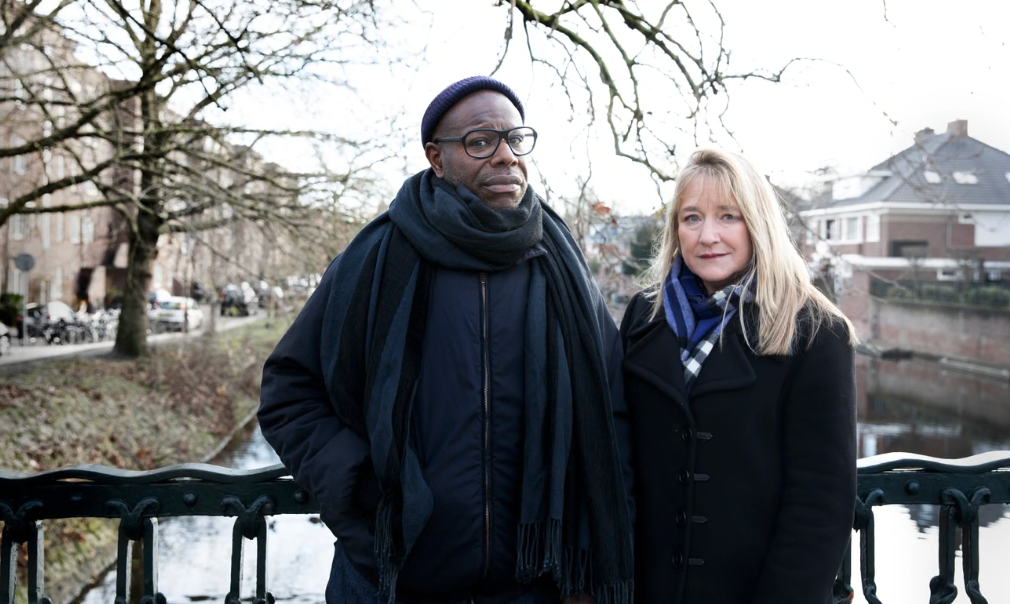
Film Director Steve McQueen and his wife Author Bianca Stigter, in their city of Amsterdam.
First Screening. Kanopy. Over three nights in my study. I am still recovering from a physical illness when I watched this and it probably wasn’t the right timing, but I found this mesmerizing all the same. Occupied City is a documentary by the British Master, Steve McQueen, and as a student of The Second World War and the Shoah, I could not turn away. I had heard this hit Cannes and Venice and caused quite a stir, but I had not the opportunity to see it until now. It is unavailable on physical media (a crime against artist lovers everywhere) and was lucky enough to catch it on Kanopy.
When I went to Berlin last year to see my son for two weeks, I prepped the trip by reading Alexandra Ritchie’s monumental and award winning Faust’s Metropolis, a history of Berlin. Just across from his apartment on Krautstrasse (yes, that is indeed a real street name) the Berlin Wall used to wind up on the north side of the Spree River, and just a block north of that was Jannowitzbrucke, a bridge across the Spree from his neighborhood (Mitte) to the environs of the government district. I did not bother to tell my son that this part of the Spree is narrow, and in April, May, and June of 1945 it was clogged with bodies and the river flooded the neighborhood. I didn’t bother telling him this because it is a matter of course that every street corner in Berlin has a story. A past. A dead body, be it a Jew arrested, a party official’s apartment, or a side street in the garden where, say, Karl Leibnicht was murdered in 1919. You cannot cross the street in Berlin, in Prague, in Paris, indeed in most large towns in Europe without walking through history, and so it is with Amsterdam.
The Netherlands was, for centuries, safe under British protection and had gone long stints without much chaos. But the Nazi occupation changed all this, and as McQueen effectively demonstrates, in the Dutch capital, crime is everywhere. This is evidently based Bianca Stigter’s ‘Atlas of an Occupied City’ which chronicles the forgotten crimes of the Third Reich in Amsterdam. It is not available in English. I’ve read some very disappointing reviews that point to the monotony of the exercise. Ostensibly, what McQueen is done is to log over a hundred specific incidents in Amsterdam’s tumultuous history of occupation, set up cameras there, and shoot what goes on there in contemporary society (post pandemic, which we’ll get to later). This opens with a description about how one home owner hid Jews in the basement while the modern homeowner, related to the previous owners we do not know, retrieves grocers from the former hiding place. It would be like using the Secret Annex in Otto Frank’s office to store records or an archive of magazines. From here the places multiply. Street corners. Town plazas. Houses. Train stations. Cinemas. The crimes of the occupation are delivered in a flat monotone by Melanie Hyams, McQueen’s collaborator (no pun intended) who is aided by her Dutch fluency. Sometimes, like Shoah, these scenes are staged. While Hyams recites what happened to a jewish family that was arrested in the middle of the night and deported to Auschwitz where they were all murdered, McQueen focuses on city workers installing Stolpersteine. A practice originated in Germany in the early 90’s, ’Stumbling Stones’ mark places of the Shoah all over Europe. While strolling through Charlottenburg one day, I noticed one not too far from Richard Wagner Platz that recorded a family of three who deported in 1944 to make Berlin “Judenrein” for the Fuhrer’s birthday. Obviously a lot of planning went into McQueen being there with his cameras at a specific time. Other moments are simply on a calendar. While watching a construction crew assemble a music stage in Amsterdam’s town square, Hyams recalls how the Germans, house in the Town Hall during the occupation, erected a music stage so they could attend classical concerts in the open - no Jewish conductors of course. This modern day music festival seems not to know what happened there before them, but then again most of us don’t wherever we go. Or we could take it for granted that they know something happened there, much like my son understood whenever he left his apartment. Not all of these are so on-the-nose. One scene, describing where a high ranking Nazi officer lived, shows an older woman watching the pandemic news. More than likely, she lived through the war. But another shot simply describes the Westerbok station as it was used to deport Jews, the modern station as the live shot. Mixed in with the profound is the ordinary. Everyday average Nederlanders, Jews or not, were hounded and oppressed throughout the occupation. In the Leidesplien, one Dutchman describes having been beaten to an inch of his life. When he choose to passively oppose the occupation, he spent the rest of the war in a prison cell.
In 2006, D to the K to the Motherfucking A to the Third Power sent me on a business trip to Africa. My layover was in Amsterdam, on Easter Sunday. My layover was 8 hours, and I left Schipol to see what I could see starting at six AM. I was lucky to catch a train into central station, which was deserted. As I walked through Vondelpark, I did not have Hyam’s commentary to tell me that German officers of the occupation confiscated all the houses rounding the park, evicting their tenets for the duration. I had lunch at the Hard Rock Cafe Amsterdam, where I had no clue the Resistance took revenge on collaborators after liberation by shaving the heads of dozens of people, marking them if for a short time as traitors. In countless squares that I passed through on my route that day, Dutch men and women were left rotting in the sun for days as a warning to the residents who could smell the decaying corpses. They were shot by the OrPo, or Orderpolizei not for crimes which they had committed, but in reprisals for the Resistance assassinating a number of Germans.
Sometimes these moments in the film are too much to process without tears. Watching a young boy of about three or four standing simply in the grass in a small park next to a river, Hyams recalls a mass execution on that spot by the Siecherheitdeinst, or SD (Security Service) in retaliation for Resistance activities there. Hyams tell us the SiPo and SD were housed in a girls school that is now a high school. The basement where Dutch citizens were tortured and beaten to death is just under a classroom where minors now learn math and (I hope) history.
Due to the timing of the shooting schedule, I was constantly trying to figure out if McQueen was trying to say something subtextual. While watching the Dutch police clear out of Covid protest, Hyams keeps on task, talking about occupation crimes. Was McQueen trying to draw a line between the lockdown and the occupation? Wasn’t that absurd? Like many cities, the curfew in Amsterdam was the first curfew since occupation ended. I was never able to adequately resolve this issue and I have not researched McQuee’s answer to it. Later, in an apartment where the head of the Zenstralle head lived, an old lady lives now, riding on a bike, watching Ukrainians come into Nederland on TV. They are fleeing the invading Fascist threat in their own country and the Dutch so far have used open arms. During a climate march while recounting the National Socialist Dutch Worker’s Party rallies, McQueen shows us a silent bullhorn, a Covid protestor wearing a Guy Fawkes Mask, and some black musicians having what looks like an insanely good time doling out beats as a drum quartet. Marching in Holland is different these days, way different. Though tens of thousands of black Dutch men volunteered for the Nederland Army recruited for the Allied War effort, they were never allowed to liberate their own country. A man holds up a sign during the protest that says “Climate Justice” which reads rather eery. Who does he plan on ‘punishing’ for the state of the world climate, he does not say. Another sign, seemingly aimed at Dutch authorities, has the severely underwhelming Sam Wilson message of “try harder.”
The finale of the film, in which a Jewish kid learns how to Daven in his synagogue in preparation for his Bar Mitzvah, Hyam’s narration stops. Out of the hundred thousand plus Jews in Amsterdam before the war, only about five thousand returned. Most did not survive. The occupation of the Netherlands was especially brutal for Western Europe, though one would not compare it to Warsaw or Ky’yv. In Hungary for example, hundreds of jews were tied back to back, and one shot in the head, the other left to struggle while they were both pushed off the bridge into the Danube. 90% of all the Jews in Hungary were murdered in Auschwitz in six weeks. But this is not a pain contest. This is only a document. A document of fear and perhaps a warning. Perhaps, if we join that little boy in the synagogue, it ends in a message of hope.