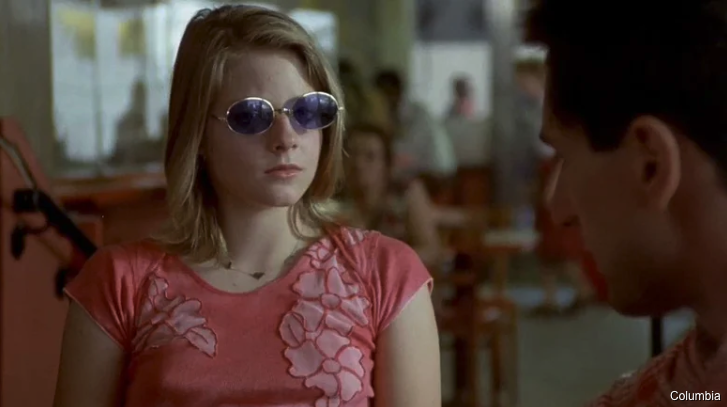
“This girl is just fourteen years old.”
Fifth Screening. Criterion Channel. My bedroom on a Friday night. I reread my previous review so that I don't repeat anything. This screening was the first time in over five years and I have not watched this one so repetitively as to make my memory numb to the environment. This has to a certain extent allowed me to see it kind-of for the first time and several things popped out at me that will be common place for others and make their eyes roll at how stupid these pronouncements are. The first is Albert Brooks' sense of humor, which is the only relief the film has, which is not over the top and is just enough to let some steam off at the upsetting topic. Because he disappears, no one thinks about him. Second is Sybil Sheppard, whom I have also ignored because of Foster's performance. Foster does not take away from Sheppard at all (though it is so towering, which I'll get to later) and Sheppard's very forward nature (confirming what sexy is) is probably the lure for Travis' intentions. There are probably dozens of essays about how Travis is a hero instead of an assassin because he killed the right father figure (Sport) instead of the wrong father figure (Palentine), but I haven't seen this addressed very much in Letterbxd or Reddit, so I thought I'd bring it up here.
This was probably the most uncomfortable time I've screened this film, and I know exactly why. The first few times were on VHS, which is shit, so you know the grainy finale is going to be shit. The last time, about five plus years ago, I saw it on DVD but on a 740 projector so it wasn't that clear. Criterion has minimum 1040 and this was a third clearer, and it made it a third more upsetting, and it has everything to do with Foster. The minute she comes on screen it makes me shift in my seat. The entire topic of child prostitution makes me want to vomit and I'm sure that's a common sentiment. I have seen set pictures of Foster and her older sister who was her stand-in as Foster could not be on set but for just a few hours each day. Her sister thus is used in shots that look like her, but are not her, and you can (if you care) parcel those parts out. Foster was fourteen at the time, and I believe the entire situation has disgusted most viewers and has caused pause for other viewer who simply do not want to discuss her nature on screen for how it will sound when read out loud. I'm going to attempt to do this to call out some issues Scorsese is trying to convey without actually coming right out and saying it, rather to leave it up to the viewer to conclude themselves. Most of the aesthetic is Foster and her sister, who look like children but who are not sexualized. The daisy dukes and the hot pants are not overt. Sybil Sheppard is more sexualized win the red and white dress in which most of her chest is exposed, though with no cleavage. Travis' conversation with Sport in doorway is perhaps the most gross I have ever heard in cinema. Sport, masterfully played by Harvey Keitel, is using openly pornographic language, including literal sexual acts, regarding a person he is advertising as "twelve and a half years old." This is enough to make someone turn off the TV, and I think the reason I don't, or the reason you don't, is because Travis' reaction to Sport is one of utter disbelief. Travis is disgusted too, on our behalf, and we side with him in the finale because of it. We see the city, since the opening, as he sees it, and we see that it is a disgusting place. Scorsese is using the audience's outrage at Sport to get us to understand Travis. I'm still not sure this is necessary (treating Iris like she is Kay Parker is below bottom-of-the barrel, even in 1976 New York, I hope) but as a device it works, and it makes us less sure of our stance on Travis when we see him moments before he tries to kill Palentine.
As we know Iris is a child, of course we the viewer would not be "turned on" the way Sport is, or even how I think Travis is at first. He seems to be, in the first scene in the apartment, at least beginning to struggle with the fact that he loves her and he's confused as to why because he knows it is wrong to love her. I think Travis conquers this struggle as evidenced in the coffee shop scene and in the finale which I'll get to. In the apartment, there is a highly controversial scene in which Iris is sitting down with Travis on the couch and it is implied she is fondling his crotch, making him stand up. Then, she undoes Travis' belt and he stops her. Finally, we see Iris actually move her face towards Travi's crotch in what is highly suggestive of a blowjob. Travis reacts by pushing her back onto the couch, frightening her as he goes off on a rant about the morality of what she is doing. When the AFI gave Scorsese the lifetime achievement award, Foster stood up in front of what looks like five hundred people and told a story about how she suggested she put her hand down DeNiro's pants and DeNiro and Scorsese very loudly objected. The State of New York had officials on set to monitor what Foster was doing in these scenes and to make sure it did not stray off the script and she was not coerced into anything. Foster has always defended the film and her acting partners as protective of her, and at least there is that. I think if I had not seen her say that, I don't know if I could watch this film. The flip side of this highly uncomfortable scene is the coffee shop, which is as fascinating as it is bizarre. Foster's appearance, in high resolution, just seems like such a contradiction. She's wearing sunglasses only a kid would wear, and at the same time she is very obviously not wearing a bra - the first time I've noticed this in a screening. Travis, meanwhile, is literally insulting her for what she does for Sport every night (no pun intended) and the entire time I'm wondering why Iris is even staying there? Why doesn't she just leave? The only reason I can think of is Travis didn't fuck her when he had the chance, so he must be sincere when he says he wants to help save her. Mid way through the scene, she changes her outlook and says maybe she'll go off and live in a commune. She invites Travis to come with her, and instead of taking the opportunity to run off with a child bride, Travis actually laughs at the suggestion and shakes his head, because he doesn't have anything in common with a bunch of hippies, but again he is there trying to get her out of the life she's in. So though Travis might be a bit of an asshole to her, she does not see him as a threat until she hears the .44 go off in the hallway (the slow motion shot of Iris turning her head is 70’s cinematic genius). Iris calls Travis a square, someone with traditional morals who can't change to have a little bit of fun, and he accuses her of being a square. This is just nonsense. Neither of them are squares. Both of them are up to their necks in immorality. Travis in the way he reacts in the world, Iris in her very appearance. This seems to me to convey Travis' contradictions. He doesn't know much about... much. He doesn't know music, or movies, or politics, or anything. He doesn't even really know what a square is as opposed to, say, a libertine. All he knows is what she's doing is wrong, and her father figure is making her do it. This is repugnant to him because fathers are not supposed to prostitute their daughters, which I think is an idea we can all support. Having watched this again, I see the coffee shop with Iris as the turning point in the film. It's the flip side of the coffee shop with Sheppard. I could not fathom why she’s not wearing a bra or Scorsese actually having that conversation with her before calling action. This is just one contradiction in the film that may be as unresolvable as it is upsetting. I should note that even at this age, Foster was used to nudity. When asked in an interview if her scenes in Nell or Backtrack or the Accused bothered her, Foster used her experience as a child model to explain why she didn’t feel pressured or exploited. As the Coppertone Girl, Foster’s bare bottom was exposed on ads all over the country, and she did brief nudity for other products while underage. She’s always defended it.
The shot of her turning her head away (again, she is framed against a man's mid section), is a startling, wide eyed, reaction of fear. Unfortunately a lot of the ending was cut, and I fear more of Foster was cut due to the censor's, which hurts the film like we know the grainyness and color correcting does. In the end, it is much more powerful than I realize, and about a generation of men who don't hide any more. Now they are on Twitter, have podcasts, and talk about banning abortion, trad wives, and how immigrants are the problem with America. Travis, as Schrader has said, is a racist, and exemplifies and America that is currently rearing it's ugly head. Eventually, another Travis is going to kill another person. Whether we approve of the murder or not is going to depend on our cultural and political stance, and that seems very fucked up to me.