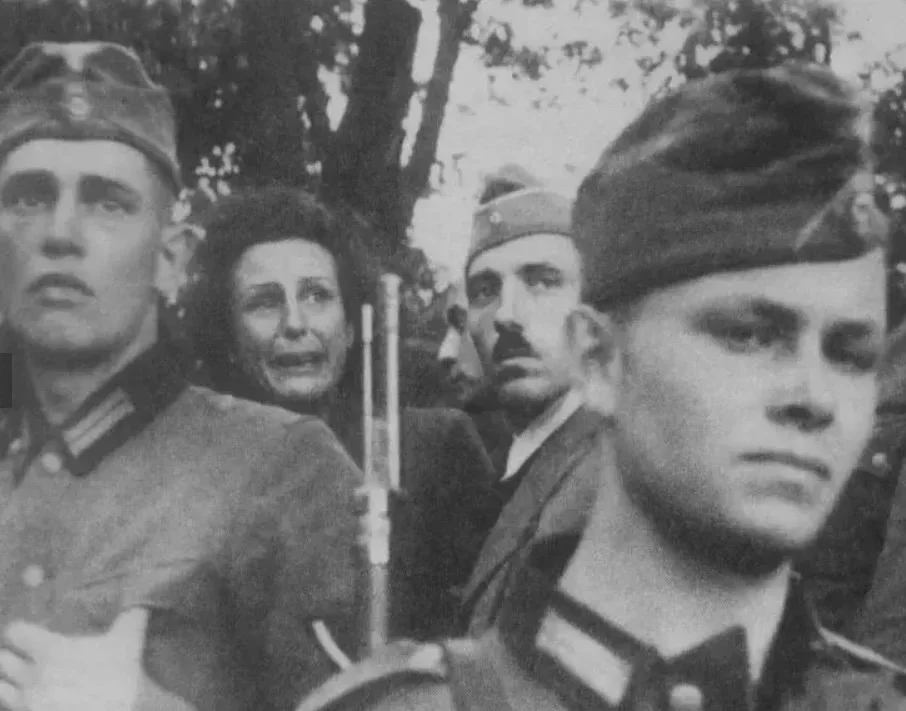
5 September 1939. According to published accounts, Nazi Filmmaker Leni Riefenstahl was attempting to set up a composition to take a picture in a village during the Nazi Invasion of Poland. When she instructed some nearby German Army troops to ‘take away’ or ‘clear out’ people who she did not want in the photograph, she watched them line up the undesirables, including women and children, and execute them with no warning. She shortly thereafter asked to leave her job as a war correspondent. Later in the war, in 1943, she used Sinti “gypsies” for scenes in her narrative film “Tiefland.” After the scene was shot, the Sinti were taken to Buchenwald concentration camp and murdered. Later in her life, she denied both of these events happened despite the Nazi documentation they did.
First Screening. Kino Lorber DVD. Kino Room. The most consequential documentary on Riefenstahl since 1993's The Wonderful, Horrible Life of Leni Riefenstahl. The directors and editor, wading through mountains of her estate's paperwork and media, have constructed a point by point rebuttal of her actions and remarks by using her own comments recorded and written. She is the textbook case in which you can refute "well, I wasn't a actually a member of the Nazi party" argument with "well, considering what you said and what you did, what the fuck difference does that make now?" She was wonderfully skilled, technically able, absurdly talented with an artist's eye. Her discerning vision captured for all time our memories or framing of the Nazi regime in all its horrible, evil "glory" sugar coated by what Susan Sontag called The Fascist Aesthetic. If you're familiar with her work, this is the doc to go on. If you're not, I would recommend the former before you get here and obviously watch all her movies first.
The one angle or perspective a lot of these studies miss is how easy it was say what it was all about. Speer, for all his lying, for all his manipulating, for all his dancing about (ready Gitta Sereny's masterpiece "His Battle with Truth"), was only dodging his personal responsibility when it came to what he was liable for at Nuremberg. Other than that, Speer wrote books, spoke on TV, and pretty much agreed with everyone that it was all a sham, and what's more - he was responsible. Whether a court condemned him to die, or not, Speer stood up and said "it didn't matter what I knew and didn't know. I was a member of the government. It was my job to know. I'm responsible." and while Riefenstahl wasn't a member of government, you could argue that she was in the time before television and social media, just as important as Speer was in the Nazi regime. How easy could it have been for her to just admit "look, this was wrong, I made the wrong call. I glorified this man and I shouldn't have." If she had spent the remaining six years of her life saying that other than dodging the fucking question, if she had actually leaned into the accusations and said "you're right, absolutely, we were lied to and I bought into the lie. What's more, I broadcast the lie because I wanted to believe in it," If she had done that, then a lot of the pain and the misery she experienced (she would call it persecution, I would call it being held to account for one's actions) then it fervently would have led her to having a more successful career in which she could done more with more to make the art she wanted to make instead of running out of interviews or arguing with whoever about what she was culpable for or responsible for.
But of course, she couldn't do that, she wouldn't do that, and the reason she wouldn't is because though she wasn't a party member, she was one of the biggest fucking Nazis who survived the war. Like Speer, she should have at minimum been in prison for minimum 20 years, and like Speer, you could argue that she should have just been shot. Instead of being grateful, like Speer, she was contemptible, and for that position she is forever damned. There's a fantastic moment in this doc when a phone conversation plays in which she says she won't say certain things because if she does, people will call her a Neo-Nazi. This is in correct. She was the OG. She was fine with shooting Jews and gassing them as long as her art survived.
On the underside of this entire debate, and what is also not included in the doc, is how she is compared to other filmmakers of the same time. It is true that she was the best, and by far and wide she had determined the image we have of the Third Reich. But it is not true that she was the only one. Others, like Harlan. Like Sonenbaum. Like Hipper, like an astounding amount of people, hundreds of artists in the film industry, did what she did, and completely got away with it like she did, and not too many of them have this level of high profile study (this was huge at Venice, Cannes, and Tulleride this year). My personal opinion is this reflects the absolute sexism among the society of the victors, and they come down on Riefenstahl not because she was so fucking good, but because she was that good AND was a woman. So much of her "persecution" came down to that, and as a reflection of us all, that does not speak well of us. That point of view, the feminist point of view, is never to be seen here, or anywhere else.