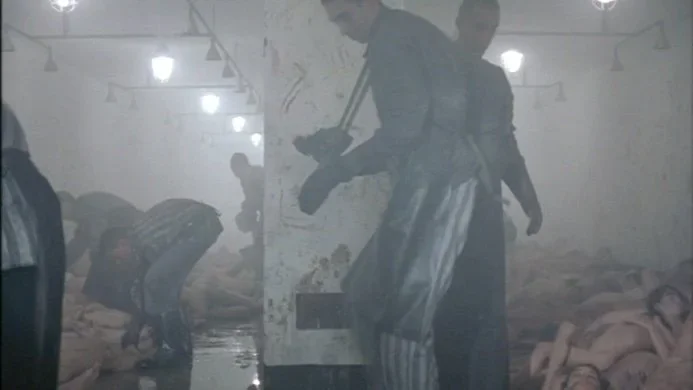
SonderKommando were Jewish victims forced into slave labor to help fool and murder other Jews. In “reward” for their services, they got to live just a little longer than their families, before being exterminated themselves. Not only did they lead in other victims under pain of death, they had to carry the bodies to the crematoria, and clean the gas chamber so it could be ready for the next group of victims. Sometimes, after the urine and feces was cleaned up, the walls had to be painted to hide the scratch marks and blood.
First Screening. Criterion Channel. My bedroom. The railroad ramp wasn’t directly in the middle of the camp, you see. It was more lopsided than that, but definitely in betweenMainly the men’s camp and the women’s camp, though those are great generalizations. The sorting took place immediately on the platform, and those selected for extermination were led along the rail track to Gas Chambers 2 and 3, or else would have to cut through the camp via a road that cut the camp down the middle and turning left to Gas Chambers 4 and 5. These were misnomers. There was no Gas Chamber 1, though there were two provisional chambers nearby. Once you entered the Gas Chamber grounds, the Kapos and guides turned around and you were now in the hands of the SonderKommando, the group of Jews forced into the great labor of convincing the victims that they were about to be deloused and thus had to strip naked and leave all their possessions on numbered hooks they were never to see again. The gas chamber itself was made to look like a huge communal shower, but chutes in the middle of the chamber were constructed to protect the Zyklon B from being covered over by dead bodies when poured form above, and thus the killing made more effective. After the screaming was over, the air vents were turned on and the chamber air cycled out. After an adequate amount of time, the doors would be open to reveal hundreds of naked dead bodies, lying on top of each other. Scratch marks could be seen on the walls. Vomit, urine, and feces were everywhere. By the summer of 1944, 860 people could fit in one chamber, and they were killing 12,000 Jews a day. The bodies were evacuated directly across to the crematoria, who found it difficult to keep up. Extra bodies were taken outside the fence to railroad ties set up like a grill where the burned bodies were doused with gasoline and wood. The personal effects in the anteroom outside the gas chamber was now loaded onto carts and take, in the case of Crematoria 4 and 5, across the road to a series of building for processing. Here is where clothing was riddled through and suitcases were opened. Cash was gathered- hundreds of thousands of marks a day - and everything was filtered through a rather sophisticated multi-level hierarchy of graft that eventually ended at Himmler himself. Usually all consumables went to the SonderKommando, who were loaded with extra food and even allowed alcohol discovered in the search. All valuables were confiscated by the SS and used to fund the camp itself. The Jews were financing their own extermination. This part of the camp was nicknamed “Kanada” because the Eastern European conception of that country was that it was full of unexploited mineral wealth. Because the SonderKommando was intimately knowledgable of all the details of the mass murder, they could not be allowed to survive. Usually after three or four months, they were murdered themselves and other Jews from the next transport would be forced to aid in the murder of their fellow men and women (and children) in exchange for something they didn’t even want - another day or week or month alive.
The Gray Zone, I have read, does have some historical inaccuracies in it, but from what I see, it is remarkably accurate in terms of the killing process. Though I feel most of the cast (David Arquette, Harvey Keitel, Steve Buscemi) is miscast, it has a strong enough supporting cast to get it through its rare minuses. The subplot with Mira Sorvino and Natasha Lyonne is as perfectly acted as it is heartbreaking to watch. Both ladies convert with utter determination their character’s dedication to try and pull off the only thing that matters: the destruction of the crematories. The goal was to destroy that which destroys. It was as admirable as it was foolhardy. The film is sickening, and shocking. It’s the only one I have seen in which the chamber itself is opened to reveal those inside. The well thought out set design includes the lush, green grass, forever rich as it is constantly fertilized in human ash.
This should be required screening in high school.