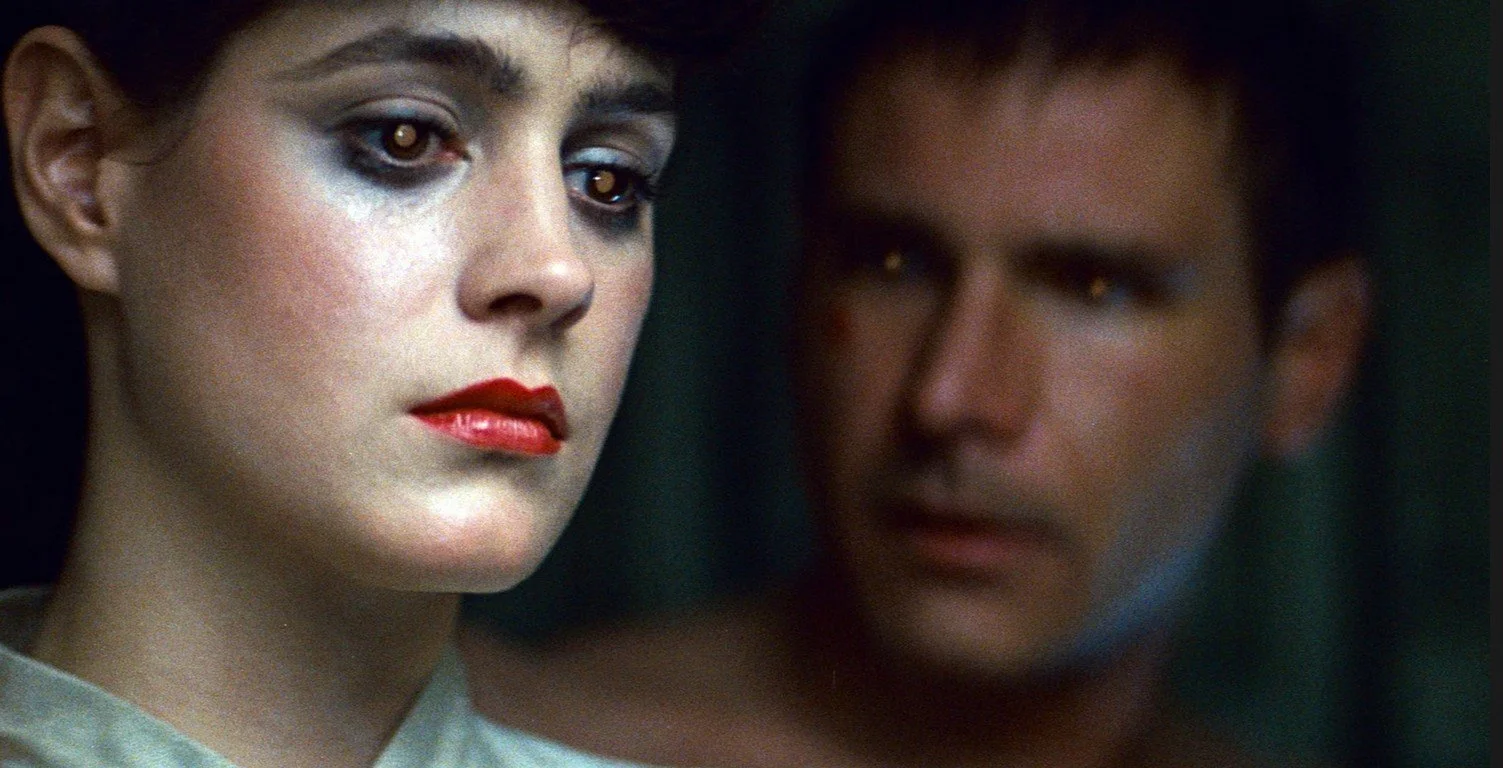
“It’s too bad she won’t live. But then again, who does?”
A Detective's Lament from the Neon Gutter:
The rain came down like bad alibis. It always does in pictures like this. The city was lit in neon bruises and electric promises, every sign buzzing like it owed money to the dark. Somewhere overhead, giant advertisements sold dreams to people who couldn't afford them, while somewhere below a detective hunted ghosts in a world that had forgotten the difference between a man and a machine. That detective was Rick Deckard. The picture was Blade Runner. The year was 1982. More specifically, I'm talking about the original theatrical cut, the version burdened with studio-mandated narration, saddled with a hastily attached happy ending, and remembered today as one of the most controversial releases of a film that would eventually become a science-fiction masterpiece.
I love Blade Runner, which is precisely why the theatrical cut frustrates me so much. The film contains some of the most ambitious world-building ever committed to celluloid. Ridley Scott created a future Los Angeles that feels ancient and futuristic at the same time, a sprawling urban labyrinth of rain-soaked streets, towering pyramids, industrial decay, and endless neon. The city is not merely a backdrop but a character in its own right, breathing through steam vents and glowing signs while crowds surge beneath the shadows of immense buildings. Decades later, filmmakers, artists, and game designers are still borrowing from its visual vocabulary. Yet despite all of that brilliance, the theatrical cut often feels like a magnificent painting that somebody insisted on explaining with footnotes written directly across the canvas.
The most notorious example is the narration provided by Harrison Ford. Good noir narration can be a thing of beauty. In the classic detective films inspired by writers such as Dashiell Hammett and James M. Cain, narration adds atmosphere and insight, allowing the audience to climb inside the detective's head. It should feel like cigarette smoke curling around a confession or whiskey poured into a glass at two in the morning. The narration in Blade Runner's theatrical cut accomplishes the opposite. Rather than deepening the mystery, it explains it. Rather than enhancing the mood, it interrupts it. Ford sounds less like a weary detective reflecting on his case and more like a man who has been cornered at a party and forced to explain the plot to someone who wasn't paying attention. The narration hangs over the film like a trombone player trapped in an air duct, desperately trying to perform a funeral march while everyone else is attending a wedding. Every time the visuals begin to achieve something poetic, the voice-over arrives carrying a flashlight and pointing at things. Noir narration should be whiskey; this narration is cough syrup.
What makes the narration particularly frustrating is that the film clearly doesn't need it. Ridley Scott's visual storytelling is among the strongest in modern cinema. Every frame contains information. The architecture speaks. The lighting speaks. The costumes speak. Even silence speaks. Deckard's emotions are often visible in Harrison Ford's face long before the narration arrives to summarize them. Watching the theatrical cut sometimes feels like attending a concert where a man repeatedly steps onto the stage to explain what each instrument sounds like. The audience already knows. The musicians already know. Yet the explanation continues anyway, smothering subtlety beneath unnecessary commentary.
The tragedy is that beneath this misguided narration lies one of the most visually extraordinary science-fiction films ever made. The Los Angeles of Blade Runner remains astonishing more than four decades after its release. Earlier science-fiction films often portrayed the future as sleek, sterile, and immaculate. Scott's future is none of those things. It is crowded, dirty, chaotic, and alive. Buildings seem to have been stacked upon older buildings for generations. Neon signs compete with each other for attention through sheets of perpetual rain. The city appears ancient despite being futuristic, as though civilization simply kept adding layers without ever bothering to remove the old ones. Every street corner suggests another story. Every passing face appears to belong to someone with a complicated past. The world feels inhabited in a way that science fiction rarely achieved before 1982.
This visual achievement is why Blade Runner remains influential even when certain aspects of the theatrical cut have aged poorly. Modern audiences often forget how revolutionary this vision was at the time. Today we are surrounded by cyberpunk imagery influenced by Scott's film, but in 1982 this world looked unlike almost anything audiences had seen before. Countless films, television series, novels, comic books, and video games owe a debt to Blade Runner. Watching it today can feel like opening a history book and discovering the blueprint for an entire genre.
That said, not every visual effect in the film has survived the passage of time equally well. There is a tendency among some film enthusiasts to treat practical effects as inherently superior to digital effects, as though craftsmanship alone guarantees immortality. The reality is more complicated. Good effects endure regardless of how they were created. Weak effects reveal themselves eventually. While Blade Runner contains many remarkable visual effects achievements, it also contains moments where the illusion begins to wobble.
The flying vehicles known as spinners provide several examples. In many scenes they remain convincing and impressive. Their movements through the city contribute significantly to the film's atmosphere and sense of futuristic scale. Yet there are also moments when the mechanics behind the illusion become difficult to ignore. Certain shots reveal movements that feel stiff or artificial. Instead of appearing to fly naturally, the vehicles sometimes seem suspended and guided through space. Careful viewers can occasionally detect the telltale signs of miniature work and wire-assisted motion. The effect is not disastrous, but it can be distracting. Rather than watching futuristic vehicles soar through the skyline, one occasionally feels as though one is watching expensive marionettes being carefully maneuvered by unseen hands just outside the frame.
Similar issues arise in some of the optical compositing work. The technological limitations of the era occasionally become visible. Layers do not always blend seamlessly. Perspectives sometimes appear slightly mismatched. Matte lines and compositing artifacts emerge here and there. None of this destroys the film. In fact, many viewers find these imperfections charming. Yet it would be dishonest to pretend they do not exist. The reason they attract attention is because they appear alongside visual achievements that are genuinely groundbreaking. When most of the cathedral is magnificent, even a single crooked brick stands out.
One of the most unintentionally amusing examples of the film's imperfections arrives during the sequence involving Zhora, portrayed by actress Joanna Cassidy. Cassidy delivers a memorable performance throughout the film, bringing both toughness and vulnerability to the role. Her character's desperate flight through the city culminates in one of the movie's most famous chase sequences. Unfortunately, the illusion occasionally stumbles whenever the production relies on a stunt double.
No reasonable viewer expects an actor to perform every dangerous stunt personally. Stunt performers are essential to filmmaking. The problem is not that a double was used. The problem is that the substitution is often glaringly obvious. There are moments when the stuntwoman appears onscreen wearing a wig that seems to have been selected by somebody who had only received a vague verbal description of Joanna Cassidy. The facial structure changes noticeably. The body language changes. The overall appearance changes. Only the wig attempts to maintain continuity, and even it appears uncertain about the assignment.
The result can be unintentionally hilarious. One moment the audience is watching Joanna Cassidy. The next moment an entirely different person appears wearing what looks like an emergency approximation of Joanna Cassidy's hairstyle. The filmmakers clearly hoped that rapid editing and frantic action would disguise the substitution. Sometimes they succeed. Sometimes they do not. During those less successful moments, viewers may find themselves paying less attention to the suspense of the chase and more attention to the wig's increasingly desperate attempt to preserve the illusion. It is one of those cinematic flaws that becomes impossible to unsee once noticed.
Fortunately, Harrison Ford remains compelling regardless of what version of the film one watches. His performance as Rick Deckard anchors the movie even when the narration threatens to undermine it. Ford understands that Deckard is not a glamorous hero. He is tired. He is cynical. He is reluctant. He is a man dragged back into a job he would rather avoid. Much of Ford's best work occurs in silence. A glance across a room, a pause before speaking, or a subtle shift in expression often reveals more about Deckard than entire passages of narration. This is another reason the voice-over feels so misguided. The film already possesses a lead actor capable of communicating exactly what the audience needs to know.
If Ford anchors the film, however, it is Rutger Hauer who ultimately walks away with it. His portrayal of Roy Batty remains one of the greatest performances in science-fiction cinema. Batty begins as a threatening figure, a dangerous fugitive hunted by the authorities. Yet as the story progresses, Hauer transforms him into something far more complex. He becomes tragic, intelligent, and strangely sympathetic. The audience gradually realizes that the supposed villain possesses more curiosity, passion, and humanity than many of the humans around him.
This transformation culminates in one of the most celebrated scenes in film history. Batty's final moments elevate the movie beyond science fiction and into something approaching poetry. The character's reflections on mortality, memory, and existence remain powerful decades later. What makes the scene extraordinary is not merely the writing but Hauer's delivery. He imbues Batty with a sense of wonder and sadness that lingers long after the film ends. By the conclusion of Blade Runner, the emotional center of the story has shifted. The hunter no longer feels like the most interesting figure. The hunted does.
The film also benefits enormously from the score composed by Vangelis. Few soundtracks are as inseparable from the identity of a film as this one. Vangelis creates an atmosphere of melancholy and mystery that permeates every scene. The music drifts through the movie like fragments of forgotten memories, blending romance, loneliness, and unease into a single emotional landscape. While many science-fiction scores emphasize excitement and adventure, Vangelis focuses on mood. The result feels timeless. Even when viewers cannot consciously recall specific melodies, they often remember how the music made them feel.
Ironically, the score accomplishes precisely what the narration should have accomplished. It deepens emotion without explaining it. It enriches scenes without interrupting them. It trusts the audience to engage with the film rather than constantly clarifying what they should think. Listening to Vangelis's music after enduring another stretch of narration can feel like stepping out of a crowded room and into fresh air.
Then there is the ending, another element that has drawn criticism for decades. For most of its running time, Blade Runner embraces ambiguity, uncertainty, and melancholy. It presents a world filled with moral complexity and unanswered questions. The theatrical cut's conclusion, however, abruptly shifts toward optimism. The change feels less like a natural development and more like an executive decision. Rather than emerging organically from the story, the ending arrives as though it had been delivered separately and attached afterward.
The contrast is striking. The film spends nearly two hours constructing a bleak and introspective atmosphere, only to conclude with a sudden reassurance that feels disconnected from everything preceding it. The ending resembles a cheerful postcard accidentally delivered to the wrong address. It is not offensive so much as misplaced. Viewers familiar with later versions of the film often find the theatrical conclusion particularly awkward because it clashes so sharply with the themes that make Blade Runner memorable.
Yet despite all these criticisms, I do not hate the theatrical cut. Far from it. I find it fascinating. It serves as a historical document, preserving a moment when competing creative visions collided. Watching it allows viewers to witness the tension between artistic ambition and studio anxiety. One side wanted ambiguity, mystery, and atmosphere. The other feared audiences would become confused and demanded explanation. The resulting compromise satisfies neither position completely, yet it remains endlessly interesting because the struggle is visible throughout the film.
In many ways, the theatrical cut resembles a masterpiece wearing an ill-fitting disguise. The greatness is obvious. So are the compromises. Every flaw stands out precisely because the underlying achievement is so remarkable. The narration feels worse because the visual storytelling is so strong. The visible effects limitations attract attention because so many other effects are extraordinary. The stunt-double mismatch becomes memorable because the surrounding sequence is otherwise so effective. The movie continually reminds viewers how close it came to perfection while simultaneously revealing the obstacles placed in its path.
When the credits finally roll, what remains is not disappointment but admiration mixed with frustration. The theatrical cut of Blade Runner contains enough brilliance to secure its place in cinematic history. Its vision of the future remains influential. Its production design remains astonishing. Its score remains haunting. Its performances remain memorable. Yet it also contains a collection of flaws that have become almost as famous as its accomplishments.
The narration clatters through the movie like a shopping cart with a broken wheel, drawing attention to itself whenever silence would have been more effective. The flying vehicles occasionally betray the wires and techniques used to create them. The stuntwoman standing in for Joanna Cassidy appears at times to be conducting a one-person campaign against believable disguise. The happy ending feels imported from an entirely different movie. None of these problems are fatal, but all of them are noticeable.
And yet the film survives them. That may be the most impressive accomplishment of all. Lesser movies can be destroyed by far smaller mistakes. Blade Runner endures because its strengths are simply too substantial to be buried. The rain still falls. The neon still glows. The city still breathes. Roy Batty still contemplates mortality beneath a darkened sky. Vangelis still fills the night with music. Harrison Ford still stalks through the shadows like a detective who knows the world has gone wrong but keeps searching for answers anyway.
The theatrical cut may be flawed. It may be compromised. It may contain narration that sounds as though it was recorded under protest and wigs that deserve independent investigation. But beneath all of that lies one of the most important science-fiction films ever made. Like any great detective in a hard-boiled novel, Blade Runner takes its beating, straightens its tie, wipes the rain from its face, and keeps walking into the darkness. The flaws remain visible, but they never manage to stop the film from becoming what it was always destined to be: a classic.