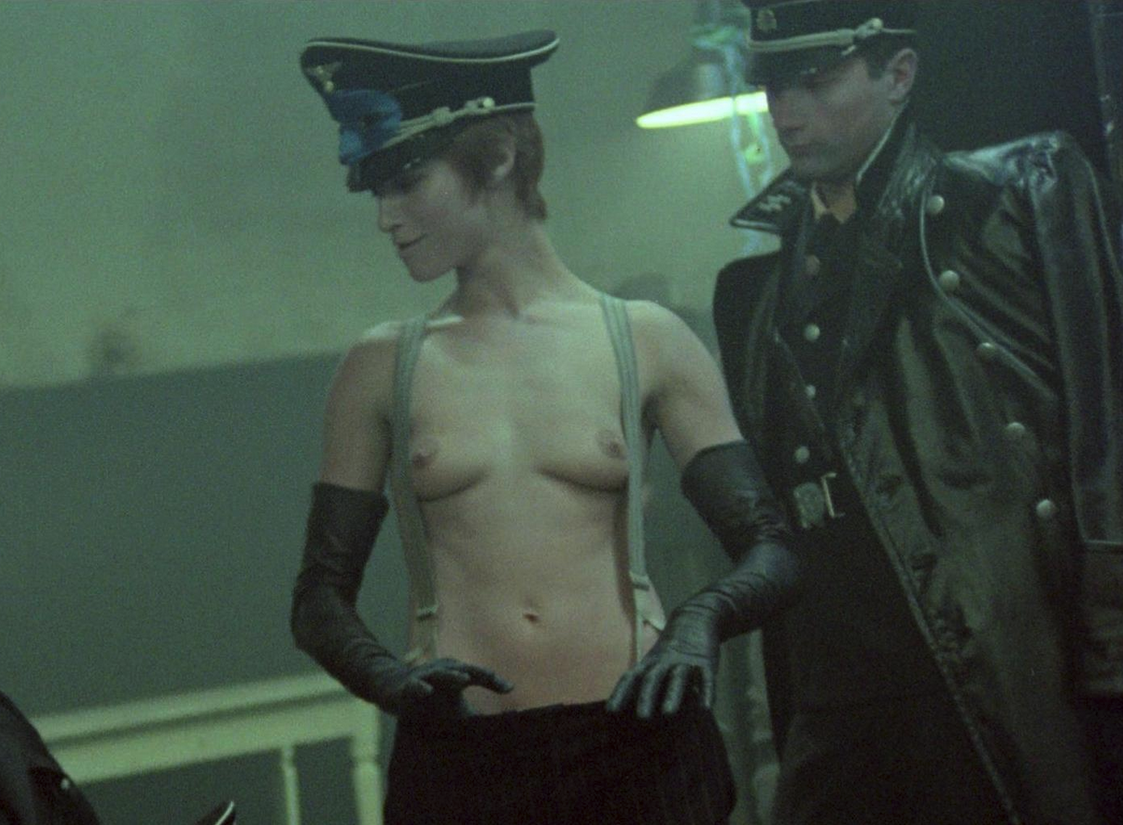
Second Screening. Criterion Blu-Ray. Kino Room. The last film of the day as I stay home with my son to go through the classics. I like to record his impressions as I find them fascinating and original. His opening question was 'when was this produced?' This was the first time it occurred to me that the production value was so on point that it masked the time frame. He said if he had to guess it was very late Sixties or early Eighties. This is in contrast to the mountains of films in the 70's in which producers could not get actors to cut their fucking hair like they did in the '40's. This aside, when it was over, his overall reaction was "this is not the most fucked up thing you showed me," which I think says LESS about The Night Porter than it does about me.
I fucking love this film.
I can't get away from it, with my deep learning of the time period and the people that made it crazy (as well as the people who turned the tide). Susan Sontag, who hated this movie with a passion, rightly called out the undercurrent in out society (on the left as well as the right) to dive into what she called 'Fascinating Fascism.' Though she hit the nail on the head, her understanding of this particular film in the short time she discussed it in her essay hit only just under the skin. There's so much going on in The Night Porter that it takes repetitive viewings to let it soak in and of course we are faced with the facts of time. Director Liliana Caviani was born in January 1933, the same year Hitler took power. She was twelve when the war was over and 39 when she made this. Weimar seems ancient now but it was recent history then, and the film needs to be in this context.
Controversial scenes, such as Lucia's cabaret dance, are simply dark mirrors to Minnelli and Bowles. The fact that she's topless wouldn't be outrageous in Berlin in 1932, and her uniform such as it is, is the only thing she has available outside her camp uniform. Her reenactment is 'degenerate art' and is banned by law... which did not stop millions of Germans from continuing to enjoy it. Her audience are her oppressors, and she is performing under threat of death like all performers were. Only Max has no interest in killing her, and that only because he's madly in love with her. The only question is why.
I'm not sure how many in the audience are getting the revelation in the sorting scene, but Lucia is not a Jew. Most declarations in the sorting are Christian, and there are additional political questions. The implication this film is between a Holocaust survivor and her SS oppressor are strong and probably cannot be shaken off, but they are nevertheless wrong. That does not mean the intent of the film lands wrong, because it really doesn't matter to begin with. She has no power, by design. The fucked up part is what happens next.
Non-Jews were easier to sexually transgress in the camps because of the Nuremberg Laws, and Max is clearly taking advantage of this. Laws are also easier to break if you know you can get away with it, but this misses the point of a sadomasochistic relationship. It's not enough to know that Max is operating as a Nazi (read 'Law of the Blood' by Chapoutot to get a handle on that), or that most Nazis were Sadists. That lack of human empathy goes without saying in their world view. But Max is not JUST a Sadist (forcing Lucia to give him a blowjob), he is also a Masochist (he smiles when he cuts his foot) and the only person returning his affection is Lucia. I do not think the film is complete as it is missing at least one scene in which she returns his affection in the camp. This may not have been written, or perhaps it was shot and cut, but either way it might delude the sadomasochistic point. I understand why - Caviani is in deep shit as it is. To show Max raping Lucia and her getting off on it would be three bridges too far, but nevertheless the relationship is thus established. It is possible that Max did what he did to thousands of prisoners. Lucia was the only one he fell in love with because she returned his affections. The other possibly just died.
This is not to say that what happens is right. It is not. And it is not to say that what happens is even possible. Caviani is doing much more than that. The only way I can convey it to reiterate how Kathaleen Hanna, frontwoman of the band Bikini Kill, described her relationship to Beasti Boy Adam Horowitz. How is it, that the founder of one of the most feminist bands in music history, went on to fall in love with the guy who wrote the immortal jingoistic tune (it is not enough to call it anti-feminist) "Girls" off the notorious and otherwise perfect 'License to Ill' LP? Hanna could only describe it thus: "You can't control who you love."
I don't know how else to explain The Night Porter than to emphasize this statement and say this film is that rule pushed to the extreme. It is two people finding each other like we all do. Because these people are who they are enforces a morality from us that would not exist but for their roles.